About Rana pretiosa Baird & Girard, 1853
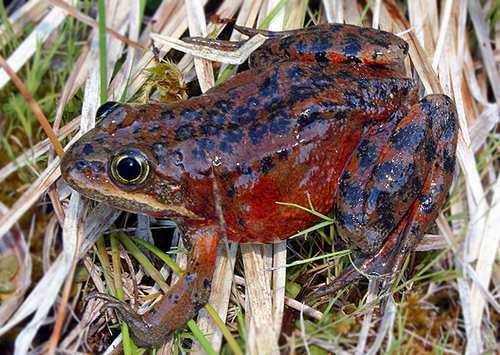
Adult Oregon spotted frogs measure 4.4–10.2 cm (1.75–4 in) in snout-vent length, the distance from the frog's snout to its vent. Like most amphibians, females are typically larger than males for reproductive purposes. This species' coloration changes with age. As tadpoles, the back and tail musculature are brown with no dark spotting, and the belly is creamy white or aluminum colored. Juveniles are usually some shade of brown, occasionally olive green. Adults can be brown or reddish brown, and tend to grow increasingly red as they age. Both juveniles and adults have black spots with light centers on their heads and backs; these spots grow larger, darker, and develop more ragged edges with age. Older frogs usually become brick red across most of their dorsal surfaces, and are often red on their entire abdomen forward to the chest. Juveniles have white or cream undersides with reddish pigments on their underlegs and abdomen, while adults have vivid orange-red underlegs and red surface pigments on their abdomen. The dorsal lateral folds are a lighter color, ranging from tan to orange. The Oregon spotted frog has relatively short hind legs for its body size; its groin is usually uniformly gray, but may sometimes be faintly mottled with gray markings and red-orange flecks. Its hind feet are fully webbed, and the webbing typically extends onto the last segment of the longest toe. This species has greenish-gold upturned eyes that are mostly uncovered by the eyelids when viewed from above. Oregon spotted frogs are distributed from southwestern British Columbia, Canada, south through the Puget/Willamette Valley and the Columbia River Gorge in south-central Washington to the Cascade Range, reaching at least the Klamath Valley in Oregon, USA. They were historically found in California, but have been extirpated there, and are also extirpated from most of western Oregon and Washington. They occur at elevations from 20 to 1,570 meters above sea level. Currently, in Oregon, this species' range covers Deschutes, Lane, and Klamath counties. In Washington, Oregon spotted frogs live in Thurston County. The Oregon spotted frog is a highly aquatic species that rarely moves far from areas of standing water. Suitable habitats include wetlands, lakes, and slow-moving streams that have shallow water zones with abundant emergent or floating aquatic plants. The frogs use mats of aquatic vegetation for basking, and dive under the vegetation to escape danger. These habitats often have a thin layer of unusually warm water, which the frogs prefer. Oregon spotted frog reproduction is entirely aquatic. Their breeding season occurs in late winter and is brief, lasting less than four weeks. Males call quietly during the day or night near traditional oviposition sites, where females lay eggs in communal piles. Oviposition at these sites begins when water temperatures reach 8 °C. The timing of oviposition varies: it falls from late February to early March at lowland sites, and from late May to late June at montane sites in Oregon. Breeding happens in warm shallow water, usually 5.1–30.5 cm (2–12 in) deep, in areas that typically have grasses, sedges, and rushes. Adult females reportedly breed every year, and usually produce just one egg mass per year. While egg masses are occasionally laid alone, communal oviposition sites hold most of the species' annual reproductive output. These communal clusters usually hold between 10 and 75 individual egg masses. In British Columbia, recorded egg masses have an average of 643 eggs each. Females lay eggs in fully exposed, shallow water that warms quickly from sunlight, which speeds up development to hatching. This exposure also makes the eggs more vulnerable to desiccation and/or freezing.