About Rana dybowskii Günther, 1876
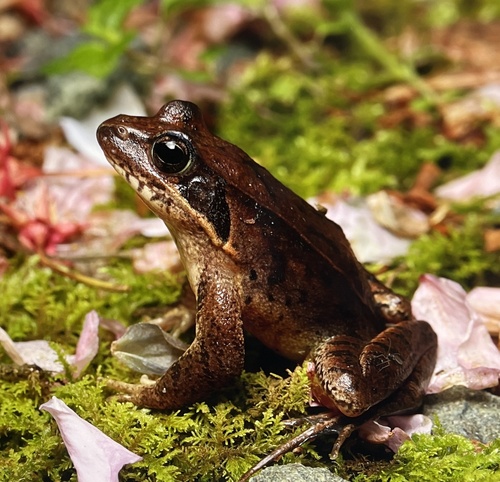
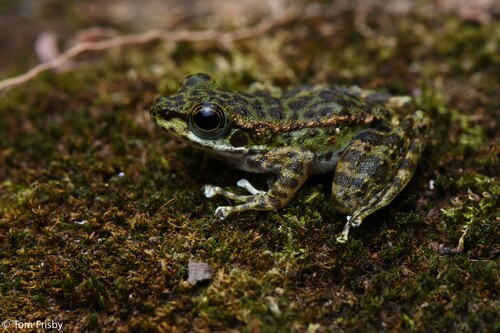
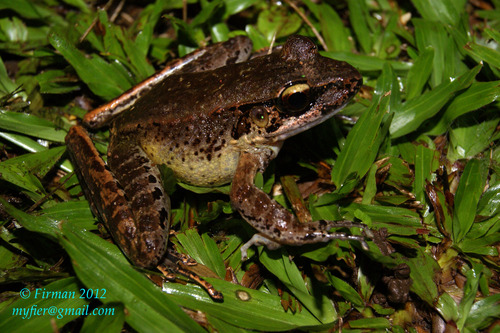
Dybowski's frog (Rana dybowskii, scientific name Rana dybowskii Günther, 1876) is a species of true frog native to Northeast Asia. Its confirmed distribution covers the Russian Far East, the Korean Peninsula, and Tsushima Island in Japan. Its presence in northeastern China has not been confirmed. This species is relatively tolerant of human disturbance, but heavy collection for use in traditional Chinese medicine has threatened it across parts of its range. Dybowski's frog breeds in slow-moving and stagnant water; when not breeding, it is most commonly found in woodlands. It occurs across a wide range of altitudes, from sea level up to 900 meters, and may occur at even higher elevations. Adult Dybowski's frogs measure 4.5–7.5 cm (1.8–3.0 in) in body length. They have relatively broad heads and bodies, and generally smooth skin with some small protuberances along the back. Males have a pair of vocal sacs that they use during the mating season. The back of Dybowski's frog is mostly tan to dark brown, and its belly is white. Dybowski's frog undergoes substantial physiological and microbial changes both when preparing for fall hibernation and when emerging from hibernation. During the hibernation period, the frogs migrate from their usual forest habitats to hibernation sites, which include spring-fed ponds, fast-flowing streams, and rivers. Male frogs arrive at hibernation sites earlier than females, and juveniles arrive earlier than adult frogs. Dybowski's frog hibernates in groups that can contain up to 1,000 individuals. The gut microbiome of Dybowski's frog is more diverse in summer than in autumn and winter, a difference largely attributed to fasting during hibernation. During migration to hibernation sites, the gut microbiota of Dybowski's frog also shows circadian fluctuations in the abundance of different bacterial taxa. The specific genera that fluctuate vary by the frog's sex, and these changes are thought to help regulate digestion and energy storage in preparation for hibernation. The gut microbiota shifts again during the hibernation period itself. These shifts are believed to support nutrient absorption and metabolism as the frogs prepare to return to normal activity in spring. Across all seasons, the dominant bacterial phyla in the gut microbiome of Dybowski's frog are Firmicutes, Proteobacteria, Bacteroidetes, and Actinobacteria.