About Rana aurora Baird & Girard, 1852
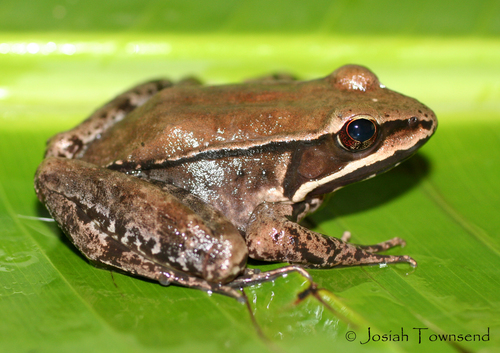
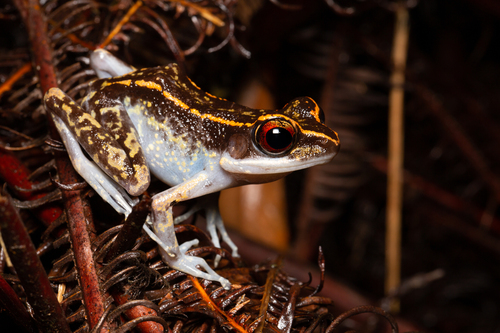
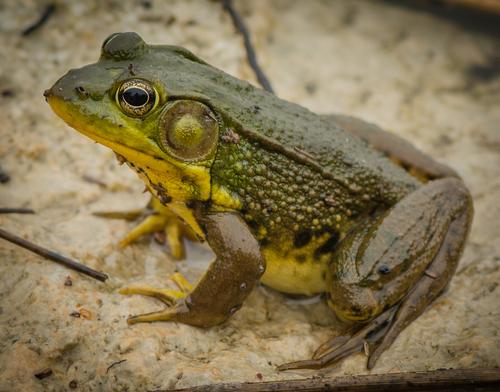
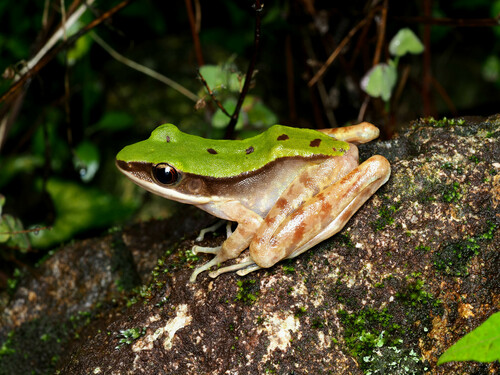
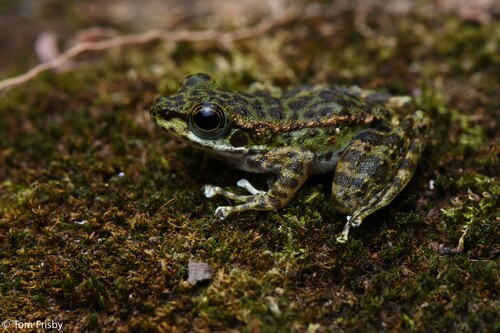
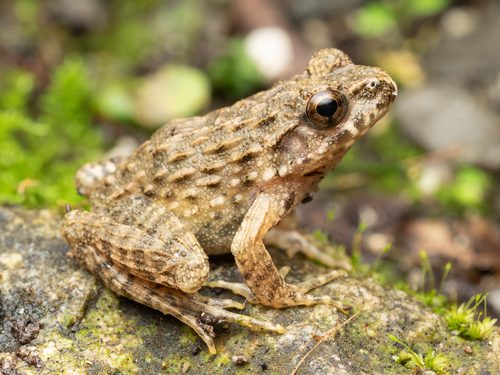
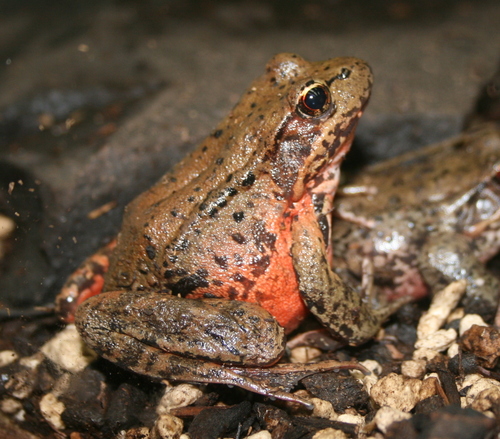
Northern red-legged frogs, scientifically named Rana aurora Baird & Girard, 1852, have smooth skin that ranges from greenish-brown to reddish-brown. Their common name comes from the bright red coloration on the underside of their relatively long, webbed hind legs. Dark spots and flecks cover their bodies in varying densities and patterns. Their eyes are golden-brown; a thin, horizontal dark marking runs from the front of each eye to the nostrils, and a light stripe follows the jawline. A reddish-brown mask covers the tympanum. Adults have characteristic features of species in the Rana genus, including prominent dorsolateral folds (ridges along the back) running the full length of the dorsal margin, non-warty skin, and a small waist. This species has long, powerful legs well adapted for jumping. Northern red-legged frogs exhibit sexual dimorphism in size: larger females can reach 10.7 cm (4.2 in), while males can reach 8.1 cm (3.2 in), though maximum size varies by location. In Washington state, individuals of both sexes are typically a few inches smaller than these overall maximum measurements. Known lookalike species include the California red-legged frog, Oregon spotted frog, and Cascades frog. Northern red-legged frogs are smaller than California red-legged frogs, and differ from them in color pattern, limb length, and eye size. Key features that distinguish northern red-legged frogs from Oregon spotted frogs and Cascades frogs include groin coloration, dorsolateral fold length, eye orientation, posture, toe webbing, and use of terrestrial habitat. The northern red-legged frog is found west of the Cascade mountain range in the Pacific Northwest. Its range includes Northern California, western Oregon, western Washington, and southwestern British Columbia, including Vancouver Island. It also occurs, somewhat less commonly, in the southern Cascade Range. In California, its range spans every coastal county from southern Mendocino County northward, and the southern limit of its range ends at Mendocino County, Northern California, a trait it shares with some other Pacific Northwest amphibians. These frogs can live at elevations up to 1,426 m (4,680 ft) overall, but are not found above 1,200 m (3,937 ft) in Northern California coastal mountain ranges, or above 914 m (3,000 ft) in Washington. The species is considered introduced to Alaska. Where the ranges of California and northern red-legged frogs overlap, most populations of the two species have genetically distinct mitochondrial DNA, indicating only a narrow band of hybridization across the region. One study that searched for both species in southern Mendocino County using environmental DNA analysis did not find widespread presence in forest streams. Northern red-legged frogs use both upland-terrestrial and aquatic habitats. Data on their overwintering habitat is sparse, though association with sword ferns and use of terrestrial habitats covers at least part of the overwintering period. Still or slow-moving water in ponds, marshes, or streams is essential breeding habitat. Their aquatic habitat includes both vernal and permanent bodies of water that contain submerged vegetation. This species is considered unusually strongly oriented to aquatic habitat, with a clear preference for thickly vegetated shorelines. Northern red-legged frogs require cover because they are preyed on by a variety of fishes, snakes, birds, mammals, and even other amphibians. The species prefers breeding ponds that have sunny patches; indirect sunlight allows eggs to absorb heat while embryos develop. Other research data indicates that some populations can tolerate closed-canopy ponds, and may even prefer them for tadpole survival. Males and females begin moving to breeding sites as early as October, and sometimes as late as January, with timing depending on latitude, cumulative seasonal rainfall, and average temperature. The breeding period generally falls between January and March. Adult frogs may stay at their breeding sites for between one and two weeks. Adult migration is easiest to observe on moonlit nights with light rain. Typically, stable minimum temperatures between 5.5 to 6.5 °C (42 to 44 °F) are required to trigger breeding. Females lay eggs when surface water temperatures are at least 6.1 °C (43 °F). Breeding sites can be either permanent or temporary, and the area usually needs to remain inundated until June for successful metamorphosis in Oregon, and until late May or June in Northern California. Male frogs arrive at breeding sites before females. It is thought that males defend their territories through nocturnal displays once they reach the breeding pond. Courtship behaviors begin in January in the California portion of the range, and as late as March in more northern regions. Male courtship vocalizations include underwater breeding choruses that are unique among ranid species, plus mating calls during amplexus. During amplexus, gravid females deposit eggs in shallow water, where the eggs attach to submerged vegetation or twigs. Males fertilize the eggs as they are laid. Egg masses are typically deposited 7 to 15 cm (2.8 to 5.9 inches) below the pond surface, away from the water edge. Egg-laying generally occurs in densely vegetated, shallow areas of wetlands with little water current. In unusual cases, egg masses have been observed in water up to 500 cm deep. Egg masses are globular, typically around 10 cm (3.9 in) in diameter, and may spread into an irregular shape underwater or float to the surface. The jelly surrounding the eggs swells after laying as it absorbs water. Estimates for the number of eggs per egg mass range from 500 to 1100, and can go as high as 2,000 eggs. Individual eggs are between 2.0 and 3.0 mm in diameter. Eggs generally hatch 3 to 5 weeks after fertilization, an unusually long incubation period compared to other Rana species. After hatching, tadpoles emerge; they are oval-shaped, and gradually become lighter in color as they age. There is a sharp spike in tadpole mortality shortly after hatching, caused by predation and high population density. Surviving tadpoles metamorphose once they reach 5–7.6 cm (2–3 in), and newly metamorphosed frogs are smaller, measuring between 2 and 2.5 cm (0.8–1 in). Adults leave the breeding pond soon after breeding concludes, and may migrate around half a kilometer to their summer locations, which are typically riparian zones. Juveniles leave breeding ponds more slowly, find cover in riparian areas, and typically migrate around 0.5 km (0.3 mi) by summertime.