About Ramphocelus flammigerus (Jardine & Selby, 1833)
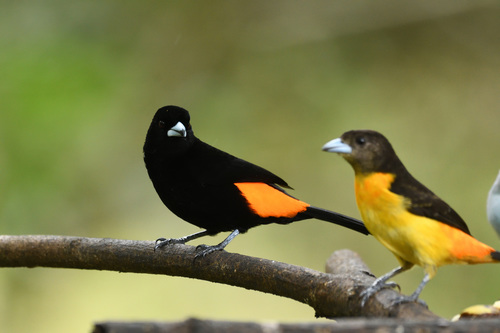
Ramphocelus flammigerus, commonly known as the flame-rumped tanager, averages 19 centimeters in total length, and displays strong sexual dimorphism. Males of both recognized subspecies have velvety black plumage with a scarlet-red patch on the back. Their chest and rump range in color from orange to red, and their belly is bright yellow. Their beak is cobalt blue, silver, or whitish with a distinct black tip. Females have an olive-brown back marked with dark spots, a reddish-orange rump, and light yellow coloration on the chest and belly. The two subspecies differ in plumage coloration: male Ramphocelus flammigerus icteronotus have a yellow rump, while male nominate Ramphocelus flammigerus flammigerus have a red rump. For females, the rump is yellowish in R. f. icteronotus, while the rump, vent, and chest are orange-red in R. f. flammigerus. The nominate subspecies of flame-rumped tanager is distributed across the Cauca Valley in western Colombia, ranging from Antioquia in the north to Cauca in the south. The species is fairly common in its native habitats, which include shrubby clearings, forest edges, and gardens, found mostly at elevations between 800 and 2000 meters above sea level. The more widely distributed subspecies, R. f. icteronotus, occurs in the Tumbes-Chocó-Magdalena region across Panama, Colombia, Ecuador, and Peru. This taxon is sometimes treated as a separate species called the lemon-rumped tanager, under the binomial R. icteronotus. It is known to hybridize with the nominate Cauca Valley subspecies in Colombia.