About Ramphocelus carbo (Pallas, 1764)
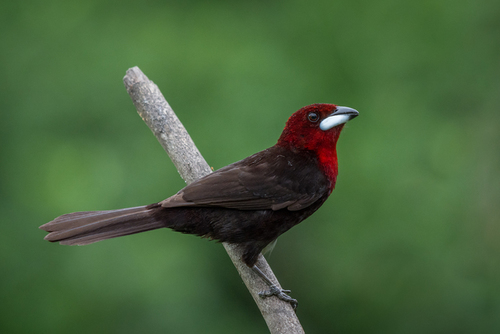
The silver-beaked tanager, scientifically known as Ramphocelus carbo, is a medium-sized passerine bird. It is a common, conspicuous resident breeder across South America, ranging from eastern Colombia and Venezuela south to Paraguay, central Brazil, and Peru, and it also lives on Trinidad. Adult silver-beaked tanagers measure 18 centimetres (7 inches) long and weigh 25 grams (0.88 ounces). Adult males have velvety crimson-black plumage, with a deep crimson throat and breast. The upper mandible of their bill is black, while their enlarged lower mandible has a bright silver appearance; males hold their bills pointed upwards during displays. Females are much duller in color, with brownish upperparts, reddish brown underparts, and a fully black bill. There is notable plumage variation between different subspecies, with differences mainly in how much contrast appears between the upperparts, and the throat and breast. This species lives in light woodland and cultivated areas. It builds a bulky cup-shaped nest, usually placed in a bush, and a typical clutch contains two green-blue eggs marked with black-brown blotches. The female incubates the eggs for 11 to 13 days until hatching, and chicks fledge 11 to 12 days after hatching. Individual silver-beaked tanagers can live at least 11 years in the wild. These are social birds that feed mainly on fruit, but they also consume vines, nectar, short grass, and insects. They are often seen in groups of six to ten individuals, and frequently make a call described as cheeng. Their song is a slow, thin kick-wick. This species was first described by German naturalist Peter Simon Pallas in 1764, who originally gave it the binomial name Lanius carbo.