About Ramphastos vitellinus M.H.K.Lichtenstein, 1823
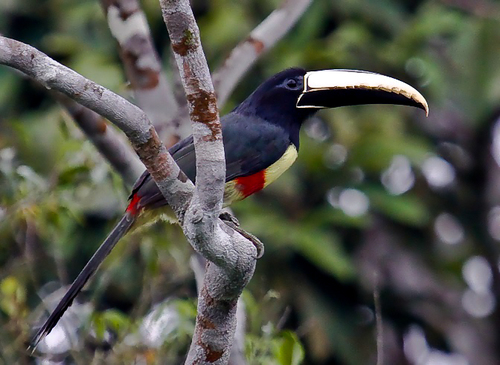
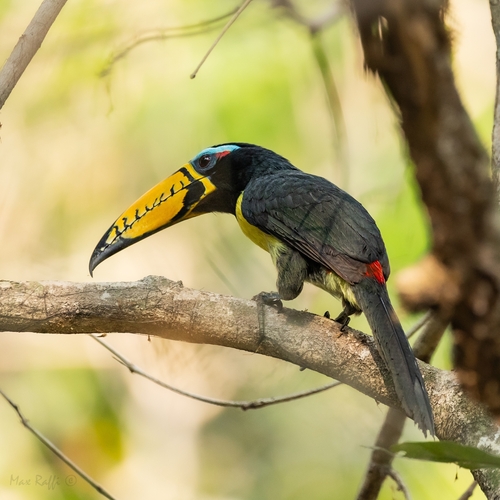
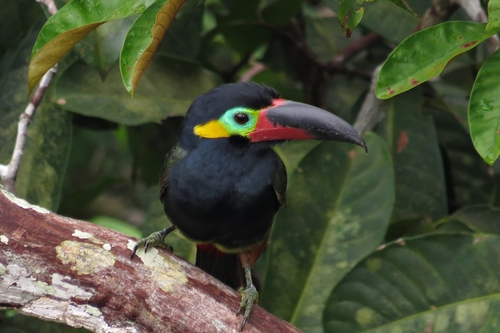
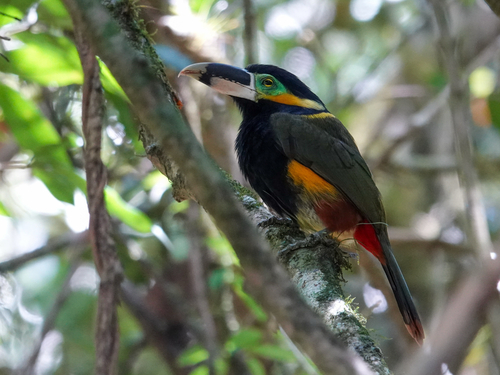
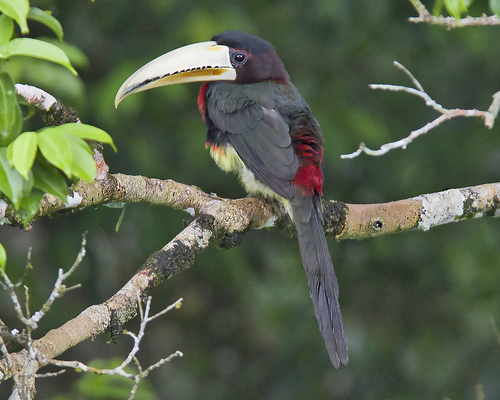
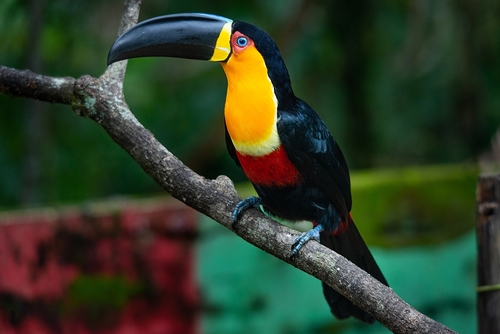
Like other toucan species, the channel-billed toucan (Ramphastos vitellinus) has bright markings and an unusually large bill. This species is typically 48 cm (19 in) in total length, and its bill measures 9 to 14 cm (3½ to 5½ in) long. Adult individuals weigh between 300 and 430 g (11 to 15 oz). The nominate subspecies R. v. vitellinus has black upperparts, belly, tail, and most of its bill, with red uppertail and undertail coverts. The bare patch surrounding its eye and the base of its bill are blue, its throat is white, and most of the central breast is yellow-orange that fades to white towards the sides. The lower breast has a distinct, broad horizontal red band that creates a sharp contrast with surrounding plumage. The iris of the nominate subspecies is dark brownish, and this subspecies is found in the northeastern portion of the species’ overall range. Subspecies culminatus resembles the nominate subspecies, but differs in having a yellow base to the upper mandible and a yellow ridge along its bill, orange-yellow uppertail coverts, and entirely white throat and breast (occasionally with a pale yellow tinge), with only a narrow red band separating the throat and breast from the black belly. This subspecies occurs in the eastern and south-central portion of the species’ range, and it is very similar to and easily confused with Cuvier's toucan (Ramphastos tucanus cuvieri). Subspecies ariel resembles the nominate subspecies, but differs in having a yellow bill base, red skin surrounding its pale blue eye, and entirely orange throat and chest. This subspecies occurs in the southeast Amazon, and an unnamed population from coastal regions of eastern Brazil is virtually identical to ariel. Subspecies citreolaemus resembles culminatus, but differs in having a clear yellow tinge to the throat, a green tinge added to its otherwise yellow culmen, a yellow-orange patch at the very base of the bill, and a pale bluish iris. This subspecies occurs in northern Colombia and northwestern Venezuela. Wherever the ranges of these described subspecies meet, individual birds with intermediate features between the described races are common due to hybridization. Some of these intermediate populations have sometimes been classified as separate subspecies; for example, theresae for the north-eastern Brazil population and pintoi for populations in south-central Brazil, both of which are intergrades between culminatus and ariel. Ramphastos vitellinus lives in forest and woodland habitats. It prefers humid regions, but can extend locally into drier regions, especially along rivers. It is found mainly in lowlands, but occurs locally at altitudes up to 1,700 m (5,600 ft).