About Ramphastos toco P.L.S.Müller, 1776
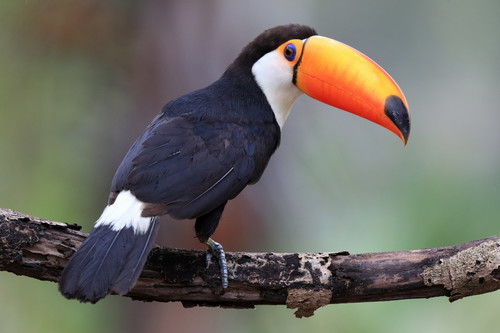
The toco toucan, Ramphastos toco, is the largest toucan species, with an average total length of 56 cm (22 in). It is easily distinguishable from all other bird species by its very large orange beak. Most of its body plumage is glossy black, with a white throat and upper throat patch. This white patch sometimes gains a citrine yellow tint and a red band where it meets the black breast, and these traits vary greatly between individual birds. The rump is white, while the underside of the tail, including the crissum, is red. Eye color is most commonly brown, though shades of yellow, green, and blue have also been recorded. The eye is surrounded by a narrow blue ring, and the remaining bare orbital skin ranges from sulfur yellow to orange. A small patch of feathers near the lores is white, and the orbital skin below the eye is occasionally greenish-yellow. The extremely long, thin bill is typically most red along the top of the culmen, and has irregular orangish-brown bands on its sides, across the tomia. Beak length differs between the sexes: it ranges from 173 to 215 mm (6.8 to 8.5 in) in males, with an average of 200.5 mm (7.89 in), and from 158 to 202 mm (6.2 to 8.0 in) in females, with an average of 178.6 mm (7.03 in). The base of the beak is black, forming a band that is thickest at the bottom of the mandible. The tip of the maxilla has a large black oval that shines intensely when viewed in light. Though the beak appears heavy, it is relatively lightweight like other toucans' beaks, because its interior is largely hollow. The tongue is nearly as long as the bill and very flat. Apart from difference in size, there are no visible external differences between males and females. Juveniles have duller plumage and shorter bills than adult toco toucans. Standard measurements for the species are as follows: wing chord length ranges from 22 to 26 cm (8.7 to 10.2 in), tail length ranges from 14.1 to 17.9 cm (5.6 to 7.0 in), and tarsus length ranges from 4.8 to 6.5 cm (1.9 to 2.6 in). Partial leucism has been recorded in the species. The toco toucan is endemic to South America, with a wide distribution ranging from the Guianas in the north south to northern Argentina and Uruguay. Northern parts of its range hold several disjunct populations, located in the Guianas, in northern Brazil near the Rio Branco, and along the mouth of the Amazon upstream to approximately Manaus in eastern Amazonas. Additional populations occur from coastal Maranhão southwest to southwestern Brazil, Bolivia, and Pampas de Heath in far southeastern Peru, and south through Piauí and Bahia to northern Argentina and Uruguay. The species was previously believed to have gone extinct in Tucumán, northwestern Argentina, by the late 1990s, but was rediscovered there in the early 2010s. The toco toucan's range within the Amazon rainforest may be growing as a result of deforestation. It has only recently been recorded in Uruguay; before this, the southern limit of its range was Lagoa dos Patos in Brazil. The recent expansion of the species' range south of the 30th parallel may be caused by escaped captive individuals or changing ecological conditions. Toco toucans are generally non-migratory and resident, but will sometimes move in large groups to search for food. Unlike other toucan species, toco toucans do not live in continuous, closed-canopy forests. Instead, they prefer a range of semi-open habitats including gallery forests, savannas, forests adjacent to water bodies, woodlands, secondary forest, chaco, plantations, orchards, and groves. They are especially common in the Brazilian cerrado, a type of tropical savanna, and gallery forests, and are also common in the wetlands of the Pantanal. They have been recorded living at altitudes up to 1,750 m (5,740 ft). Toco toucans are most often encountered flying or feeding in treetops, hopping between branches. Their flight is somewhat undulating, as they alternate between heavy flapping and gliding. Like other toucans, toco toucans have large home ranges, with an average size of 86 ha (210 acres). They are more widely dispersed than other toucans, which do not cross large bodies of water, and can maintain flight across water bodies over 5 km (3.1 mi) wide. Toco toucans are not highly active during the day, and occasionally rest in treetops. They are less social than other toucans, and usually feed alone or in small groups at fruiting trees. When foraging as a group, toco toucans fly from treetop to treetop in single file. Group members will often groom each other (preen), though this behavior usually stops once egg-laying begins, as mates begin to preen only each other. After the breeding season ends, toco toucans will sometimes form large flocks that fly through forests searching for fruit. These flocks may sometimes include other species such as the white-throated toucan.