About Ramphastos sulfuratus R.Lesson, 1830
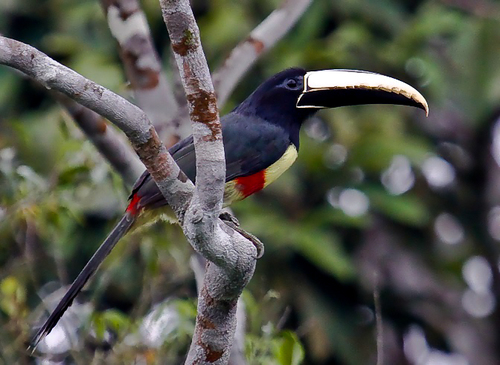
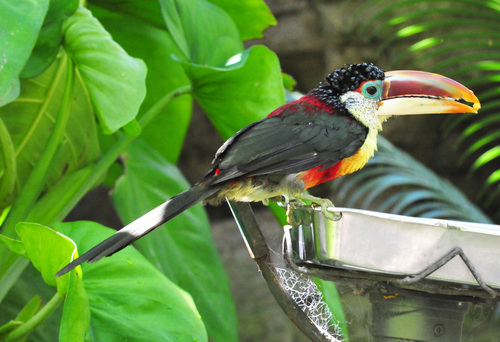
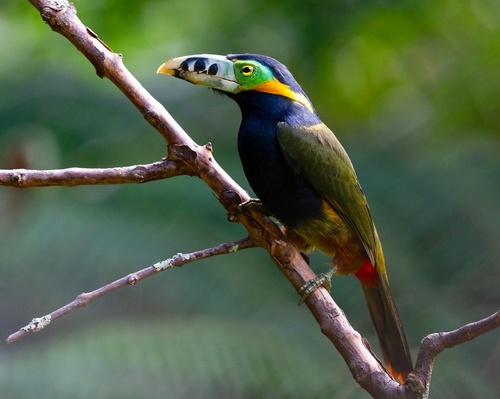
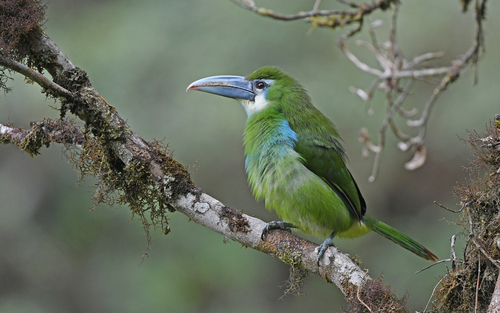
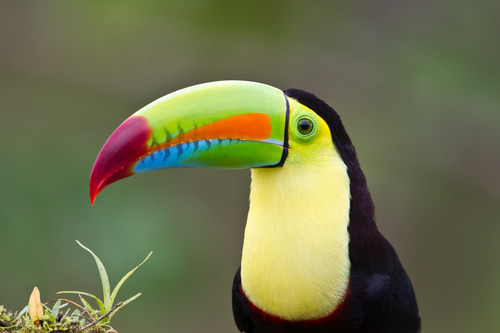
Including its bill, the keel-billed toucan (Ramphastos sulfuratus R.Lesson, 1830) has a total length of roughly 42 to 55 cm (17 to 22 in), with a typical wing length between 189.4 to 208.4 mm (7.46 to 8.20 in). Adult birds usually weigh between 380–500 g (13–18 oz). Its large, brightly colored bill averages 12–15 cm (4.7–5.9 in) long, making up around one third of the bird's total body length. The bill is primarily green, with a red tip and orange sides. Though the bill appears large and heavy, it is actually a spongy hollow bone covered in keratin, a lightweight and hard protein. It has been proposed that the bill's blood vessels may help the toucan regulate its body temperature. The keel-billed toucan's plumage is mainly black, with a yellow neck and chest, red undertail coverts, and a thin red band at the base of the yellow chest plumage. This species moults once per year, has blue feet, and has red feathers at the tip of its tail. Like almost all birds in the order Piciformes, keel-billed toucans have zygodactyl feet: toes 2 and 3 face forward, while toes 1 and 4 face backwards, for a total of two toes pointing forward and two pointing back. Since toucans spend much of their time in trees, this foot arrangement may help them stay perched on branches and jump between branches. Males and females of the species are similar in appearance, differing only in size.
The keel-billed toucan's range extends from southern Mexico to Venezuela and Colombia, including Belize where it is the country's national bird. It roosts in the canopies of tropical, subtropical, and lowland rainforests, at elevations up to 1,900 m (6,200 ft). It roosts in tree holes, often alongside several other toucans. Despite residing in the region's primary forests, it can also be found in adjacent plantations, pastures, and second-growth forests.
Like many other toucan species, keel-billed toucans are highly social birds that are rarely seen alone. They travel in small flocks of around six to twelve individuals through lowland rainforests. Their flight is slow and undulating: they perform six to ten rapid wing beats, then glide with their beak held forward and dipped downward, as if pulling the rest of their body along. They draw their feet forward during flight, and typically only fly short distances. They live in groups, often sharing cramped tree hole roosts; five or six toucans can fit into a single tree hole. These roost holes are located between 3–27 m above the ground, and have small entrance openings. To fit into these small holes, toucans fold their tail over their body and tuck their large beak against their back. This posture also helps them maintain a normal body temperature while sleeping. The bottoms of roost holes are often covered with seed stones from fruit the toucans have eaten, adding to the limited space inside. Groups have a defined family structure. Birds often "duel" one another using their bills, and toss fruit into each other's mouths. They also play a game similar to ball, where one bird throws fruit into the air and another catches it. Their calls include vocalizations like "grr", "trrii", and "rrrk"; a loud male can be heard from one kilometer away. They also produce non-vocal communication sounds by clacking their large bills and beating their wings. Known predators of the keel-billed toucan include hawk-eagles and collared forest falcons, and collared forest falcons are a major predator in some areas.
Keel-billed toucans feed mostly on a wide variety of fruit, such as Cymbopetalum mayanum (Annonaceae) and gumbo-limbo (Bursera simaruba), but their diet may also include insects, eggs, nestlings, and lizards. The bill is surprisingly dexterous, allowing the toucan to access a large range of fruit that it could not reach otherwise. When eating fruit, it uses its bill to cut open the fruit, then tosses its head back to swallow the fruit whole. Keel-billed toucans usually forage from the mid-story up to the forest canopy, off the ground; they rarely feed on the forest floor. In 2018, a research team in Costa Rica observed a keel-billed toucan eating carrion, which may be the first recorded observation of carrion consumption by any toucan. The toucan's feeding behavior benefits the plants it eats: large seeds that are digested and vomited by the birds are more likely to sprout than uneaten seeds. Occasionally, the larger chestnut-mandibled toucan will follow a keel-billed toucan to a food source, then chase the smaller bird away.