About Ramphastos dicolorus Linnaeus, 1766
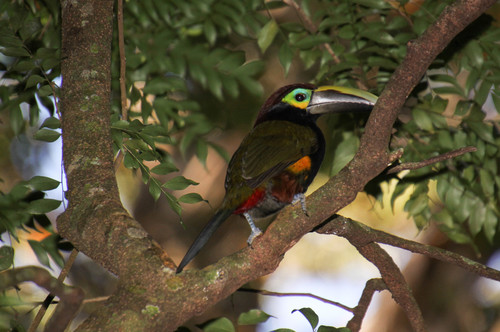
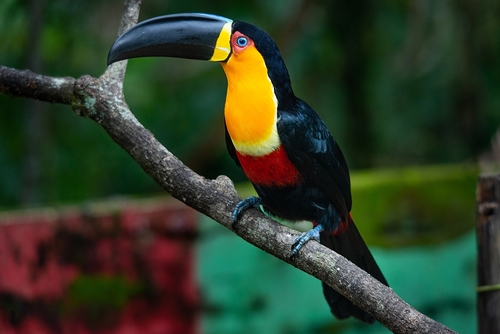
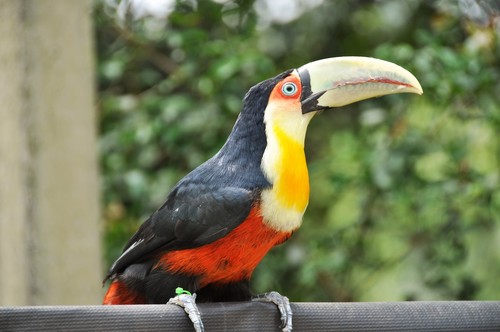
Ramphastos dicolorus Linnaeus, 1766, commonly called the red-breasted toucan, is the smallest species in the genus Ramphastos. It measures 42 to 48 cm (17 to 19 in) long and weighs 265 to 400 g (9.3 to 14 oz). Males and females have similar overall plumage, though the female's bill is shorter than the male's. The bill is mostly green to green-yellow, with a vertical black line at its base, red and ivory tomial "teeth", and green striations on the maxilla. The species' crown, nape, upperparts, and tail are black, except for red uppertail coverts. Its face is yellow, with bare skin in red, blue, and yellow-green tones surrounding the eye. The throat and upper breast are yellow, with a distinct red patch on the lower breast. The belly and undertail coverts are red, and the flanks are black.
The red-breasted toucan ranges from Tocantins, Minas Gerais, and Espírito Santo in south-central, east-central, and southeastern Brazil, southward through eastern Paraguay and eastern Bolivia, and into the northern Argentinian provinces of Formosa, Chaco, Corrientes, and Misiones. It primarily lives in subtropical and tropical sub-montane and montane forest, and can also be found in scrublands, tree-containing savanna, and plantations. Most individuals occur between 100 and 1,500 m (300 and 4,900 ft) in elevation; it only rarely reaches elevations as high as 2,070 m (6,800 ft).