About Ramphastos ambiguus Swainson, 1823
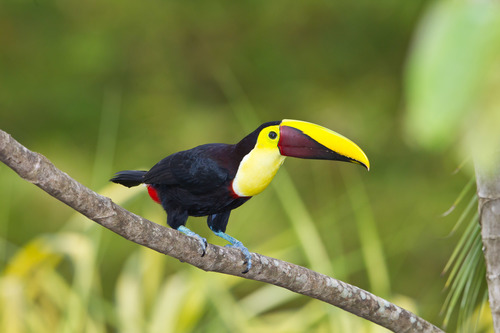
Ramphastos ambiguus, commonly known as the yellow-throated toucan, measures 47 to 61 cm (19 to 24 in) in total length and weighs 584 to 746 g (1.3 to 1.6 lb). Across its three recognized subspecies, overall body dimensions differ very little. In all three subspecies, females have shorter bills than males: male bill lengths range from 15.1 to 19.8 cm (5.9 to 7.8 in), while female bill lengths range from 12.9 to 16.0 cm (5.1 to 6.3 in). Other body measurements do not differ notably by sex; wing chord measures 20.4 to 24.8 cm (8.0 to 9.8 in), tail length measures 14.0 to 16.2 cm (5.5 to 6.4 in), and tarsus length measures 4.7 to 5.5 cm (1.9 to 2.2 in). All three subspecies have nearly identical plumage. Their body is mostly black, with a maroon tint on the hindneck and upper back, and white uppertail coverts. Their face, throat, and upper breast are bright yellow, with white and crimson bands positioned below the breast. Their vent and undertail coverts are bright red. The color of the bare skin surrounding the eye differs between subspecies: it is sky blue in the nominate subspecies R. a. ambiguus, yellow-green in R. a. abbreviatus, and varies between yellow and bright green in R. a. swainsonii. The structure and color of the bill also differs between subspecies. All three have a mostly yellow maxilla, with a greenish yellow stripe along the culmen and a thin black line at the bill base. The nominate R. a. ambiguus and R. a. abbreviatus have black mandibles, while the mandible of R. a. swainsonii is maroon to reddish chestnut brown. The chestnut-mandibled subspecies R. a. swainsonii primarily inhabits lowland evergreen primary forest, and also occurs in gallery forest, older secondary forest, and well-treed parks and gardens. It avoids dry forest and large open areas, but can be found in plantations with fruiting trees that border existing forest. The two black-mandibled subspecies usually occupy the interior of humid primary montane forest, and also occur at forest edges, in forest clearings, and in older secondary forest. Elevation ranges for the chestnut-mandibled subspecies vary by country: it occurs from sea level up to 1,000 m (3,300 ft) in Ecuador, below 2,000 m (6,600 ft) in Colombia, and up to 1,200 m (3,900 ft) in Costa Rica. For the black-mandibled subspecies, elevation ranges are between 1,000 and 1,600 m (3,300 and 5,200 ft) in Ecuador, and up to 2,500 m (8,200 ft) in Colombia.