About Ramaria stricta (Pers.) Quél.
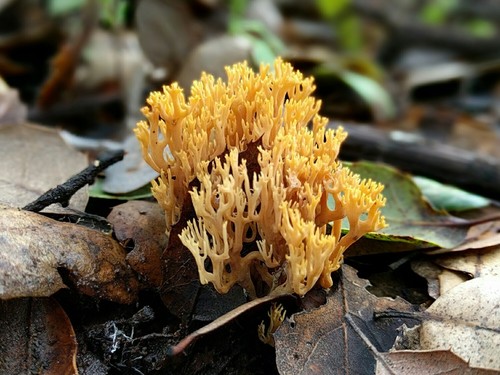
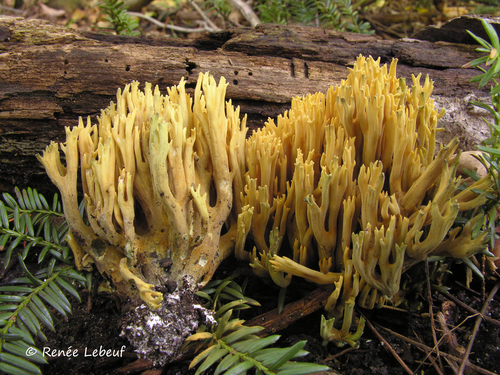
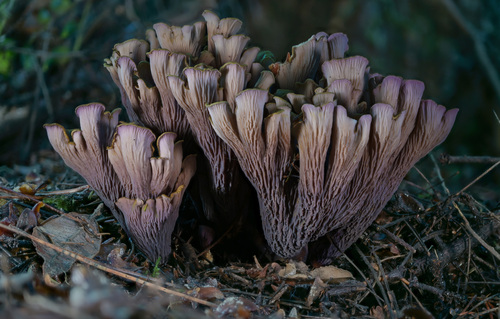
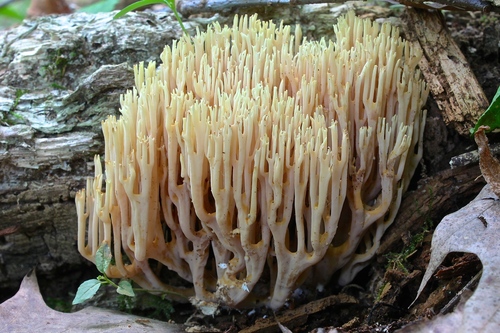
The fruit body of Ramaria stricta ranges in color from brownish to yellow, and grows paler closer to its branch tips. When bruised, it develops a light reddish brown discoloration. When fresh, the basidiocarp has a leathery texture, which becomes brittle once it dries out. Growing from a whitish base, the stipe branches up to 8 times; all branches are upright and nearly parallel, and each branch ends in 4 to 5 thorn-like tips. Overall, the fruit body is medium-sized and bushy, reaching up to 10 cm tall and 7 cm wide (4 by 2+3⁄4 inches). The stipe is either single or begins branching right at the base, and white mycelium and rhizomorphs spread out from its base. Ramaria stricta has an odor of anise and a bitter taste. It produces a dark yellow spore print. Its spores are roughly elliptical, covered in low cyanophilous warts, and measure 7–10 by 3.5–5.5 μm. Its basidia have basal clamps, are mostly four-spored, and sometimes contain cyanophilous granular contents. Ramaria stricta has a cosmopolitan distribution and is a fairly common species. It is a lignicolous fungus, meaning it grows on wood, and is common in late summer and fall in coniferous forests of the Pacific Coast and Rocky Mountains. It grows on dead wood, stumps, trunks, and branches of both deciduous (leafy) and coniferous trees. Fruiting bodies that grow on deciduous wood tend to be more orange and less bushy than those that grow on coniferous wood. Fruit bodies can grow in aligned "log lines" along decaying wood that is buried just below the ground surface or that is in an advanced state of decomposition.