About Ramaria botrytis (Pers.) Bourdot
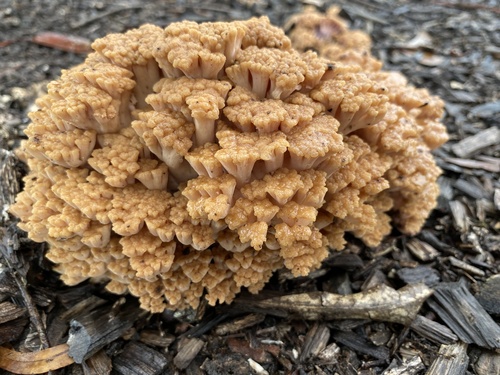
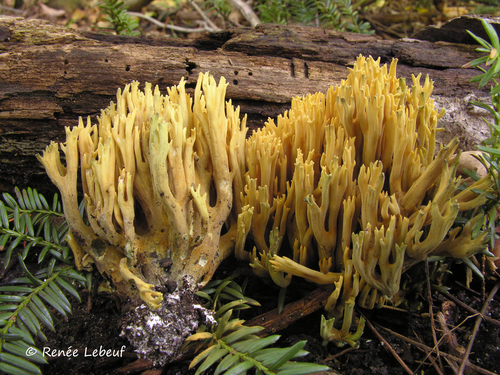
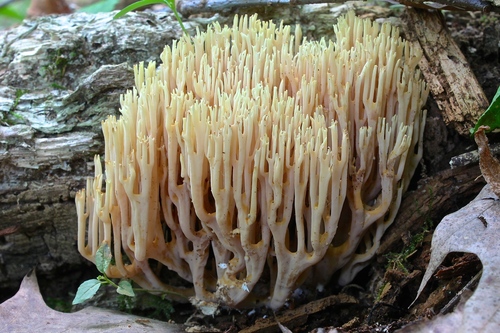
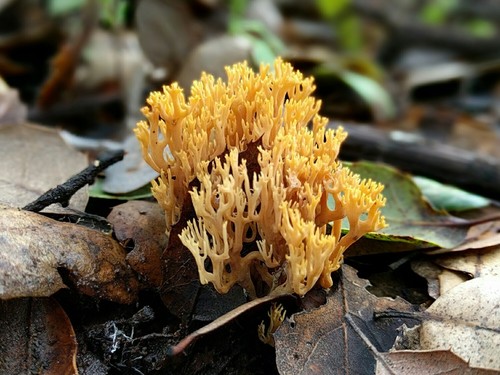
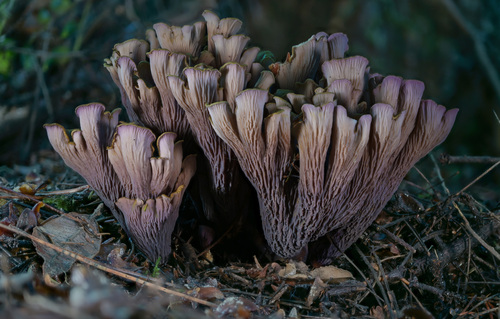
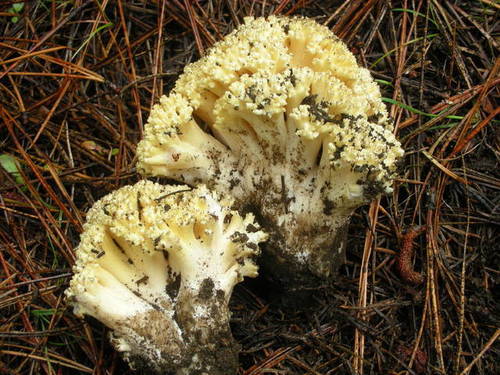
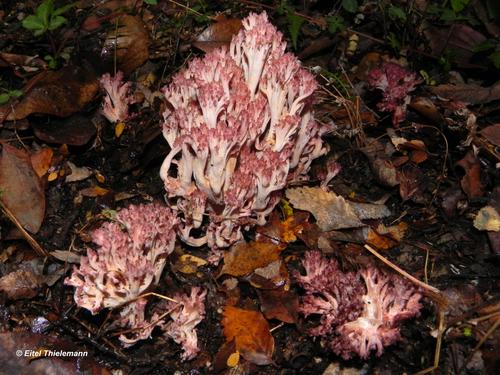
The fruit bodies of Ramaria botrytis are 6 to 20 cm (2+1⁄2 to 8 in) tall and 4 to 30 cm (1+1⁄2 to 12 in) wide. They are fleshy, cauliflower-like masses that grow from a stout central stem. The stem splits into a few lower primary branches before branching densely in the upper portion. The stem itself is short and thick, measuring roughly 2–6 cm (3⁄4–2+1⁄4 in) long and 1.5–6 cm (1⁄2–2+1⁄4 in) in diameter, and it tapers toward the base. Initially white, the stem and branches both turn pale yellow, buff, then tan as the fungus ages. Old fruit bodies can fade to almost white, or develop an ochre tint from fallen spores. The branching pattern is irregular: primary branches are few and thick, typically 2–3 cm (3⁄4–1+1⁄4 in) across, while final branches are slender, 2–3 mm across, and usually end in five to seven small branchlets. The tips of these branchlets are pink to purplish-red. The flesh is solid, white, and has an odor that is either indistinct or pleasant. When a drop of Melzer's reagent is applied to stem tissue, a weak amyloid staining reaction develops, often requiring more than 30 minutes to appear; this reaction helps distinguish R. botrytis from other similar fungi. Spores are produced by basidia on the outer surface of the branches. In spore deposits, spores are pale yellow. When viewed microscopically, spores have fine longitudinal or oblique striations that often fuse into a vein-like network. Their shape ranges from roughly cylindrical to sigmoid (curved like the letter "S"), and they measure 12–16 by 4–5 μm. Basidia are four-spored, occasionally two-spored, and measure 59–82 by 8–11 μm. The sterigmata, the slender projections of the basidia that attach to the spores, are 4–8 μm long. Combined, the hymenium and the subhymenium (the tissue layer directly beneath the hymenium) are about 80 μm thick. The hyphae that make up the subhymenium are interwoven, 2.5–4.5 μm in diameter, thin-walled, and clamped. Two varieties of R. botrytis are recognized: R. botrytis var. aurantiiramosa is distinguished from the more common variety by the orange color of its upper branches. R. botrytis var. compactospora typically has a more pronounced wine-red, purple, or reddish color on its branch tips, and has smaller spores that measure 9.2–12.8 by 4–5.4 μm. Ramaria botrytis is an ectomycorrhizal species, meaning it forms mutualistic associations with the roots of broadleaf trees, particularly beech. In a study testing how effectively several edible ectomycorrhizal fungi promote growth and nutrient accumulation in large-fruited red mahogany (Eucalyptus pellita), R. botrytis was the most effective at improving root colonization and macronutrient uptake. Reports of associations with conifers are thought to actually refer to similar related species. Fruit bodies grow on the ground, occurring singly, scattered, or in small groups among fallen leaves in woodlands. They can also grow in fairy rings. R. botrytis is classified as a "snowbank fungus", meaning it commonly fruits near the edges of melting snowbanks in spring. In Korea, it is commonly found at sites that also produce the prized edible species Tricholoma matsutake. Ramaria botrytis has been recorded in Africa (Tunisia), Australia, Chile, Asia (including the eastern Himalayas of India, Nepal, Japan, Korea, Pakistan, China, the Far East of Russia, and Turkey), and Europe (including the Netherlands, France, Portugal, Italy, Bulgaria, and Spain). It is widely distributed across North America, where it fruits from October to January on the West Coast and July to September elsewhere. It is most common in the southeastern United States and along the Pacific Coast, and has also been found in Mexico and Guatemala. The variety R. botrytis var. aurantiiramosa has a limited distribution restricted to Lewis County, Washington, where it associates with Douglas-fir (Pseudotsuga menziesii) and western hemlock (Tsuga heterophylla). Variety compactospora is only known from Sardinia, Italy, where it has been found growing in sandy soil in forests made up of strawberry tree (Arbutus unedo), tree heath (Erica arborea), and holm oak (Quercus ilex). Ramaria botrytis is an edible species, and some consider it a choice edible. Its taste is described as slight or fruity, and has been compared to sauerkraut, green peanuts (fresh harvested, undehydrated peanuts), or pea pods. Older fruit bodies develop an acidic flavor. It is sold in food markets in Japan under the name Nedzumi-take, and is harvested from the wild in Korea and Nepal. The thick base and main branches require longer cooking than the smaller branchlets. In the Garfagnana region of central Italy, the mushroom is stewed or pickled in oil. Fruit bodies can be preserved by slicing thinly and drying. One field guide rates its edibility as questionable, warning of the risk of confusion with the poisonous species Ramaria formosa. Other authors note that some people may experience laxative effects after eating this mushroom. Collectors are advised to exercise caution when gathering fruit bodies near polluted areas, as the species is known to bioaccumulate toxic arsenic. Chemical analysis shows that fresh R. botrytis fruit bodies have a food energy value of 154 kilojoules per 100 grams, which is comparable to the 120–150 kJ range reported for commercially grown edible mushrooms. As a percentage of dry matter, the fruit bodies contain 39.0% crude protein, 1.4% lipids, 50.8% carbohydrates, and 8.8% ash. Most of the lipid content is made up of oleic (43.9%), linoleic (38.3%), and palmitic (9.9%) fatty acids.