About Ramaria araiospora Marr & D.E.Stuntz
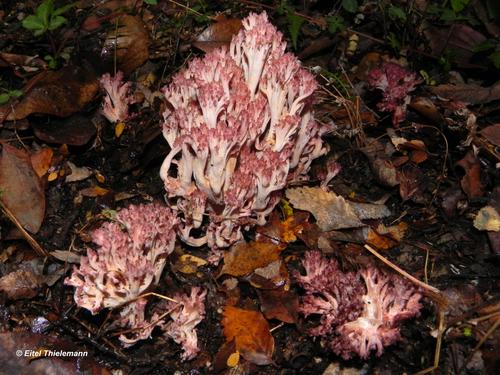
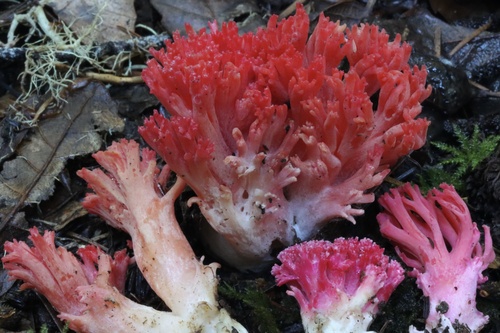
Ramaria araiospora Marr & D.E.Stuntz has fruit bodies that typically measure 5–14 cm (2–5+1⁄2 in) tall by 2–10 cm (3⁄4–4 in) wide. It has a single, somewhat bulbous stipe 2–3 cm (3⁄4–1+1⁄8 in) long and 1.5–2 cm (5⁄8–3⁄4 in) thick, which branches up to six times. Its branches are slender, usually about 1–5 mm (1⁄16–3⁄16 in) in diameter, while branches near the base are thicker, reaching up to 4 cm (1+5⁄8 in) thick. Terminal branches are forked or finely divided into sharp tips. In young specimens, the context is fleshy to fibrous, and becomes brittle when dried. Branches are initially red, fading to a lighter red as they mature; the base including the stipe is white to yellowish-white, and branch tips are yellow. When dried, the base of fruit bodies becomes yellowish white and the branches become dull red. The fruit bodies have no distinctive taste or odor. Spore deposits are white, cream, or yellowish. Spores are somewhat cylindrical, ornamented with lobed warts, and measure 9.9 by 3.7 μm. The spore-bearing basidia are club-shaped, produce one to four spores (four is most common), and measure 43–75 by 7–12 μm. The variety rubella differs from the standard type by having slightly more bluish or crimson colored branches in mature specimens, and slightly smaller basidia that measure 30–70 by 6–10 μm. It is not known with certainty, but the species is probably mycorrhizal. Fruit bodies grow on the ground singly or scattered, under conifers (especially western hemlock) and deciduous trees (particularly tanoak). Fruiting usually occurs in September and November. The species is primarily known from the Pacific Northwest region of North America, though it or a very similar undescribed species has been reported from Kansas. Variety rubella has been collected in the eastern Himalayas and Mexico.