About Ramalina intermedia (Delise ex Nyl.) Nyl.
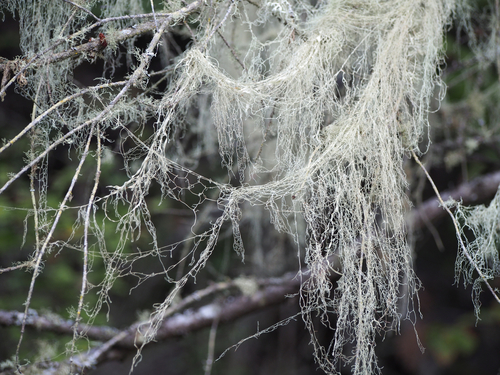
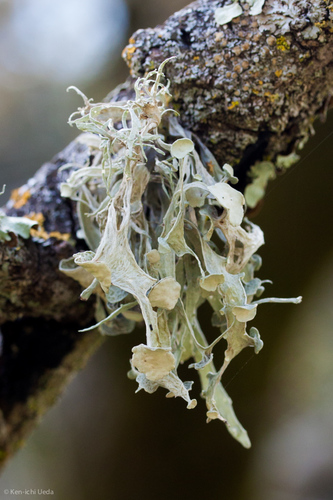
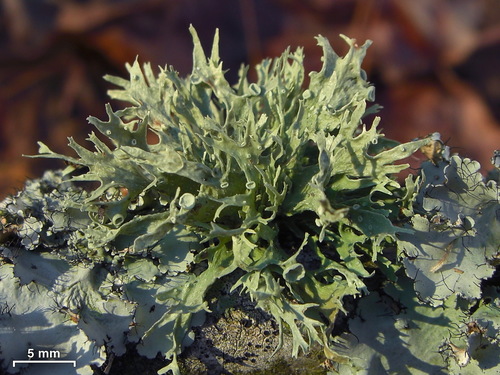
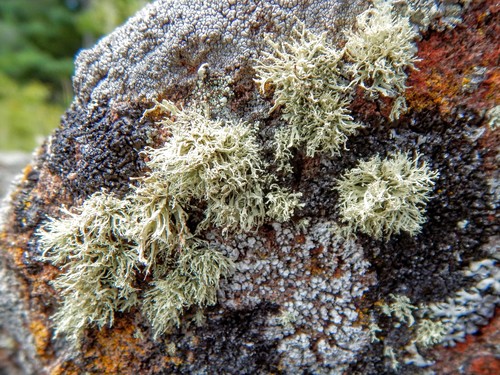
Ramalina intermedia (Delise ex Nyl.) Nyl. is a fruticose lichen with slender, branched thalli. It primarily attaches to substrates, most often trees or rocks, using a small holdfast. Its branches are flattened, sometimes twisted, and have a light greenish-yellow color caused by the presence of usnic acid, a secondary metabolite common to many lichens. The thallus surface is typically covered in tiny, granular structures called soredia, which function in asexual reproduction. These soredia are especially concentrated at the tips of branches, forming soralia: powdery patches that develop terminally on recurved lobe tips. Chemically, R. intermedia contains sekikaic acid and homosekikaic acid, and atranorin, another lichen product, may occasionally be present. Thin-layer chromatography has confirmed these chemical compounds across different populations of the species, though their concentrations can vary. The overall branching structure of R. intermedia is typically isotomic, meaning all branches are more or less equal in length, resulting in a symmetrically branched appearance. Adventive branching can develop after the thallus is damaged, however, which produces irregular branch patterns. Microscopically, the photobiont layer, where symbiotic algae live, sits beneath a protective upper cortex, which lets the lichen carry out photosynthesis efficiently. In most observed specimens from North America, this species lacks sexual reproductive structures such as apothecia, a trait that separates it from some similar species. In comparison to other Ramalina species, R. intermedia is smaller, and its branches rarely grow wider than 3 mm. It can be mistaken for species like Ramalina farinacea due to its similar morphology, but R. intermedia can be told apart by its narrower lobes and the absence of certain chemical compounds such as protocetraric acid.