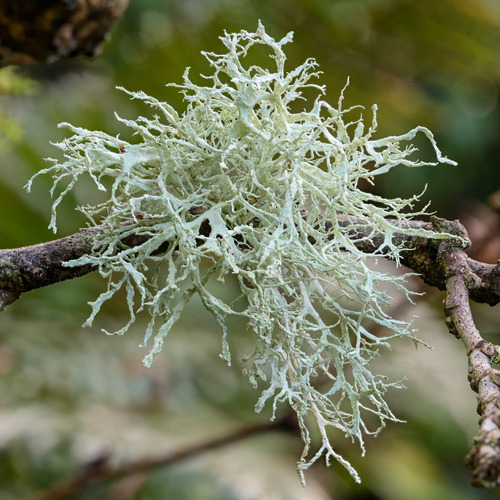
About Ramalina farinacea (L.) Ach.
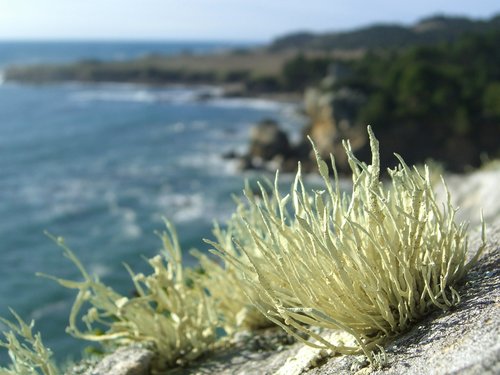
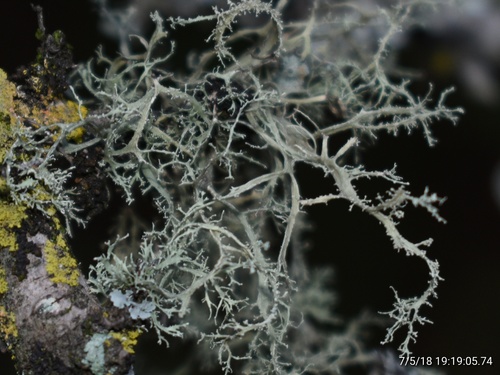
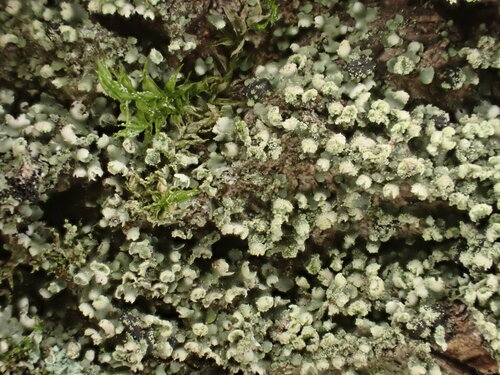
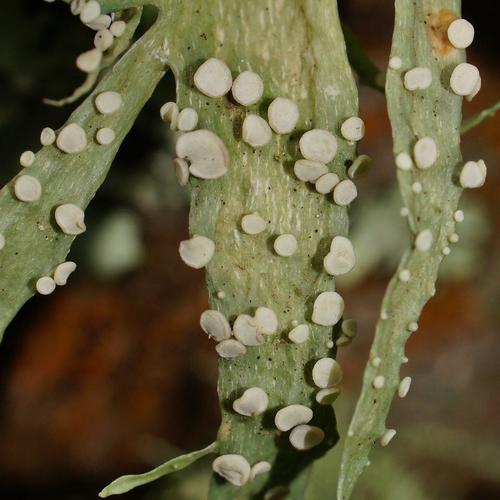
Ramalina farinacea (L.) Ach. typically grows 3–6 cm long, and some specimens can reach up to 10 cm. It forms tufted, hanging structures attached by a clearly defined holdfast. This lichen often divides into numerous flattened branches up to 3 mm wide, which may occasionally be slightly concave. Its colour ranges from yellow-green to dark grey-green; its surface is matt, smooth, and firm in texture. Internally, it has a solid medulla (inner tissue layer) and a cartilaginous subcortex, the supportive layer beneath the outer surface. A key distinctive feature is its numerous soralia, specialized asexual reproduction structures, located along branch margins. These soralia are discrete, circular to elliptical, saucer-shaped when young, and become flat as they mature. They produce fine, powdery soredia (reproductive propagules) 20–30 μm in diameter that are pale yellow-green. Sexual reproductive structures called apothecia are rarely observed; when present, they develop laterally on branches. The ascospores, spores produced in sacs called asci, are broadly ellipsoidal and measure 8–15 by 5–7 μm. Chemically, Ramalina farinacea has four distinct chemotypes (chemical variants), all of which contain usnic acid in the medulla and soralia. The chemotypes can be distinguished by their chemical reactions: some produce orange-brown or orange-red reactions in chemical tests, as they contain protocetraric acid; others produce yellow-red or yellow-orange reactions, containing salazinic acid, sometimes with norstictic acid; some fluoresce blue-white under ultraviolet light, containing hypoprotocetraric acid; and others show no distinctive chemical reactions. Ramalina farinacea grows in a diverse range of habitats and on a variety of substrates. It commonly grows on trunks and twigs in shaded deciduous woodlands, and also thrives on sun-exposed, wind-swept isolated trees, hedgerows, and scrub. It can colonize wooden posts, is occasionally found free-living on sand dunes, and very rarely occurs on rock surfaces. In North America, it is most abundant along coastal regions between approximately 30–60°N latitude, with several races extending inland. It has a strong preference for oceanic climates along both the Atlantic and Pacific coasts. In the United Kingdom, it is found throughout Britain, Ireland, and Wales. The morphology of Ramalina farinacea shows distinct variation in response to environmental conditions. In air-polluted environments, specimens often grow as dark green tufted forms with short, decumbent (lying flat), contorted or recurved branches. In deeply shaded woodland settings, by contrast, the lichen typically grows more elongated and paler, with sparse, narrow branching. These shade forms may superficially resemble Evernia prunastri, but can be distinguished by their tough, cartilaginous subcortex and their terete (cylindrical) structure with photobiont cells (the algal partner cells) distributed beneath all surfaces. Morphological features in this species are largely responses to the microenvironmental conditions of substrate and climate, rather than chemical composition. Research has found that specific substrates or habitats often have characteristic branch widths and morphologies, with coastal localities typically producing thinner-branched thalli than inland localities. Among Ramalina species, R. farinacea has exceptional tolerance to environmental pollutants. It is the least sensitive member of its genus to sulphur dioxide pollution, withstanding concentrations below 60 μg per cubic metre, and can also tolerate wind-blown inorganic fertilisers that are toxic to many other lichen species. This environmental resilience helps make it a common lichen throughout its range. Substrate preferences of the species vary by chemical race and geographic region. For example, in North America, the protocetraric acid race makes up 80–90% of populations on coastal and inland oaks, while other chemical races form major proportions of populations on alders in adjacent areas. A latitudinal gradient has been observed in the distribution of chemical races, with the hypoprotocetraric acid race becoming more frequent moving northward. While Ramalina farinacea is typically sterile, fertile specimens with apothecia occur in some populations at rates ranging from 0 to 14%. These fertile individuals are usually found on tree trunks rather than crown branches, and are typically large thalli in well-established populations located in favourable, localized mesic habitats.