About Ramalina celastri (Spreng.) A.Massal.
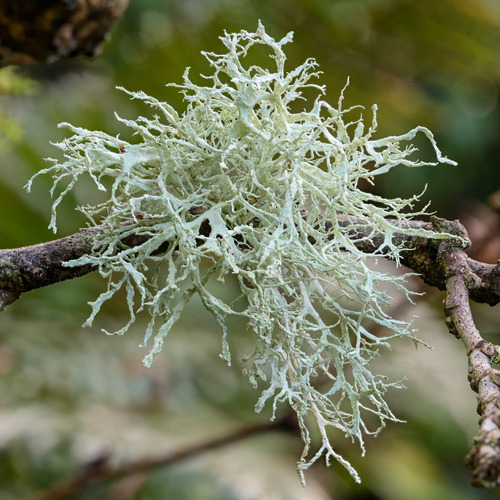
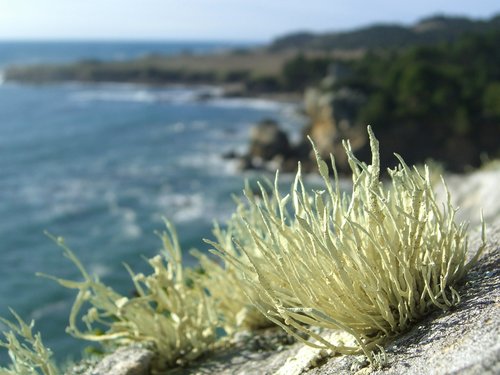
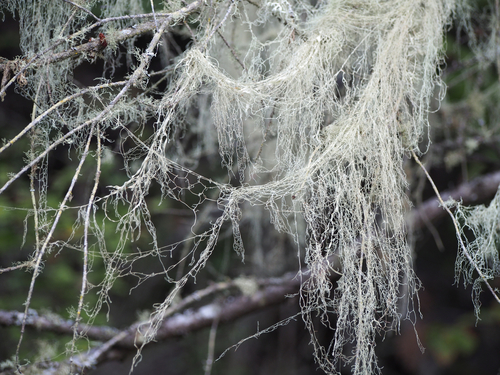
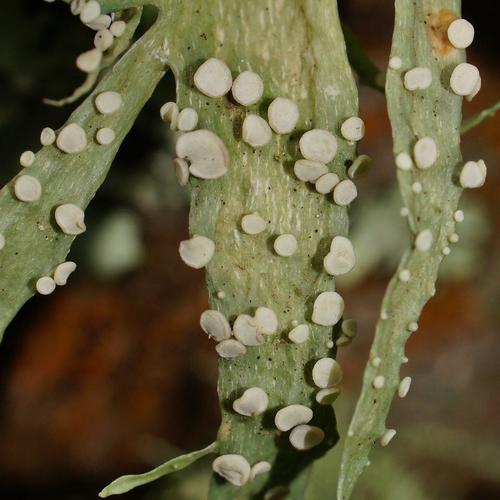
Ramalina celastri (Spreng.) A.Massal. is a lichen that typically forms a corticolous (bark-growing) thallus, the main body of the lichen. Its thallus has a rigid, erect to somewhat pendulous (hanging) structure that can grow up to 15 cm long. It emerges from an often broad base, and has sparse to moderate branching. Branch colour ranges from straw-coloured to pale green. The branches are solid, flattened, and lanceolate (lance-shaped), and may be either flat or slightly channelled (canaliculate). Branch width varies widely from 1 to 20 mm, and most commonly measures 3 to 5 mm. Young branches are thin and more or less smooth; as they age, they develop longitudinal or net-like (reticulately) ridged surfaces. These textures come from strands of cartilaginous tissue, and mature branches often have holes or cracks. Short linear or irregular laminal pseudocyphellae (small thallus pores that enable gas exchange) are commonly present, but soralia (asexual reproductive structures) are absent. This species produces numerous apothecia (fruiting bodies) for reproduction. Apothecia are mostly found along the lateral and surface areas of the thallus, and are supported by a stalk (stipe). The apothecia disc may be flat or convex, and is surrounded by a smooth thalline exciple, the rim of tissue around the disc. Its spores measure 4–7 by 11–16 μm. Thin-layer chromatography confirms that Ramalina celastri has no medullary substances. The only consistently present secondary lichen metabolite is usnic acid; atranorin is an inconsistent accessory substance that is sometimes present and sometimes absent. Ramalina celastri is widely distributed across the world's tropical areas. It grows on bark and wood, and is found on trees, shrubs, and wooden posts, and has also been recorded growing occasionally on rocks. It occurs typically in the warmer, more humid regions of Australia, specifically in New South Wales and Queensland, as well as in northern New Zealand. In New Zealand, rock-dwelling forms of Ramalina celastri on the North Island, which grow exclusively in coastal environments, have distinct morphological differences from tree-dwelling specimens: they have a more robust structure with wider and longer thalli, and cross-sections show their medulla is thicker. In East Africa, the lichen is common and widespread at elevations between 800 and 3,400 m (2,600 and 11,200 ft). It is less common in Brazil than in other tropical countries. It has also been recorded from India. In North America, its range extends north to southern Texas. In Argentina, Ramalina celastri has been used as a bioaccumulator of atmospheric deposition in passive biomonitoring studies. These studies linked high zinc content in the species' thallus to high levels of motor vehicle traffic, and industrial and agricultural activity.