About Rallus aquaticus Linnaeus, 1758
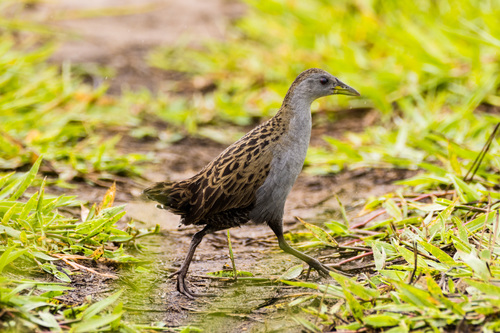
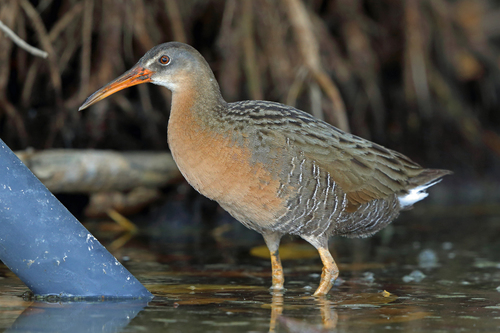
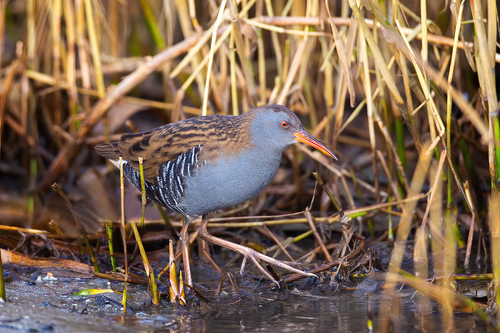
The water rail (Rallus aquaticus Linnaeus, 1758) adult of the nominate subspecies is a medium-sized rail, measuring 23–28 cm (9.1–11.0 in) in length with a 38–45 cm (15–18 in) wingspan. Males typically weigh 114–164 g (4.0–5.8 oz), while females are slightly lighter at 92–107 g (3.2–3.8 oz). Upper parts from the forehead to the tail are olive-brown with black streaks, most prominent on the shoulders. The sides of the head and underparts down to the upper belly are dark slate-blue, with the exception of a blackish area between the bill and eye, and brownish sides to the upper breast. Flanks are barred black and white, and the undertail is white with some darker streaks. The long bill and iris are red, and the legs are flesh-brown. The sexes have similar plumage; while females average slightly smaller with a more slender bill, determining sex through measurements alone is unreliable. Juveniles have a blackish crown, a white chin and throat, and buff or white underparts with darker bars. Their flank markings are brown and buff instead of black and white, the undertail is buff, and eye, bill and leg colours are duller than those of adults. Downy chicks are entirely black except for a mainly white bill. After breeding, water rails undergo an extensive moult, and are flightless for around three weeks. Individual adults can be identified by their unique undertail markings, with adult males having the strongest black undertail streaks. It has been suggested that the dark barring on this species' undertail is a compromise between the signalling function of the pure white undertail seen in open water or gregarious species like the common moorhen, and the need to avoid being overly conspicuous. The water rail can be easily distinguished from most other reed bed rails by its white undertail and red bill. The red bill is slightly longer than half the total length of the rail's head (making up 55–58% of the head's total length) and is slightly down-curved. The somewhat similar slaty-breasted rail of tropical Asia has a stouter bill, a chestnut crown, and white-spotted upperparts. Juvenile and freshly moulted water rails may have a buff undertail like the spotted crake, but spotted crakes have white-spotted plumage and a much shorter, mainly yellowish bill. The water rail's range does not overlap with that of any other Rallus species, but vagrant water rails can be distinguished from their American relatives by the absence of rufous or chestnut colouring on the closed wing. The larger African rail has unstreaked darker brown upperparts and brighter red legs and feet.
The water rail breeds across temperate Eurasia, discontinuously from Iceland and Ireland to North Africa, Saudi Arabia, and western China. Its distribution in Asia is poorly studied. The Icelandic subspecies R. a. hibernans became extinct around 1965, caused by habitat loss from wetland draining and predation by the introduced American mink. Before its extinction, at least some birds remained on Iceland year-round, relying on warm volcanic springs to survive the coldest months. This subspecies was also found in winter in the Faroe Islands and Ireland, and seen on passage through the Western Isles, indicating it was a partial migrant. The nominate subspecies R. a. aquaticus is resident in the milder south and west of its range, but migrates south from areas that experience harsh winters. It winters within its breeding range, and also further south in North Africa, the Middle East, and the Caspian Sea area. Peak migration occurs from September to October, with most birds returning to breeding grounds from March to mid-April. A nominate subspecies specimen labelled as collected from Baluchistan by Richard Meinertzhagen is considered to have doubtful provenance. R. a. korejewi is another partial migrant subspecies, with part of its population wintering from Iraq and eastern Saudi Arabia eastwards through Pakistan and northern India to western China. The water rail's breeding habitat is permanent wetland with still or slow-moving fresh or brackish water and dense, tall vegetation, which may include common reed, reedmace, irises, bur-reed, or sedges. In coastal areas, sea rush is common in saltmarsh breeding sites, while sedges and bur-reed are dominant in somewhat less saline environments. A study in the Netherlands and Spain found that sea rush provided better concealment than other maritime plants, and as in other habitat types, nests are built from the nearest available plants. Where it occurs, saw-sedge provides good breeding habitat, with its tall 1.5 m (4.9 ft) dense structure offering good cover for nesting rails. The preferred breeding habitat is Phragmites reedbed with plants standing in water 5–30 cm (2.0–11.8 in) deep, with muddy areas for feeding and a rich diversity of invertebrate species. Locations with nearby willows or shrubs are favoured over large areas of uniform habitat. In addition to natural fresh or marine marshes, water rails may use gravel or clay excavations and peat workings as long as there is suitable habitat with good cover. They can also be found in rice paddies, on floating islands, and in flooded sugarcane fields in Kashmir. A Finnish study found that the main factor influencing water rail distribution is the extent of vegetation cover, with the highest densities in the most vegetated areas; the presence of other nearby marshes is also significant. Factors that are important for other marsh birds, such as temperature, rainfall, shore line length, and extent of peat, were not statistically relevant for water rail distribution. Areas with the highest water rail densities also had the greatest numbers of three species considered at risk in Finland: the great reed warbler, Eurasian bittern, and marsh harrier. The northern breeding limit of the water rail appears to be determined by the transition from nutrient-rich wetland to poorer, more acidic water. This transition leads to common reed being replaced by a more open vegetation type dominated by marsh cinquefoil, which is unsuitable for water rails. Occasionally, water rails use more unusual breeding locations: one pair nested in the open beside a road in Scotland, and when an English nature reserve installed nest boxes for bearded tits (reed "wigwams" with a wooden floor), water rails nested both inside the boxes and under the wooden floor, sometimes with bearded tits in residence above. Although mainly a lowland species, water rails breed at 1,240 m (4,070 ft) in the Alps and 2,000 m (6,600 ft) in Armenia. An Italian study suggested that reed bed birds require a minimum area of wetland for breeding, which for the water rail is around 1 ha (2.5 acres), though the highest densities occur in marshes of 10 ha (25 acres) or more. During migration and in winter, water rails may use a wider range of wet habitats, including flooded thickets or bracken. Freezing conditions can force birds into more open locations such as ditches, rubbish dumps, and gardens, or even out onto exposed ice. A Welsh study found that individual winter territories overlap, with each bird using a significant proportion of the reed bed. After abandoning sites in freezing weather, birds return to their former range, and a density of 14 birds per hectare (6.6 per acre) was recorded. Birds wintering in Iceland rely on warm geothermal streams, and may access these streams through tunnels under snow. When not feeding, they shelter in holes and crevices in solidified lava. This species sometimes wanders well outside its normal range, and vagrants have been recorded in the Azores, Madeira, Mauritania, the Arctic, Greenland, Malaysia, and Vietnam.