About Raja undulata Lacepède, 1802
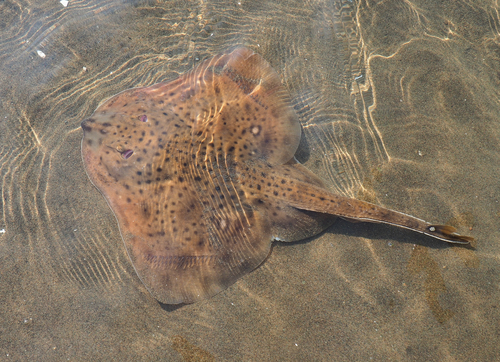
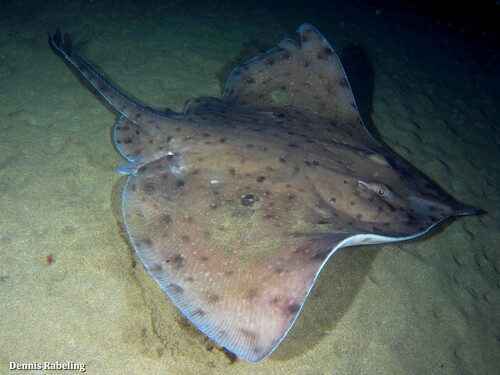
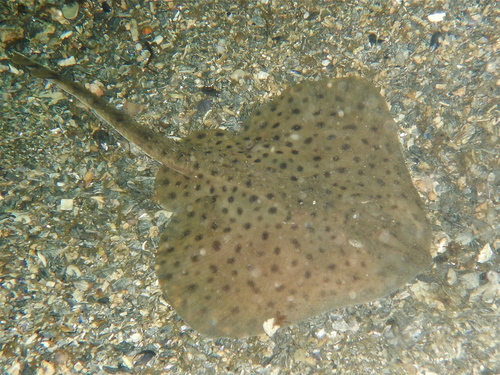
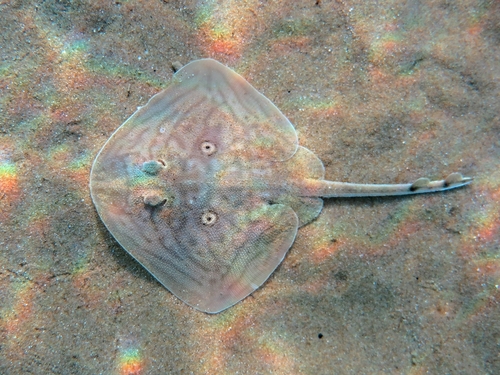
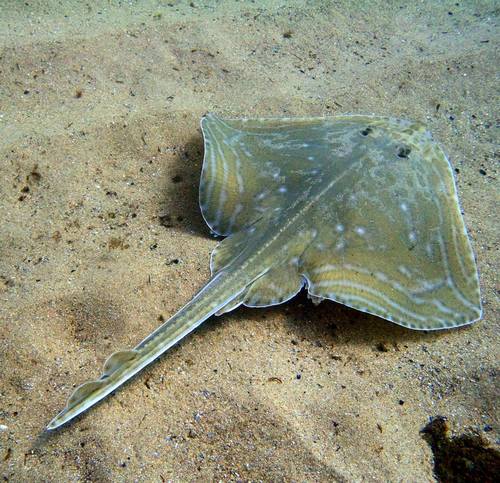
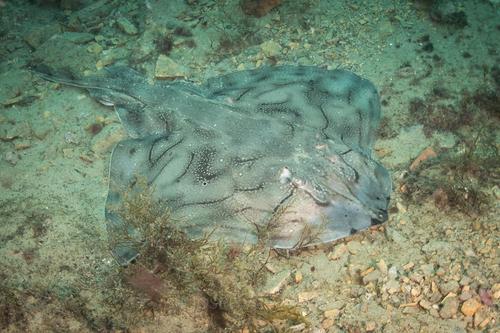
The undulate ray (Raja undulata Lacepède, 1802) has a disc-shaped body that is triangular at the front and nearly circular at the rear. It has dermal denticles modified into protective spines: in adults, median spines are scattered, while in young individuals they are arranged in a regular pattern. Males have one lateral row of spines on each side, while females have three. The undulate ray has medium-sized eyes, with spiracles located just behind the eyes. Its mouth sits on the ventral (lower) surface of the body, is slightly curved, and is followed by five pairs of small gill slits. Its tail is the same length as its body, and has two clearly separated dorsal fins near the tip of the tail; most often, there are two spines between these two fins. The dorsal (upper) surface of the body ranges in color from light brown to citrine or grey, marked with darker wavy bands and many small white patches. The snout and body margins are often a lighter shade, with dark spots. The ventral (underside) is creamy-white with a greyish margin. This species typically weighs around 10 lb (4.5 kg), but can reach a maximum weight of 22.13 lb (10.04 kg) and a maximum length of 100 cm (39 in). This species has a patchy, discontinuous distribution in the northeastern Atlantic Ocean, ranging from southern Ireland and southern England south to Senegal, and also occurs in the western Mediterranean Sea. It is uncommon across its full range, but can be locally abundant, most notably around northwestern Ireland, on the eastern side of the English Channel, and near the south coast of Portugal. It is also found sporadically throughout the northern Mediterranean Sea. It usually lives on sandy, muddy, or detrital bottoms at depths between 50 and 200 meters, ranging from coastal areas down to the upper continental slope, though it is occasionally found in shallower water. A study found that female undulate rays have a higher gonadosomatic index in winter, indicating that this species breeds during the winter season. Females also mature at significantly larger sizes and older ages than males.