About Raja radula Delaroche, 1809
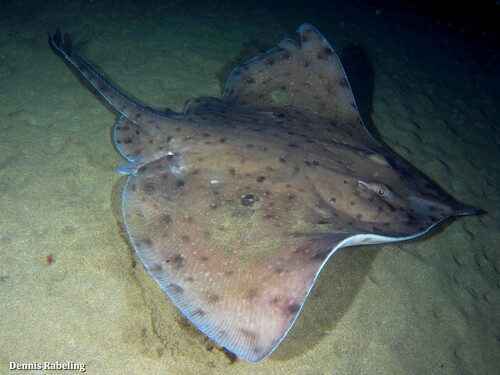
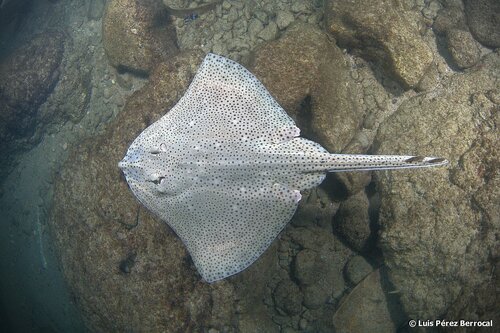
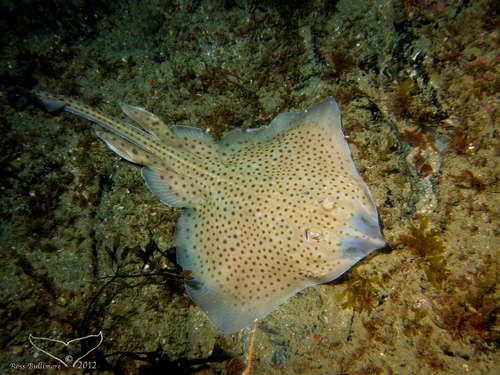
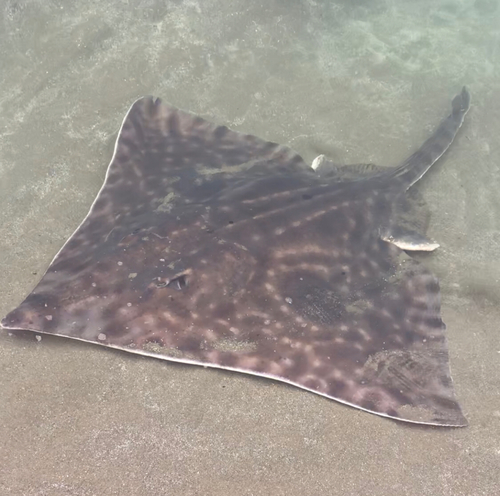
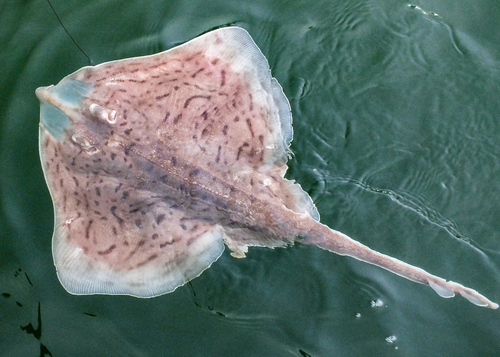
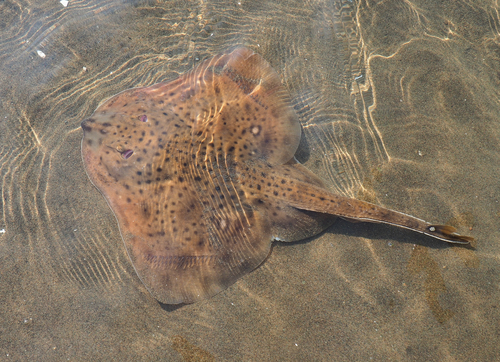
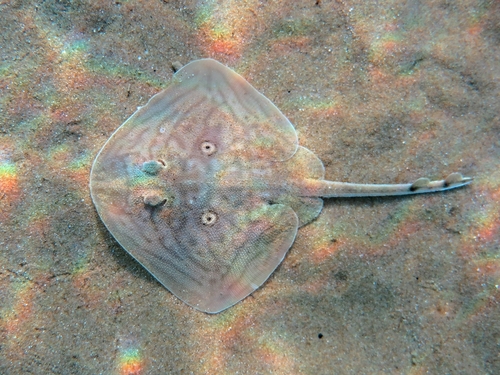
Raja radula, commonly called the rough ray, gets its common name from the spinules covering its upper surface. In juvenile and male rough rays, these rough spinules are only found on the snout and the lower half of the tail. Females have spinules in these same areas, plus additional spinules around the mouth, along the mid-section of the body, and across the full length of the tail. These spinules are distinct from the thorns that occur on the inner part of the eye and along the midline from the back of the head to just before the dorsal fin; there are also two thorns located between the dorsal fins. The rough ray has a subcircular body with a short, curved snout. Its anterior body edges are convex, and its wing-like pectoral fins have angular tips. Most individuals reach a total length of around 70 centimeters. The upper surface of the body is primarily light brown to grey, marked with darker spots and lines. Two eye-shaped spots (ocelli) sit on either side of the spinal midline, at the point where the body is at its widest; each ocellus has a yellow inner ring and a thick darker outer ring speckled with small light dots. The underside of the ray is white, with darker colouring along the edges and some additional dark spots on the tail. Raja radula is a bottom-dwelling (benthic) species native to the Mediterranean Sea. Existing records of this species from the Atlantic Ocean are almost certainly misidentifications of Leucoraja naevus and/or Raja africana, and require further clarification to confirm. The species lives in coastal areas, at depths between 2 and 300 metres, on sandy or muddy bottoms of the continental shelf. Like many other rays, Raja radula is oviparous, meaning it produces offspring by laying eggs. Its eggs are encased in a protective capsule that measures 5.1 to 5.7 centimetres long. Embryos hatch after approximately 4 months of development. The species reproduces year-round, with a reproductive peak occurring in late spring to early summer. Males and females reach sexual maturity at different sizes: females mature at a 34 centimetre disc width, while males mature at a 30 centimetre disc width. Half of all individuals reach maturity at 4.47 years for males and 5.89 years for females. Females can live up to 12 years, and reach a maximum total length of 80 centimetres. Males can live up to 9 years, and reach a maximum total length of 65 centimetres. As a result, the common average total length of 70 centimetres is estimated to be achieved at 9 years of age.