About Raja microocellata Montagu, 1818
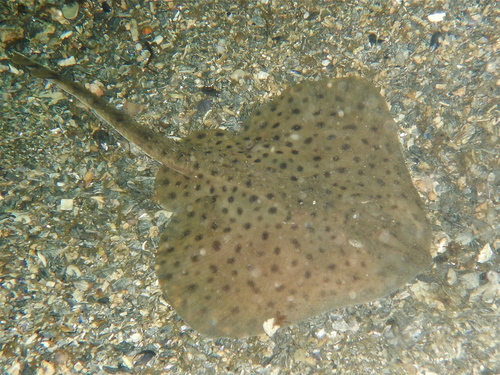
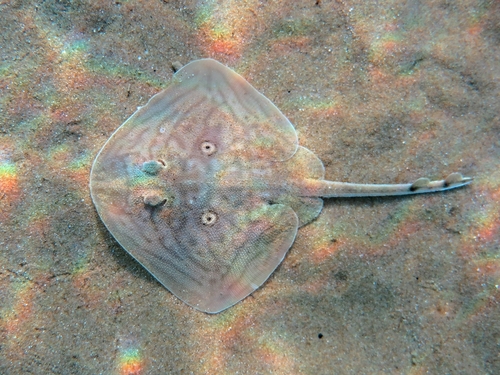
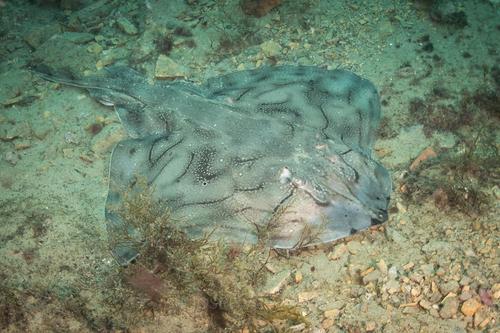
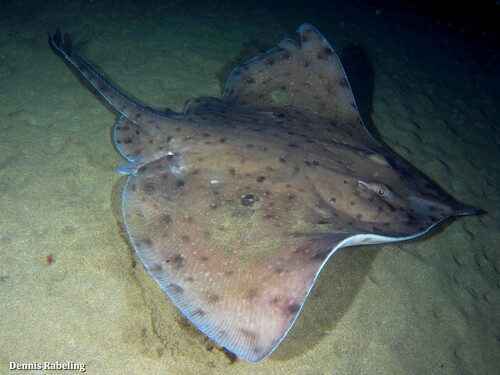
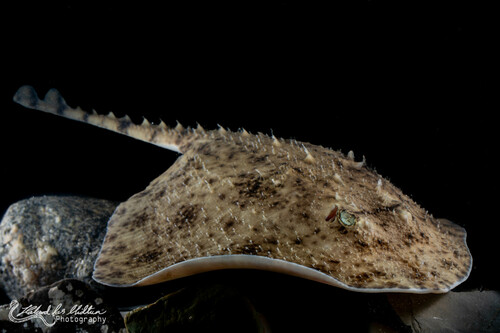
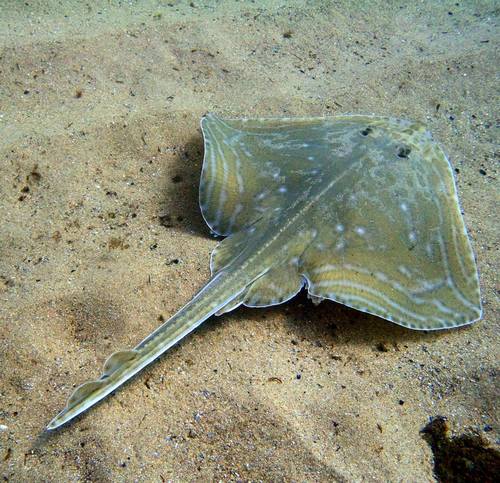
The smalleyed ray, Raja microocellata Montagu, 1818, is a smaller species of skate. It can grow to a total length of 87 centimetres (34 in) and reach a weight of 4.5 kilograms (9.9 lb). It has the typical dorsoventrally flattened body shared by other members of its family, and has distinctively small eyes and spiracles located on the top of its head. Its snout is pointed, and its tail extends from a rhomboid pectoral disc. The smalleyed ray ranges in colour from greyish olive to light brown, with lighter patches on its back. Pale streaks also run parallel to the margins of its pectoral fins, called wings. Its belly is white. Spines run along the tail and the midline of its body; these spines are set very close together and point inwards at right angles.
The smalleyed ray occurs in the eastern Atlantic Ocean, from the southwestern waters of Great Britain and Ireland south to Rio de Oro in Western Sahara. It is not found in the North Sea or the Mediterranean Sea. Within Britain and Ireland, it is most common in the Bristol Channel and off the coast of Ireland.
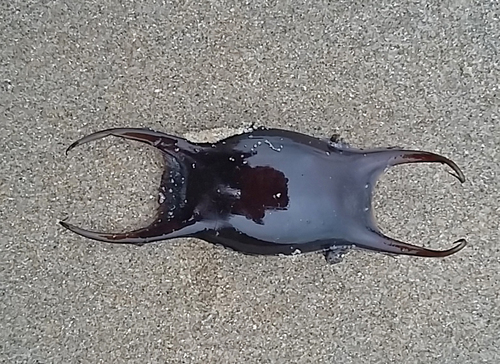
This is a shallow water species that is typically not found in water deeper than 100 metres (330 ft). It prefers to hunt over substrates made of sand, mud, and light shingle, and is known to enter estuaries. The main prey of the smalleyed ray is fish, and it also feeds on squid. It is an ambush predator that buries itself in the substrate, and launches itself at passing prey when it comes within reach. It has also been recorded preying on other small marine animals such as worms and crustaceans when opportunity allows, and will scavenge on dead fish. This species is oviparous. Males and females mate by pairing in an embrace. After mating, the female lays between 54 and 61 eggs. Each egg is a rectangular capsule 6.6 to 10.0 centimetres (2.6 to 3.9 in) long and 4.1 to 6.3 centimetres (1.6 to 2.5 in) across, with a stiff horn at each corner. The egg capsules are deposited in sand or muddy areas. After hatching, the young smalleyed rays will follow larger objects, including their mother.