About Raja clavata Linnaeus, 1758
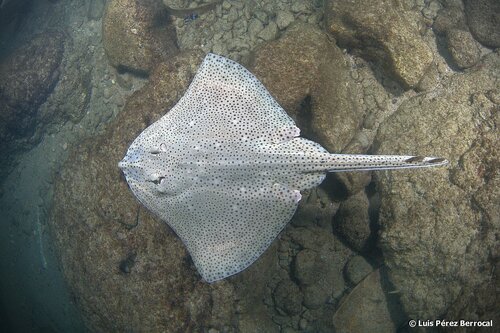
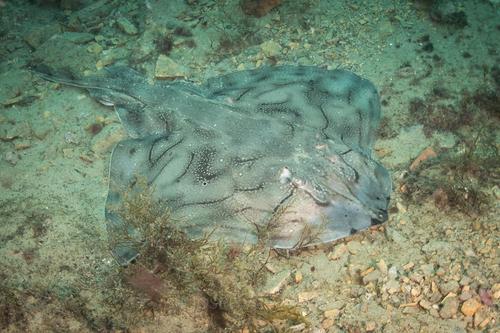
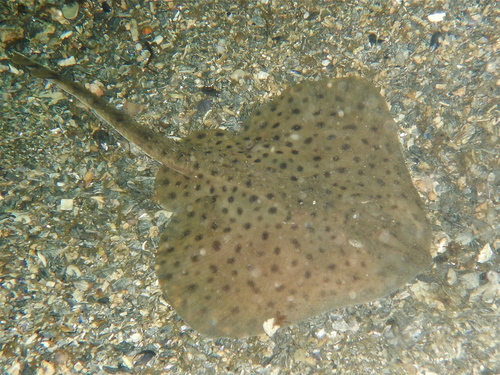
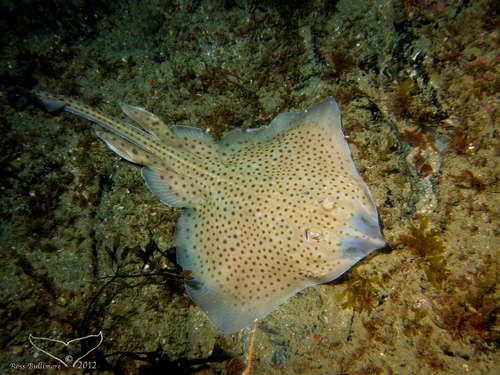
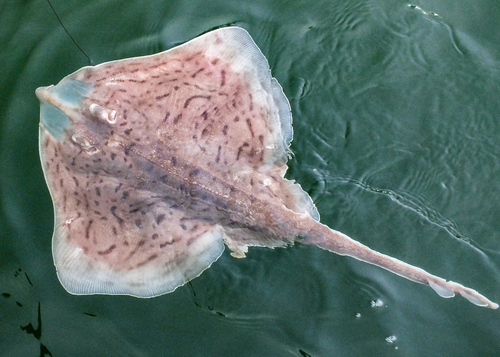
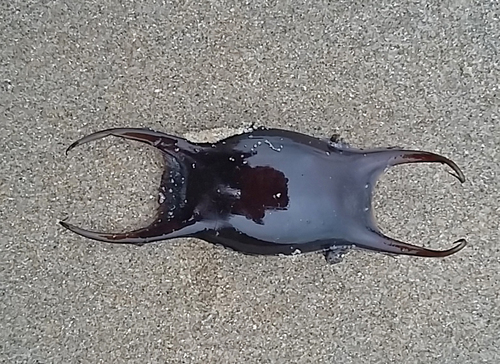
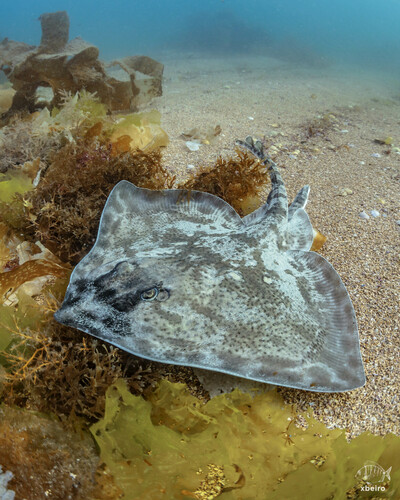
Description: Like all rays, the thornback ray (Raja clavata) has a flattened body with broad, wing-like pectoral fins. Its overall body shape is kite-shaped, and it has a long, thorny tail. The back is covered in many thorny spines; older females also have spines across their underside. Adults can reach a maximum length of 1 metre (3.3 ft), though most individuals are shorter than 85 centimetres (33 in). This ray typically weighs between 2 and 4 kg (4.5 to 8.75 lb). Its dorsal colour ranges from light brown to grey, marked with darker blotches, many small dark spots, and yellow patches. Sometimes the yellow patches are ringed with small dark spots. The underside is creamy-white with a greyish edge, and the ray can turn black when threatened. In sexually mature individuals, some spines develop thickened, button-like bases called bucklers; these structures are especially well-developed on the backs and tails of mature females. Distribution: The thornback ray is found in Atlantic coastal waters of Europe and western Africa. It also occurs from South Africa into the southwestern Indian Ocean, and lives in the Mediterranean and Black Seas. Its native range may extend as far south as Namibia and South Africa. Its natural habitats include large open seas and shallow coastal seas. It is occasionally found trapped in large estuarine pools at low tide, and it is likely one of the most common rays that divers encounter. Habitat: The thornback ray usually lives on sedimentary seabeds made of mud, sand, or gravel, at depths between 10 and 60 metres. Juveniles feed on small crustaceans, particularly amphipods and bottom-dwelling shrimps; adults feed on crabs, shrimps, and small fish. Life cycle: Thornback rays are an oviparous (egg-laying) and polyandrous species. Females lay eggs in pairs, and deposit them on shallow sand, mud, pebble, or gravel bottoms. A single female can lay up to 170 egg cases in one year, with an average fecundity of 48 to 74 eggs. In northwestern Europe, egg cases are laid during spring; in the Mediterranean, laying occurs in winter and spring. Each egg case is an oblong capsule with stiff pointed horns at its corners, and holds a single embryo. The capsules measure 5.0–9.0 cm long (excluding the horns) and 3.4–6.8 cm wide. Egg cases are anchored to the seabed with an adhesive film. Embryos rely entirely on yolk for nutrition. Eggs hatch after approximately 4 to 5 months, and newly hatched pups measure 11–13 cm in length. The mating season runs from February to September, with a peak in activity in June. During the mating season, adults form same-sex aggregations; females move into shallower inshore waters around one month before males arrive. Mating does not take place in the Baltic Sea. This species is a known host for the marine leech Pontobdella muricata. British Isles population: Research into growth and maturation of Raja clavata in the Solway Firth (located on the border between Cumbria, England and Dumfries and Galloway, Scotland) found that males mature at an average 42 cm disc width, while females mature at an average 45 cm disc width. The Solway Firth population is heavily fished by an unrestricted commercial fishery, and 48.6% of the retained catch consists of immature individuals. Research suggests that fishing pressure has caused a reduction in the size at which female thornback rays reach maturity.