About Raja brachyura Lafont, 1871
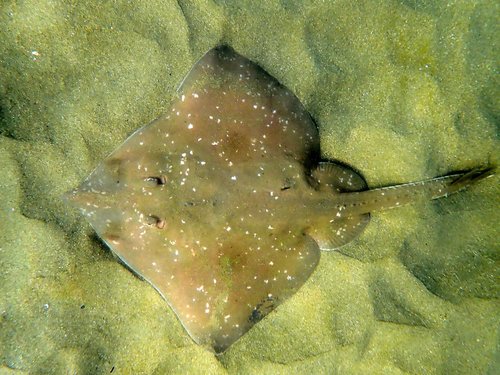
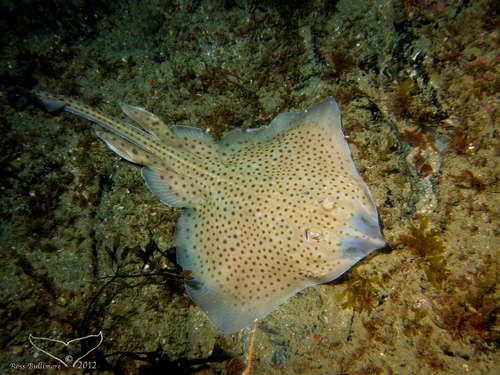
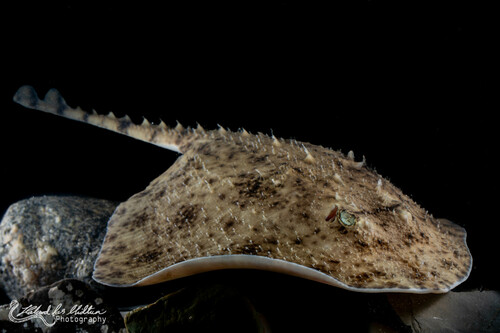
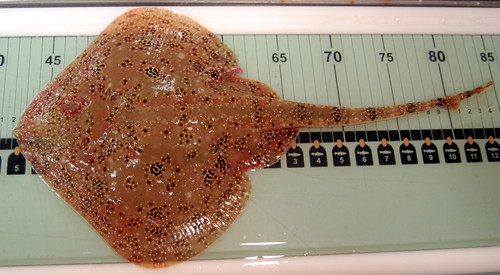
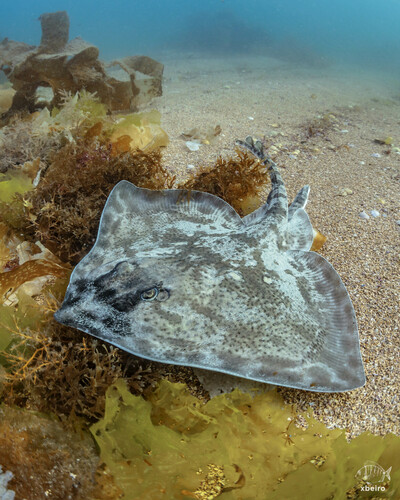
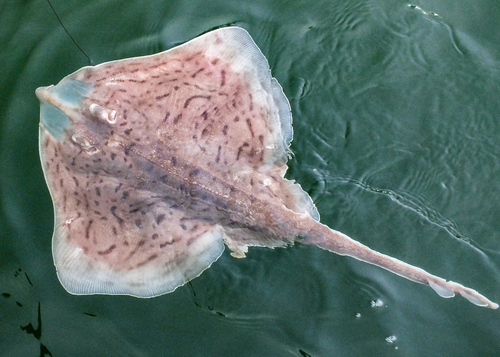
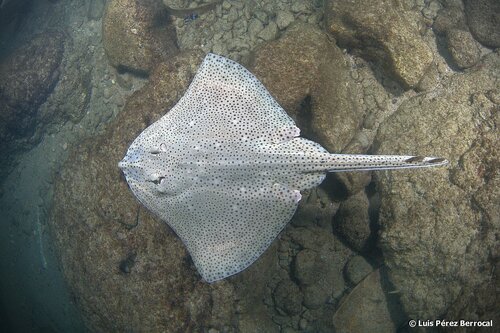
Like all rays, the blonde ray (scientific name Raja brachyura Lafont, 1871) has a flattened body with broad, wing-like pectoral fins. Its overall body shape is kite-shaped, with a short tail; this feature gives the species its specific name brachyura, which comes from Ancient Greek and means "short tail". Its base body color is brown, marked with a small number of creamy-white blotches and dense dark spots that continue all the way to the edges of the pectoral fins and along the tail. The maximum published total length for this species is 120 cm (47 in). The blonde ray occurs in the Eastern Atlantic Ocean, ranging from Scotland south to Morocco, where it lives at depths between 10 and 380 m (33–1,247 ft). It is also found occasionally in the Mediterranean Sea. It is a demersal species, meaning it lives close to the seabed, and prefers areas with sandy or muddy bottoms. Like many other elasmobranch species, the blonde ray uses shallow coastal waters as nursery areas, so most individuals found near shore are juveniles. The blonde ray is oviparous, and its embryos rely entirely on yolk for nutrition while developing. Individuals reach sexual maturity when they grow to 85–92 cm (33–36 in) in length, which corresponds to an age of 8 to 10 years. Females produce clutches of roughly 40 to 140 eggs, and they tend to their eggs after laying them. The average lifespan of a blonde ray is approximately 15 years.