About Rafflesia tuan-mudae Becc.
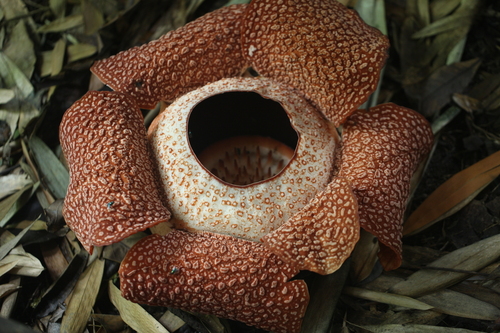
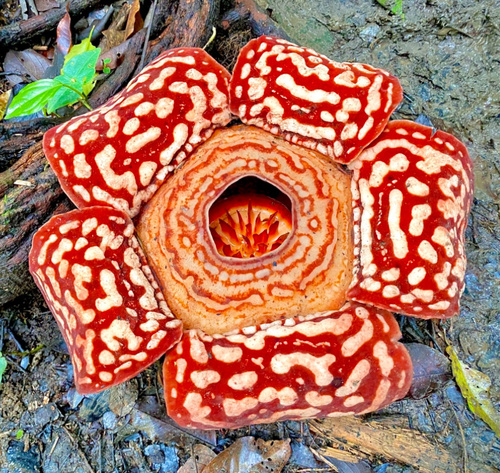
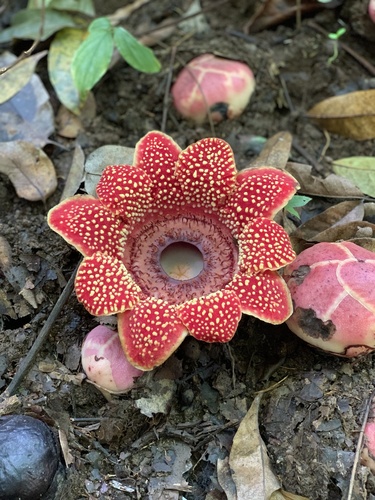
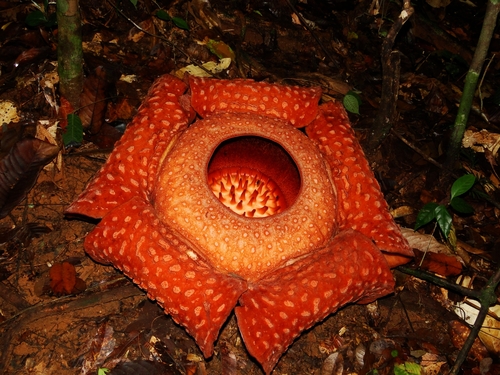
This species, Rafflesia tuan-mudae Becc., most commonly produces flowers around 60 cm in diameter, which develop from buds that are 20 cm in diameter. Occasionally, buds grow up to 30 cm in diameter, and these can produce flowers that reach nearly 1 meter across. In 2020, a R. tuan-mudae specimen discovered in Maninjau Forest Reserve, West Sumatra, measured 111 cm (3 feet 8 inches) in diameter. This measurement makes it the largest recorded flower ever documented; the previous largest recorded flower was also found at this same site, so it may have come from the same individual plant. In the early 1930s, observers studied an easily accessible population over several years in the Gunung Raja mountains, which straddle the Malaysia-Indonesia border in western Borneo southwest of Kuching. They found that these plants bloomed continuously year-round, at least during 1933, which was a notably good year for rafflesias across Indonesia. In the 1910s, scientists only knew of a small number of localities where this species occurred. Between the 1910s and 1935, many new populations were discovered, especially in West Kalimantan. This expanded the known range of the species and increased the number of sites people could visit, though some of these sites remain quite remote. In Sarawak, one of the easiest places to see R. tuan-mudae is Gunung Gading National Park. It can also be observed at Lanjak-Entimau Wildlife Sanctuary. Flowers of R. tuan-mudae emerge from liana-like host vines of the species Tetrastigma rafflesiae and Tetrastigma diepenhorstii. The seeds reach the host plant via an unknown animal vector, then penetrate the root tissue and grow inside the host tissue for an indefinite period before buds begin to develop. The bud develops for nine months before maturing into a large orange to red flower. The flower stays in full bloom for only seven days. Flies are the main pollinators of this species. All Rafflesia flowers produce a scent of rotting meat to attract pollinators, although the scent of R. tuan-mudae is comparatively mild. Even with the milder scent, the flowers are just as effective at attracting flies, which carry pollen on their backs. Male and female flowers can only be distinguished by feeling for anthers underneath the flower's central disk. Visitors are strongly encouraged not to touch or handle R. tuan-mudae, especially the buds, because they are fragile and may die if damaged.