About Radix auricularia (Linnaeus, 1758)
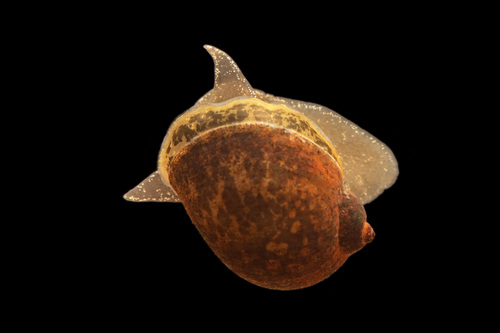
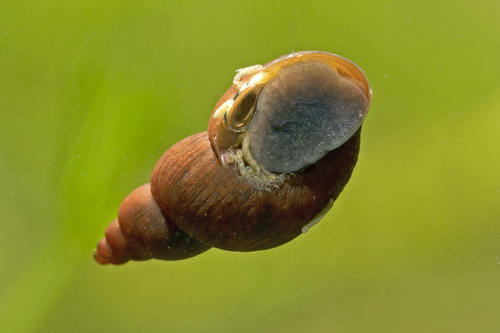
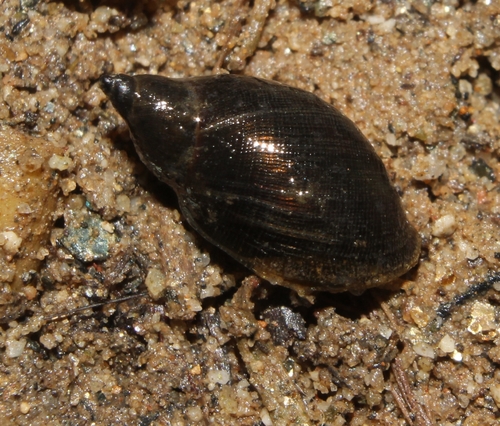
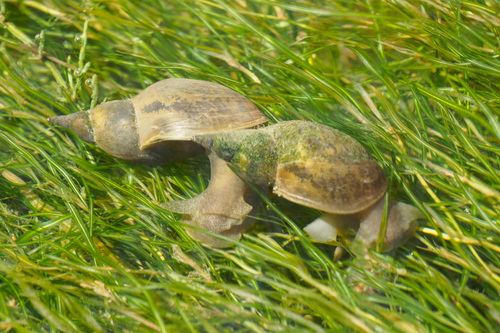
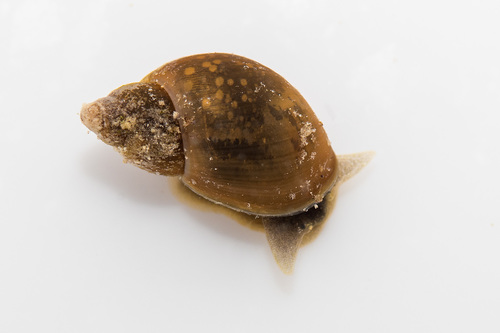
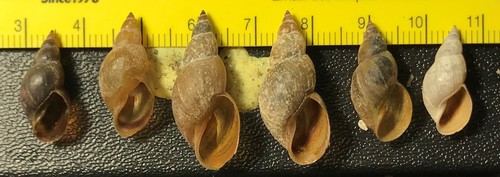
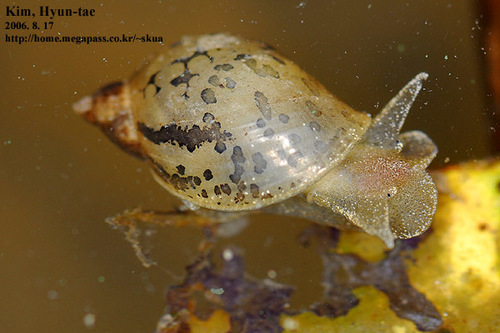
Radix auricularia (Linnaeus, 1758) is a species of freshwater snail described by its shell features as follows. The shell is thin, roundly ovate, and very inflated, with the last whorl accounting for 90% of its total volume. The spire is rounded, broad, short, and conic, pinching steeply at the apex, and is very small relative to the body whorl. There are 4 to 5 convex, inflated, smooth whorls that increase rapidly in size, separated by deep, deeply impressed sutures that are channeled in some specimens. The body whorl is large and spreading. The shell surface is shining, with fine, wavy, crowded growth lines, and occasionally has a heavy ridge that marks a past growth rest period. Shell color ranges from yellow to beige or tan; the epidermis sometimes displays alternating light and dark color lines. The species has a large ear-shaped aperture that contains no operculum, is roughly 5 times higher than the spire, and makes up four-fifths of the total shell length. The aperture is ovate, rounded at the upper end, and flares at the lower end in older specimens. The peristome is thin and sharp. The columella is sigmoid with a plait across its middle, which is reflected over the umbilicus. The umbilicus may be wide or covered, but it is most often narrow, deep, and nearly closed. Full-grown adult shells can reach approximately 30 mm in height and 25 mm in width, though most individuals in a population only grow to around half the maximum size. For most mature individuals, shell width ranges from 12 to 18 mm, and shell height ranges from 14 to 24 mm. The width-to-length ratio of the Radix auricularia shell is greater than 0.75. This species is native to Europe and most of the Palearctic, including Oman, Tibet, and Vietnam. In Europe it is found in Croatia, Finland, Germany, Sweden, Great Britain, Ireland, the Netherlands, Poland, the Czech Republic, Slovakia, and other regions. In Asia it occurs across the East Palearctic, including northern Vietnam and Oman. Radix auricularia is an introduced species in the United States, New Zealand, Botswana, and South Africa. In the United States Mid-Atlantic region, it occurs in Massachusetts' Charles River, New York's Cayuga Lake and Hudson River, various ponds across New Jersey, New York, and Pennsylvania, and Vermont's Lake Champlain. The first North American record of this species dates to before 1869 from the Hudson River near Troy, New York, a waterway connected to Lakes Erie and Ontario via the New York Canal System. The next record was from Lincoln Park, Chicago, beside Lake Michigan in 1901. It was later found in Lake Erie and a tributary stream in 1911 and 1948, in Lake Ontario in 1930, and has also been reported from Lake Huron. In 2019, the species was recorded in Botswana and South Africa. In Russia's Lake Baikal, an introduced population that was previously restricted to shallow bays and floodplain areas has recently colonized the lake's rocky drop-off, showing the species' ability to adapt to new environments in large lakes. Snails in this new habitat have more inflated apertures and more compact shells than individuals from shallow zones, suggesting wave action may have selected for snails with stronger suctioning feet in the newly colonized area. Radix auricularia inhabits freshwater lakes, ponds, and slow-moving rivers with mud bottoms. It can live on boulders or vegetation in both low and high-flow environments, and can tolerate anoxic conditions. It tends to prefer very still (lentic) waters such as lakes, bogs, or slow rivers with a silt substrate. It has been recorded in environments with a pH between 6.0 and 7.1. Its average preferred temperature is around 19 °C, with wide fluctuations around this average tied to seasonal photoperiod changes. In Great Britain, it is restricted to hard water. It can tolerate polysaprobic waters: heavily polluted, anoxic areas with high concentrations of organic matter, sulfides, and bacteria. Like almost all pulmonate snails, Radix auricularia is a hermaphrodite. It carries out oogenesis in spring as daylight hours increase, and spermatogenesis in late summer and early fall as daylight hours decrease. It is iteroparous and breeds biennially. It lays eggs in clumps of 50 to 150 eggs. Egg development speeds up as water temperature increases above 10 °C, but eggs cannot survive and develop when water temperature reaches 36 °C.