About Racomitrium lanuginosum (Hedw.) Brid.
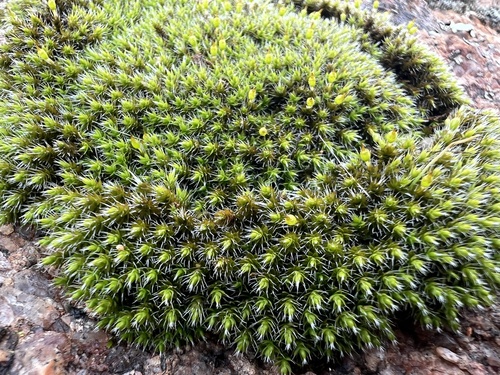
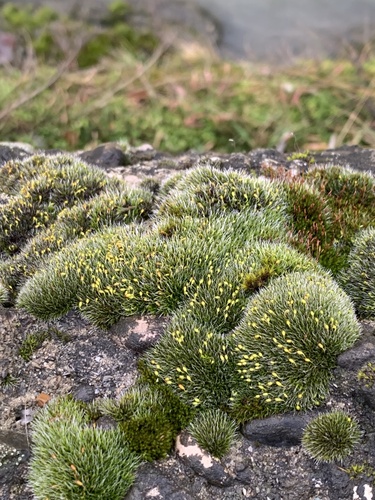
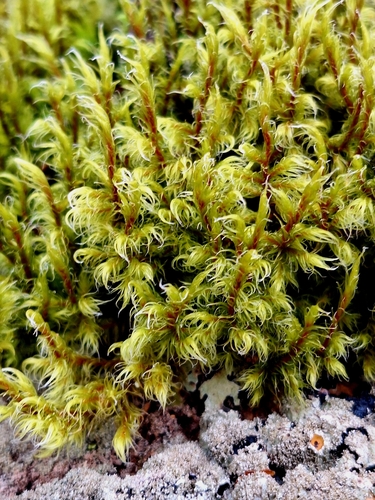
Racomitrium lanuginosum (Hedw.) Brid. grows in large cushiony mats. Its stems reach up to 12 centimetres (4.7 in) in length and are irregularly branched. Its leaves measure 3–5 millimetres (0.12–0.20 in) long and 0.6–0.9 mm (0.02–0.04 in) wide, are lanceolate-shaped and pointed, and have a prominent midrib. Each leaf ends in a long, thin hair-point, with teeth along both sides of the hair-point that angle 40°–90° away from the leaf axis. The transparent hyaline margins of the hair-point run downward along the sides of the leaf. Especially when the plant is dry, these hair-points give it a downy appearance, a feature referenced in many of the species' common names. Sporophytes are rarely produced overall, though they are reported to be abundant in coastal areas. The capsules are 1.0–1.7 mm (0.04–0.07 in) long, smooth, and brown, and contain spores that measure 8–12 μm long. The shape of the leaf hair-points of R. lanuginosum is unique among mosses. In terms of distribution and ecology, Racomitrium lanuginosum grows from sea level up to the alpine zone, most often among boulder scree and on exposed rock surfaces. It can also grow in tundra or bogs, and is found more often on acidic rocks than calcareous rocks. It has a circumpolar distribution across the Northern Hemisphere, and also occurs as isolated disjunct populations in the mountains of the tropics and the Southern Hemisphere. Within North America, R. lanuginosum is widespread across northern Canada, and extends further south to Maine in the east, and to California and the Rocky Mountains in the west. It is also found in Costa Rica, as well as in mountainous regions of South America and South Africa. In the Atlantic Ocean, isolated populations occur on Iceland, the Azores, the Canary Islands, Madeira, Tristan da Cunha and South Georgia; it also grows on Réunion in the Indian Ocean, in New Zealand, Hawaii, and the sub-Antarctic islands Deception Island, Kerguelen, Îles Crozet, Heard Island and the Prince Edward Islands. In addition to its wide range across Arctic Asia, R. lanuginosum is found in some temperate and tropical mountains on Borneo, Java, Sumatra and New Guinea. In Australia, R. lanuginosum is restricted to Tasmania and the highest elevations of the Great Dividing Range on the border of New South Wales and Victoria.