About Rachycentron canadum (Linnaeus, 1766)
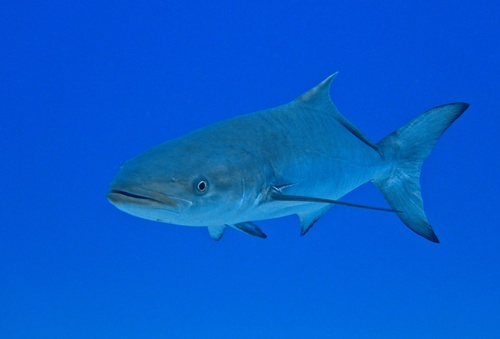
Cobia, scientifically known as Rachycentron canadum (Linnaeus, 1766), reaches a maximum length of 2 m (78 in) and maximum weight of 79 kg (174 lb). This fish has an elongated, spindle-shaped (fusiform) body and a broad, flattened head. Its eyes are small, and the lower jaw extends slightly past the upper jaw. Fibrous, villiform teeth line the jaws, tongue, and roof of the mouth. Cobia have smooth bodies covered in small scales, and are dark brown in color that fades to white on the belly, with two darker brown horizontal bands on the flanks. These stripes become more prominent during spawning, when they darken and the cobia’s background body color flashes. The large pectoral fins are usually held horizontally, which may help the fish take on a profile similar to a shark. The first dorsal fin holds six to nine independent, short, stout, sharp spines; the family name Rachycentridae, derived from the Greek words rhachis meaning "spine" and kentron meaning "sting", comes from these dorsal spines. Mature cobia have a forked, slightly lunated dark brown tail, and lack a swim bladder entirely. Juvenile cobia have a distinct pattern of obvious black and white bands, plus a rounded tail. The previous record largest cobia caught on rod and reel was captured from Shark Bay, Australia, and weighed 60 kg (135 lb). The current IGFA-certified record for cobia is 79.6 kg (175 lb), caught near Rottnest Island, Australia. Cobia resembles its close relatives, the remoras of the family Echeneidae, but it does not have the remora’s dorsal sucker and has a stouter body. In terms of distribution and habitat, cobia are usually solitary except for annual spawning aggregations, and will sometimes gather around reefs, wrecks, harbours, buoys, and other structured aquatic locations. They are pelagic, but may enter estuaries and mangroves to hunt for prey. They are found in warm-temperate to tropical waters of the West and East Atlantic Ocean, across the entire Caribbean, in the Indian Ocean off the coasts of India and Australia, and along the Pacific coast of Japan. Cobia have been reported in multiple locations of the eastern Mediterranean Sea since 1978, thought to have entered either via the Suez Canal or through escape from mariculture. Juvenile cobia that escaped from offshore aquaculture in Ecuador in August 2015 have become an introduced, established population in the eastern Pacific, and have since spread north to the Pacific coasts of Colombia and Panama. Cobia are eurythermal, tolerating a wide temperature range from 1.6 to 32.2 °C, and are also euryhaline, able to live in salinities from 5.0 to 44.5 ppt. Ecologically, cobia feed primarily on crabs, squid, and fish. Like their remora relatives, they follow larger animals including sharks, turtles, and manta rays to scavenge food. They are a very curious fish, and show little fear of boats. Predators of cobia are not well documented, but mahi-mahi (Coryphaena hippurus) is known to prey on juvenile cobia, and shortfin mako sharks (Isurus oxyrinchus) eat adult cobia. Cobia are frequently parasitized by nematodes, trematodes, cestodes, copepods, and acanthocephalans. For culinary use, cobia is sold commercially and fetches a relatively high price for its firm texture and excellent flavor. There is no dedicated wild fishery for cobia because the species is naturally solitary. Cobia is raised through aquaculture, and its flesh is most commonly sold fresh. It is typically served as grilled or poached fillets. Chefs Jamie Oliver and Mario Batali each prepared multiple cobia dishes during the "Battle Cobia" episode of the Food Network show Iron Chef America, which first aired in January 2008. Thomas Keller’s restaurant The French Laundry has also featured cobia on its tasting menu.

