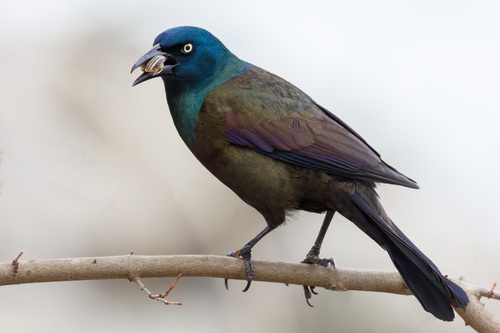
About Quiscalus quiscula (Linnaeus, 1758)
Adult common grackles (Quiscalus quiscula) are 28 to 34 cm (11 to 13 in) in total length, have a wingspan of 36–46 cm (14–18 in), and weigh between 74–142 g (2.6–5.0 oz). This species is less sexually dimorphic than larger grackle species, though differences between males and females are still noticeable. Males average 122 g (4.3 oz), which is larger than females that average 94 g (3.3 oz). All adult common grackles have a long, dark bill, pale yellowish eyes, and a long tail. Their feathers look black, with purple, green, or blue iridescence on the head, and a primarily bronze sheen on the body plumage. In addition to being smaller, adult females are usually less iridescent, have noticeably shorter tails, and do not form a keel (longitudinal ridge) with their tails during flight, unlike males. Females also have brown plumage that lacks the purple or blue gloss seen on males. Juvenile common grackles are brown with dark brown eyes. A group of common grackles is called a "plague".
The breeding habitat of common grackles is open and semiopen areas across North America east of the Rocky Mountains. Their nests are well-concealed cup structures built in dense trees (especially pines) or shrubs, usually located close to water. Sometimes common grackles nest in tree cavities or human-made structures, including bird houses. They often nest in colonies, some of which are quite large. A clutch of common grackle eggs contains between four and seven eggs. Common grackles are permanent residents across most of their range. Birds that breed in the northern part of the range migrate in flocks to the Southeastern United States for the non-breeding season. The distribution of the common grackle is largely explained by annual mean temperature, and the species has expanded its range by more than three times its size since the last glacial maximum around 22,000 years ago.