About Quiscalus nicaraguensis Salvin & Godman, 1891
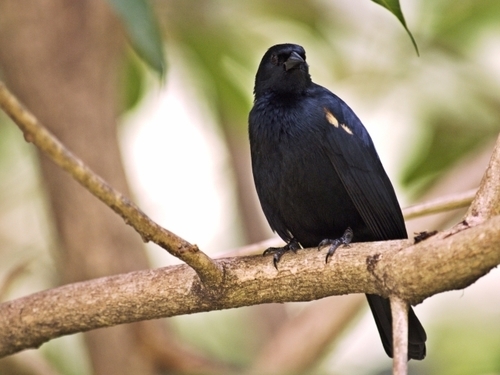
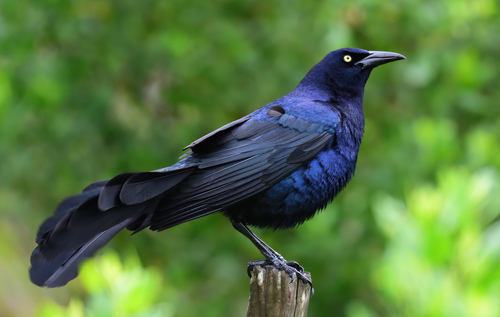
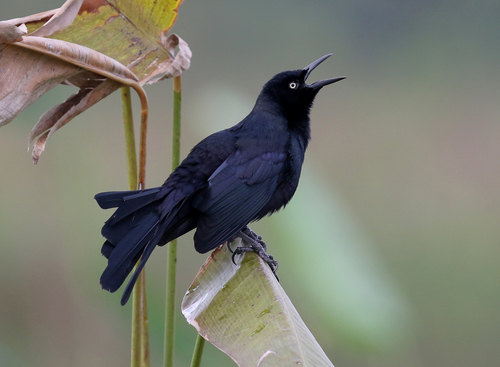
Quiscalus nicaraguensis, commonly called the Nicaraguan grackle, is a medium-sized bird. It has a long, graduated tail, and fairly long bill and legs. Its bill and legs are black, and its eye is pale yellow. Males reach approximately 31 cm in length, while females are around 25 cm long. Adult males have entirely black plumage with an iridescent gloss: the gloss is violet on the belly and tail, violet-green on the head, back, and breast, and blue-green on most of the wings. The male's tail is V-shaped, curving upward from the center to the outer feathers. Immature males are duller and less glossy than adult males, with brown bellies and thighs. Females are brown on their upperparts, and have a pale stripe over the eye called a supercilium, which is made more prominent by their dark lores and ear coverts. A female's thighs, flanks, and undertail coverts are dark brown; the rest of her underparts are buff, darkest on the upper breast and paler on the throat and belly. The Nicaraguan grackle shares part of its range with the similar great-tailed grackle (Quiscalus mexicanus), which is larger, has a longer tail and a larger bill. Male great-tailed grackles have less green gloss in their plumage than male Nicaraguan grackles, while female great-tailed grackles are darker on their underparts and have a less obvious supercilium. The Nicaraguan grackle produces a range of calls: it makes a frequent nasal call, multiple different whistling notes, and a sharp, rising whine. Its song consists of a series of whistles that increase in both speed and frequency. This species is restricted to western Nicaragua and northern Costa Rica. It occurs mainly around Lake Nicaragua and Lake Managua, but its range has expanded slightly due to human clearing of forests and creation of pastures. It may be a fairly recent arrival in Costa Rica, where it occurs in the Caño Negro area along the Río Frio. It is not migratory, but does make some local movements in response to seasonal changes and changes in water level. It only nests in marshland, but forages in scrubland, wet pastures, and along lake shores and riverbanks.