About Quiscalus mexicanus (Gmelin, 1788)
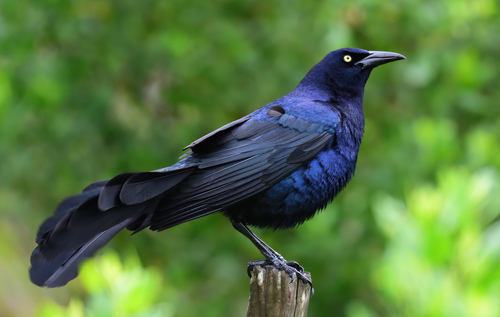
Great-tailed grackles (Quiscalus mexicanus) are medium-sized birds, larger than starlings and smaller than crows. They measure 38–46 cm (15–18 in) in length, with a wingspan ranging from 48–58 cm (19–23 in). Males weigh 203–265 g (7.2–9.3 oz), while females weigh 115–142 g (4.1–5.0 oz), and both sexes have long tails. Males are iridescent black with a purple-blue sheen on the head and upper body feathers, while females are brown with darker wings and tail. Adult great-tailed grackles of both sexes have bright yellow eyes. Juveniles of both sexes have brown eyes and brown plumage similar to females, except for streaks on the breast. Great-tailed grackles, especially adult males, have a keel-shaped tail that can be folded vertically by aligning the two halves of the tail. The great-tailed grackle and boat-tailed grackle were considered the same species until genetic analysis identified them as two separate species.
Great-tailed grackles originated in the tropical lowlands of Central and South America. Historical records from Bernardino de Sahagún show that during the reign of Aztec emperor Ahuitzotl, the Aztecs introduced great-tailed grackles from their native range on the Mexican Gulf Coast to the Aztec capital of Tenochtitlan in the highland Valley of Mexico, most likely to use the birds' iridescent feathers for decoration. Between 1880 and 2000, great-tailed grackles expanded their breeding range by over 5,500% as they moved north into North America, following urban and agricultural corridors. Their current range extends from northwestern Venezuela, western Colombia, and western Ecuador in the south to Minnesota in the north, to Oregon, Idaho, and California in the west, and to Florida in the east. Vagrants have been recorded as far north as southern Canada. Great-tailed grackles forage on the ground in open clear areas including pastures, wetlands, mangroves, and chaparral, and their range has expanded alongside the spread of agricultural and urban areas.
Great-tailed grackles are known for having diverse foraging habits. They extract larvae and insects from grassy areas, eat lizards, bird nestlings, and bird eggs, forage in freshly plowed land, remove parasites from cattle, and eat fruits (such as bananas and berries) and grains (such as maize; they even open corn husks to eat the cob). They turn over objects to search for food underneath, including crustaceans, insects, and worms. They hunt tadpoles and fish by wading into shallow water. Although they cannot swim, they also catch fish by flying close to the water's surface and diving a few inches into the water to retrieve fish. They are also known to pick dead insects off the license plates of parked cars, and kill barn swallows while in flight.