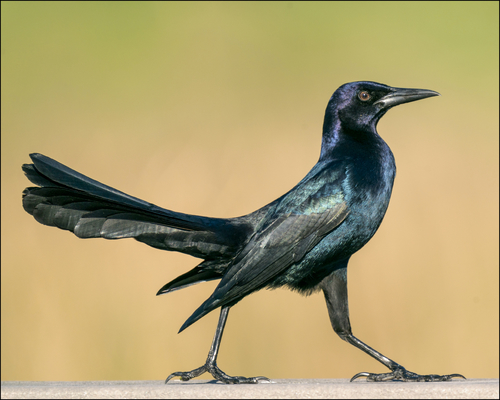
About Quiscalus major Vieillot, 1819
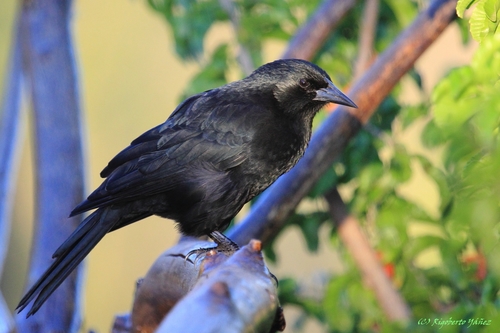
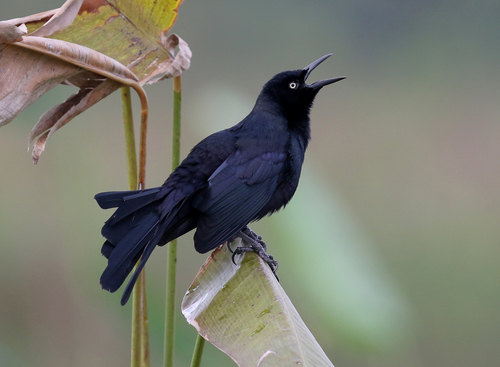
Boat-tailed grackle (Quiscalus major Vieillot, 1819) shows clear size and plumage differences between adult males and females. Adult males measure 37–43 cm (15–17 in) in length and weigh 165–250 g (5.8–8.8 oz), with entirely iridescent black plumage, a long dark bill, a pale yellowish or brown iris, and a long keel-shaped tail. Adult females are much smaller, at 26–33 cm (10–13 in) long and 90–115 g (3.2–4.1 oz) in weight, with a shorter tail; their body is tawny-brown, apart from darker wings and tail. For all adult boat-tailed grackles, wingspan ranges from 39–50 cm (15–20 in). Standard measurements for the species are 13–20 cm (5.1–7.9 in) along the wing bone, 11–20 cm (4.3–7.9 in) in tail length, 2–4.2 cm (0.79–1.65 in) along the culmen, and 3.6–5.8 cm (1.4–2.3 in) along the tarsus. On average, the boat-tailed grackle weighs about 10% more than the closely related great-tailed grackle, though male great-tailed grackles have even longer tails. Young male boat-tailed grackles are black but do not have the iridescent plumage of mature adults. Immature females are duller in color than adult females, and have blotches or spots on the breast. Eye color in this species varies by geographic range: Gulf Coast and inland populations have dark eyes, while Atlantic coast populations have pale eyes. The boat-tailed grackle inhabits coastal saltwater marshes and the entire Florida peninsula. In salt marsh areas, least bitterns often associate with boat-tailed grackles and form mixed breeding colonies with them. Significant populations of boat-tailed grackles have become established in multiple cities and towns along the United States Gulf Coast, where they use human activity for protection from predators and scavenge for food in human trash. Urban boat-tailed grackles forage in trash bins, parking lots, and outdoor restaurant patios.