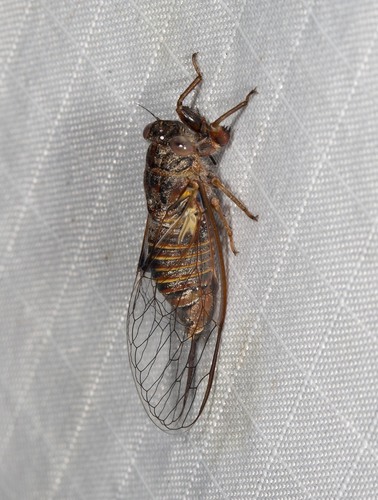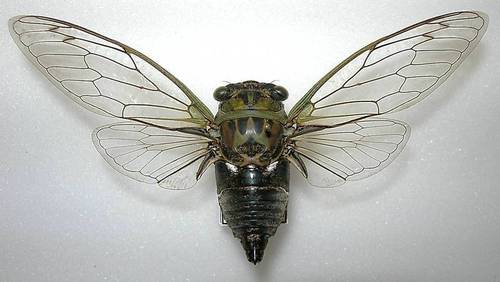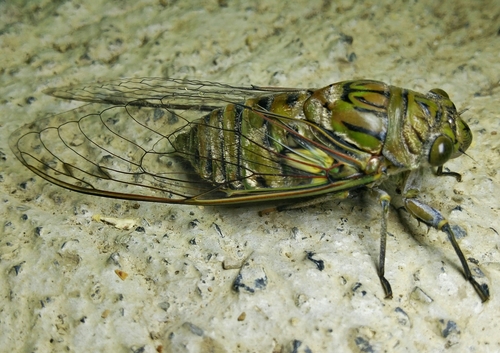
About Quesada gigas (Olivier, 1790)
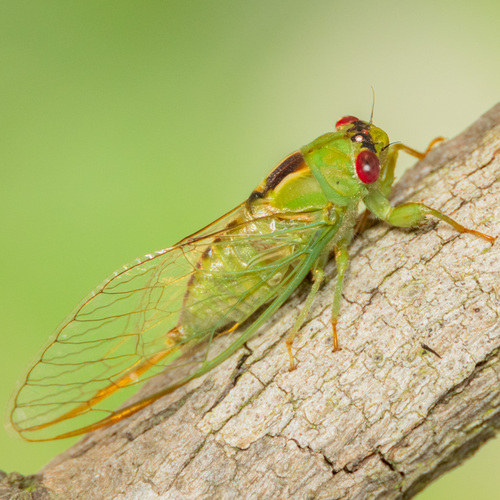
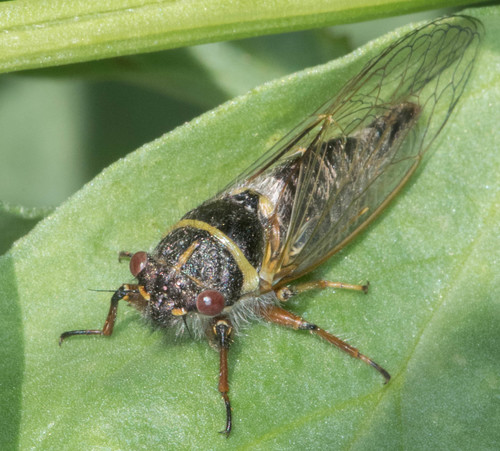
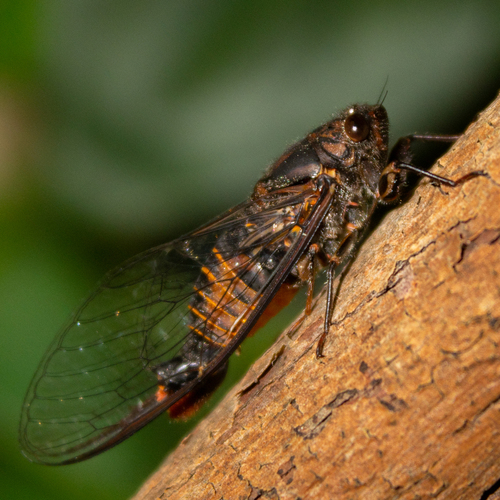
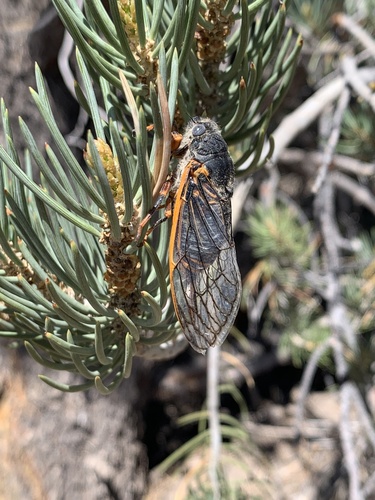
Quesada gigas, commonly known as the giant cicada, is the second-largest cicada species in North America, surpassed only by the empress cicada Megapomponia imperatoria. Like other cicada species native to Texas, the giant cicada has coloration that provides effective camouflage in its natural environment. These true bugs typically have a patterned mix of black, green, and brown; their eyes range from brown to olive, and their pronotal collar is brownish-green. Texas cicada species are more easily distinguished from one another by their calling sounds than by their appearance. It is the only species of the genus Quesada that occurs in North America. This species feeds on plants from a wide variety of plant families. As an endothermic species, it can survive in a broad range of different environments. In the United States, the giant cicada lives primarily in South Texas brushland. Its range in this region spans approximately from Laughlin Air Force Base near Del Rio, Texas in the west, through Uvalde, San Antonio, and Austin in the east, reaching almost to the western edge of Houston. There have been confirmed sightings of the species near the Texas cities of Bellville, Brenham, Chappell Hill, and Hempstead. Further south, its range covers most of the southern half of Texas before extending into Mexico. In Mexico, it is primarily found from Coahuila, along the Mexican Gulf coast states, and through to the Yucatán Peninsula. The species' range does not usually extend inland or far to the west until it reaches San Luis Potosí. In western Mexico, its range starts just north of Mazatlán, continues southward along the coast, and extends inland through Guadalajara and Mexico City, covering all regions further south from there. South of Mexico, the giant cicada is found across most of Belize, El Salvador, Guatemala, Honduras, Nicaragua, Costa Rica, Panama, Brazil, Colombia, Ecuador, Venezuela, the Guianas, Trinidad and Tobago, Bolivia, Peru, Paraguay, and Uruguay. In Argentina, its range extends as far south as Buenos Aires and Córdoba, and as far west as the Provinces of San Juan and San Luis. Immature giant cicadas spend at least four years developing underground before emerging as adults. During their underground stage, nymphs feed on tree roots, most commonly those of huisache or other members of the legume family. In south Texas, adult giant cicadas usually emerge between April and October; in central Texas, emergence typically occurs from June to July.