About Querula purpurata (Statius Muller, 1776)
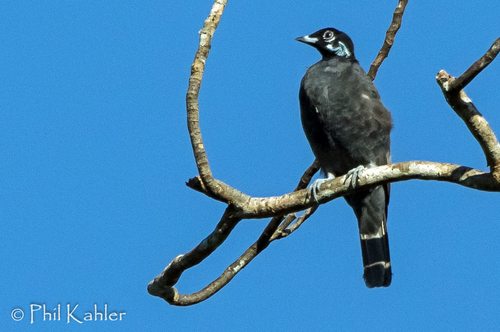
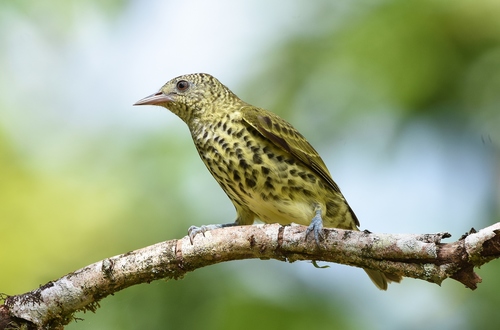
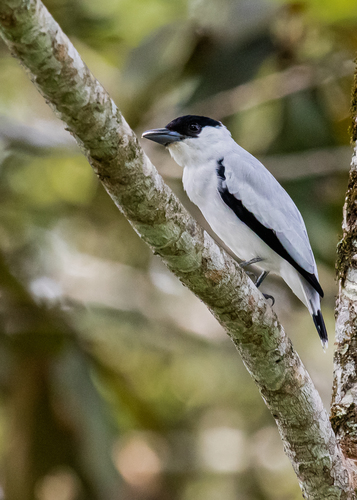
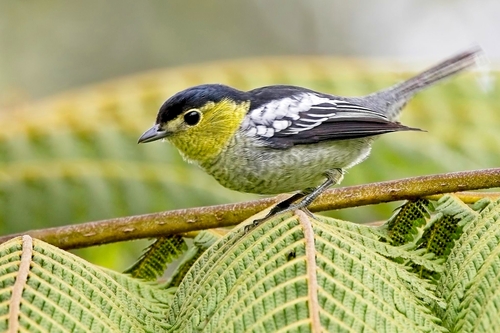
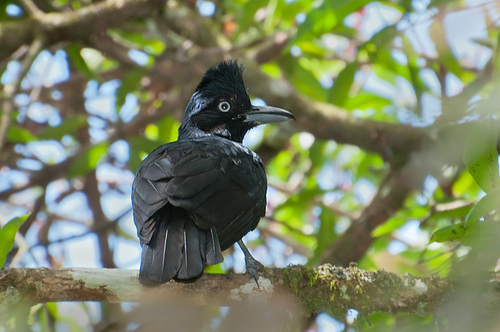
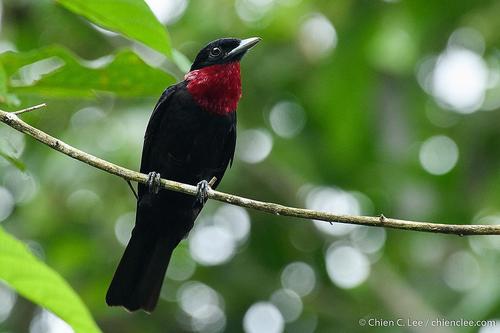
The purple-throated fruitcrow, scientifically named Querula purpurata (Statius Muller, 1776), measures 25 to 30 cm (9.8 to 12 in) in length and weighs 91 to 133 g (3.2 to 4.7 oz). Adult males have glossy black upperparts and duller black underparts. Their long, square-tipped dark reddish purple throat feathers form a distinct "shield" that extends to the sides and upper breast. Adult females are entirely dull black, and do not have this throat shield, though they may have a small number of crimson feathers on the throat. Both sexes have dark brown irises, a pale gray or silver gray bill with a black tip, and dusky gray to black legs and feet. Juveniles have dull black crowns, wings, and tails; the rest of their plumage is brownish black with faint, indistinct black barring. The purple-throated fruitcrow has a disjunct distribution, split into two main populations. One population occurs in Central America from southeastern Nicaragua south along the Caribbean coast of Costa Rica and Panama, and also along the Pacific coast of Panama from the Canal Zone southwards. Its range extends across north-central Colombia, through the Cauca and Magdalena river valleys, and continues south along the western Andes slope through Colombia into northwestern Ecuador, reaching as far as northern Los Ríos Province with scattered records further on. The second population ranges from southeastern Venezuela east through the Guianas and extreme northern Brazil to the Atlantic coast in Amapá state. This range extends south through eastern Brazil to western Maranhão and Tocantins, and from there west across southern Amazonian Brazil to the Andes in southeastern Colombia, eastern Ecuador, eastern Peru, and northern Bolivia. Some sources state that the species avoids a wide band of northern Amazonia, but van Perlo's field guide depicts the species occupying the entire Amazon Basin. The purple-throated fruitcrow lives in lowland evergreen forest in the tropical zone, where it prefers the forest midstory to canopy. Its elevation range varies by location: from sea level to 500 m (1,600 ft) in Costa Rica, up to 1,400 m (4,600 ft) in Colombia, mostly below 500 m (1,600 ft) on both sides of Ecuador, up to 1,000 m (3,300 ft) in Peru, up to 500 m (1,600 ft) in Venezuela, and from sea level to 750 m (2,500 ft) in Brazil.