About Quercusia quercus (Linnaeus, 1758)
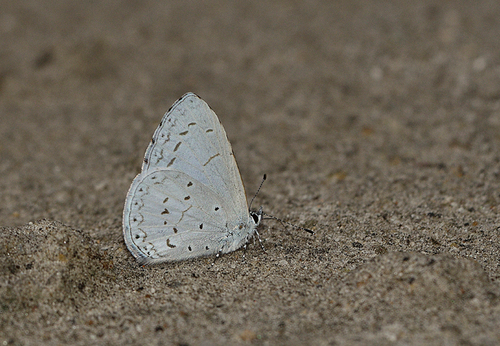
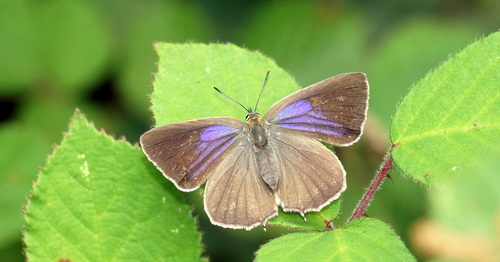
This species has the scientific name Quercusia quercus (Linnaeus, 1758). According to the description in Seitz: Z. quercus L. (74 c, d). Males have a blue gloss and a narrow black distal border on the upper side. For females, the basal area of the forewing is blue, and the cell of the hindwing is often bluish. The underside is leaden-grey, with a white line before the outer third that is dark-edged on the proximal side, and weak yellow spots in the anal area of the hindwing. The aberration ab. obsoleta Tutt consists of females that have no blue gloss at all. There are also transitional specimens with reduced blue, which are called semiobsoleta. The aberration ab. pallescens Tutt consists of males that have a pale grey-greenish gloss instead of blue. In ab. excessus Tutt, the hindmargin of the forewing carries a coppery streak. Courvoisier proposed the name ab. latefasciata for specimens that have a broader white line on the underside. ab. bellus Gerh. (74 d) are females with small orange spots at the apex of the forewing cell; these spots are reduced to two in ab. bipunctatus Tutt, and to one in ab. unipunctus Tutt. This species is widely distributed, found across all of Europe and Asia Minor, from England and the Atlantic coast to Armenia, and from Northern Europe to the Mediterranean. Beyond the Mediterranean Sea and on the Iberian Peninsula, the subspecies iberica Stgr. (74 d) occurs. iberica is larger than the nominate form, very dark on the upper side. In males of iberica, the blue area is very sharply defined but not very extensive. The underside is paler silvery grey, so the whitish line is less prominent. The egg is semiglobular, whitish grey, and granulose. The larva is already fully developed in summer, but does not leave the egg before April. It bores into young shoots, and later rests on young leaves, especially those on the lower twigs of old oak trees. This larva is an extreme cannibal, and is apparently avoided by insect-eating birds: it has been found unharmed in the nest of a blue tit containing young birds (Bingham-Newland). On the other hand, it is heavily parasitized by ichneumons and a species of Tachina, which develops after the caterpillar pupates (Steinfert). Fully grown larvae are yellowish brown with a reddish tint. There is a row of triangles on the back connected by a dark line, and the sides are greenish. It feeds on various oak species, and is also reported to occur on other plants such as Myrica. It becomes fully grown in July. The pupa is rounded, brown, with irregular blackish spots, and three rows of dark spots along the back. Adult butterflies fly from June to August across plains and hills, but usually occur singly, and are more abundant in certain years. They rest on the outer twigs of oak bushes with their wings always held closed, but sometimes flutter high up among the crowns of old oaks. For the British Isles: This active small butterfly is most often seen fluttering high up in oak trees on warm sunny days in July and early August. Males have a glossy purple sheen on the upperside; females only have two blue patches on the forewing. The underside is light grey with a white streak edged in black running down the middle of both wings. The hindwings have a short tail, with two orange spots at the base on the underside. It is common and widespread across southern and central England and Wales, becoming rarer and more restricted to isolated locations as far north as central Scotland. In Ireland, it occurs in a few scattered isolated colonies across the country, but is probably still under-recorded due to its reclusive habits. Males generally stay high up in trees; females come down to lower levels to lay eggs. Both sexes feed mainly on honeydew, though females are occasionally attracted to flowers when resting from egg laying. Regarding its life cycle and foodplants: Eggs are laid singly at the base of oak buds in late summer, and hatch the following spring as the buds break. Both of Britain's native oaks, sessile oak (Quercus petraea) and pedunculate oak (Quercus robur), are used. Some introduced oak species are also used, including Turkey oak (Quercus cerris) and evergreen oak (Quercus ilex). In winter, eggs can be easily found when examining bare branches closely. The caterpillar completes development inside the egg after two to three weeks, but does not hatch until spring, when it burrows into flower buds to feed while safely concealed. As it grows larger and the buds open, it spins a silken retreat and feeds only at night. Pupation usually happens in leaf litter, where pupae are tended by ants that bury them. Pupation may also sometimes occur in a crevice in the bark of the foodplant. There is one brood per year, with adult butterflies on the wing in July and August.