About Quercus virginiana Mill.
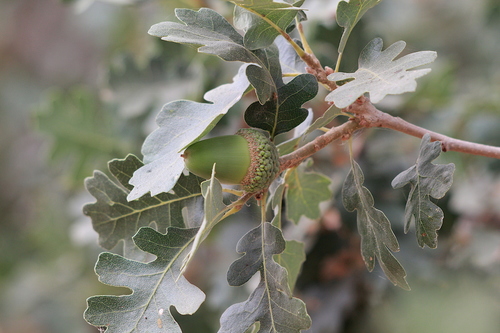
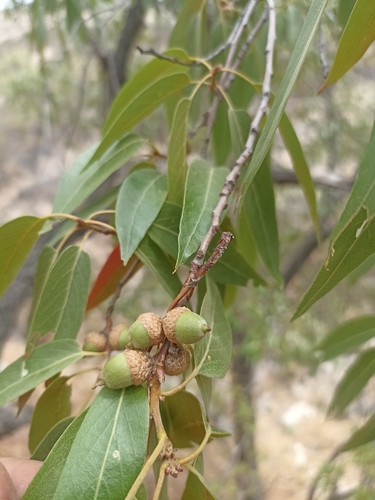
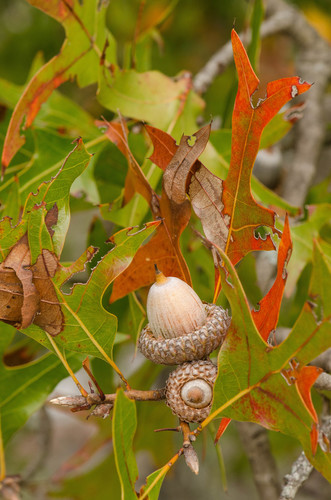
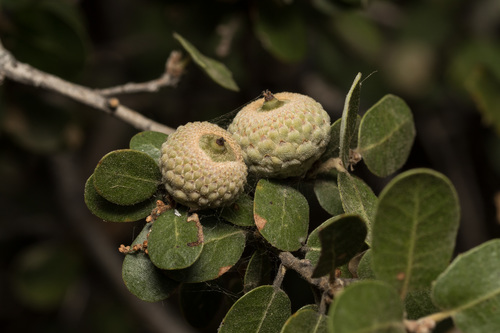
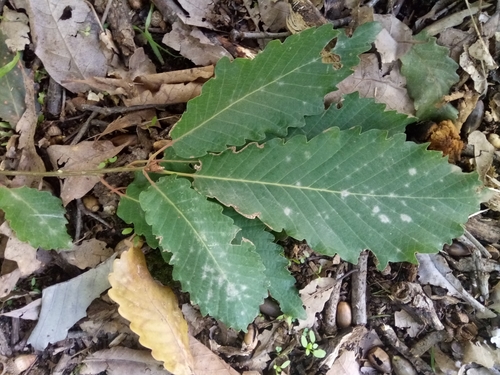
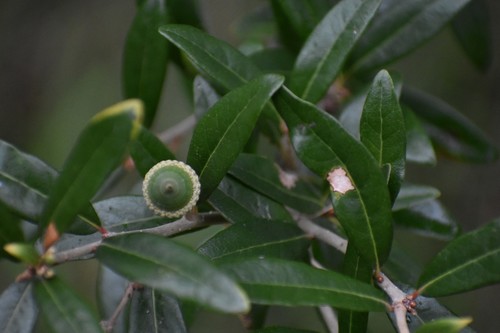
Quercus virginiana Mill., commonly known as southern live oak, retains leaves nearly year-round but is not a true evergreen. It drops its old leaves immediately before new leaves emerge in spring. Occasionally, aging leaves may turn yellow or develop brown spots during winter, which is often mistaken for oak wilt — a condition whose symptoms typically appear in summer. Defoliation can happen earlier in marginal climates, or during dry or cold winters. Its bark is dark, thick, and marked with longitudinal furrows. Leaves are stiff and leathery, with shiny dark green upper surfaces and pale gray, very densely fuzzy lower surfaces. Leaves are simple, generally flat with thick opaque margins, measure 2–15 centimetres (3⁄4–6 inches) long and 1–5 cm (3⁄8–2 in) wide, and grow alternately along branches. Male flowers are green hanging catkins 7.5–10 cm (3–4 in) long. Acorns are small, 1–2.5 cm (3⁄8–1 in), oblong (ovoid or oblong-ellipsoid) in shape, shiny, and range from tan-brown to nearly black, often with black tips. Acorns are borne singly or in clusters.
Depending on growing conditions, southern live oaks range in size from small shrubs to large, spreading trees. Typically, open-grown trees reach 20 m (66 ft) in height, with a limb spread of nearly 27 m (89 ft). Their lower limbs often curve downward toward the ground before bending upward again, and they can grow at severe angles. Historically, Native Americans bent young saplings to grow at extreme angles to use them as trail markers. Young southern live oaks have a deep taproot for anchoring, which eventually develops into an extensive, widespread root system. Combined with its low center of gravity and other traits, this makes the species extremely resistant to strong sustained winds like those in hurricanes.
In the wild, Quercus virginiana grows and reproduces on the lower coastal plain of the Gulf of Mexico and lower East Coast of the United States. Its native range starts in southeast Virginia, extends south along the coast through North Carolina as a narrow band to the interior South Carolina coast, where it begins to expand farther inland. As the range moves south, it expands further inland: it grows across southern Georgia, covers all of Florida south to the northernmost Florida Keys, grows along the Florida panhandle to Mobile Bay, extends westward across the southernmost two tiers of counties in Mississippi, and covers the southern third of Louisiana, with the exception of some barrier islands and scattered parts of the most southern parishes. The range continues into Texas, narrowing to hug the coast until just past Port Lavaca, Texas. There is a common misconception that southern live oak reaches its northwestern limit in the granite massifs and canyons of southwestern Oklahoma; those populations actually belong to Quercus fusiformis (Escarpment Live Oak), a closely related, much more cold-hardy species that is a rare glacial relict also found around Norman, Oklahoma.
Along the Gulf of Mexico and south Atlantic coastal plain of the United States, southern live oak occurs in single-species and mixed forests, dots savannas, and forms occasional clumps in grasslands of the lower coastal plain. It grows in a wide range of soil textures, from heavy clay loams to sands mixed with organic materials or fine particles. It can dominate some maritime forests, especially where fires are infrequent and do not last long. It is found on higher topographic sites as well as hammocks in marshes and swamps. In general, southern live oak grows close to the coastline and is rarely found more than 90 m (300 ft) above sea level. It grows across a wide range of sites with varied moisture levels, from dry to moist, and survives well in both dry sites and wet areas, tolerating short-duration flooding when water is moving and drainage is good. Good soil drainage is a key requirement for sustained growth. Annual precipitation in its native range is typically 650–1,650 millimetres (25–65 in), with most precipitation falling in spring and summer. Soils where it grows are usually acidic, with a pH between 5.5 and 6.5. The northernmost known mature specimen grows in either Annapolis, Maryland or Bowie, Maryland, and multiple healthy young specimens grow in Baltimore’s Bolton Hill neighborhood, with saplings also found growing around nearby Towson.
Southern live oak grows vigorously when it has plentiful moisture on well-drained soil. It tends to survive fires, because fire often does not reach its crown; even if a tree is burned, its crown and roots usually survive and resprout vigorously. Live oak forests also limit fire spread from adjacent areas, because their dense cover discourages the growth of flammable understory vegetation. The species can withstand occasional floods and hurricanes, and is resistant to salt spray and moderate soil salinity. Though it grows best in well-drained sandy soils and loams, it also grows in clay. Its branches frequently support other plant species, including rounded clumps of ball moss (Tillandsia recurvata), thick drapings of Spanish moss (Tillandsia usneoides), resurrection fern (Pleopeltis polypodioides), and parasitic mistletoe.
Southern live oak is cultivated in warmer climates as a specimen or shade tree in the southern United States (USDA Hardiness Zone 8 and south), in the Mexican states of Nuevo León and Tamaulipas, and in warmer regions of the United States, Europe, and Australia. Cultivation is relatively simple: young seedlings grow quickly when given ample soil moisture, and planting depth has little effect on establishment success. After a few years, the tree only needs occasional supplemental water. Southern live oak is very long-lived, with many specimens over 400 years old in the deep southern United States. It is reliably hardy in USDA Hardiness Zone 8a, putting its northern inland limit for long-term cultivation around Atlanta, Memphis, and Washington, D.C.
The wood of southern live oak is hard, heavy, difficult to work with, and very strong. In the era of wooden ships, live oaks were the preferred source of ship framework timbers, as their natural trunk and branch angles provided inherent strength. The frame of the USS Constitution was built from southern live oak harvested from St. Simons Island, Georgia; the dense grain of the wood allowed the ship to withstand cannon fire, earning her the nickname "Old Ironsides". Even today, the U.S. Navy owns extensive live oak timber tracts. Today, the primary role of southern live oaks is providing food and shelter for wildlife. Acorns are an important food source for bobwhite quail, the threatened Florida scrub jay, wood duck, yellow-bellied sapsucker, wild turkey, black bear, various squirrel species, and white-tailed deer. The dense tree crown makes the species valuable for shade, and it provides nesting sites for many mammal species. Historically, Native Americans extracted cooking oil from the acorns, used all parts of the tree for medicinal purposes, used leaves to make rugs, and used bark to make dyes. The roots of seedlings sometimes form starchy, edible tubers; people in past centuries harvested and fried these tubers for human consumption similarly to potatoes. In 1937, southern live oak was designated the official state tree of the U.S. state of Georgia.