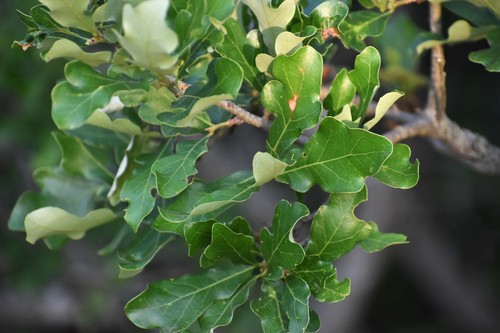
About Quercus sinuata Walter
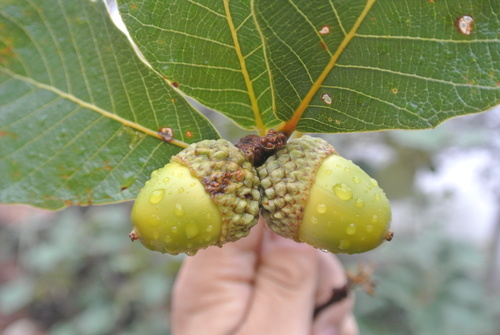
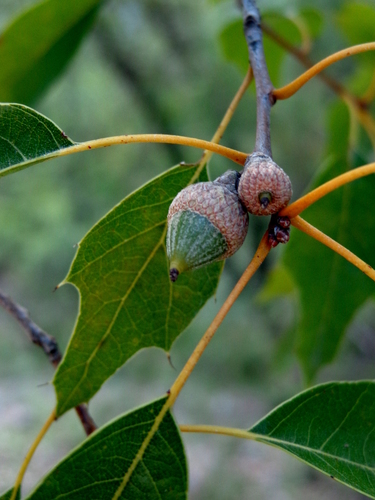
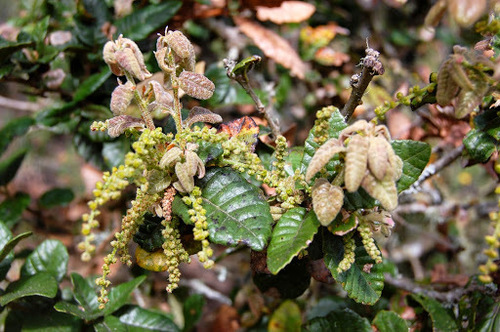
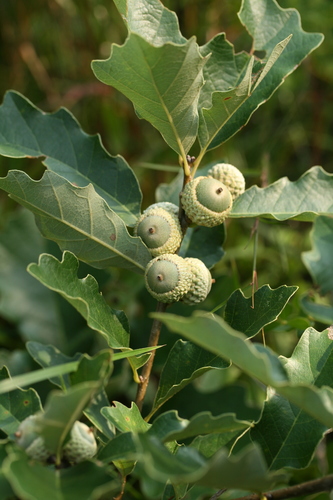
Quercus sinuata Walter is a deciduous tree that reaches up to 20 meters (67 feet) in height. Its leaves are narrow and marked with shallow rounded lobes. This species typically grows in wet habitats including river bluffs, river bottoms, and flatwoods, and it generally grows over basic substrates such as mafic rocks, shells, or calcareous sediment. The species is divided into two varieties, and morphologically intermediate forms sometimes occur in areas where the ranges of the two varieties overlap. These two varieties are Quercus sinuata var. breviloba (Torr.) C.H.Mull., found in Texas, Oklahoma, and Mexico, and Quercus sinuata var. sinuata, found in Alabama, Arkansas, Florida, Georgia, Louisiana, Mississippi, the Carolinas, and Texas. Quercus sinuata var. breviloba is native to central and north central Texas, south central and southwest Oklahoma, and the northern Mexican states of Coahuila, Nuevo León, and Tamaulipas. Quercus sinuata var. sinuata is native to the south-central and southeastern United States, ranging from central Texas and southwestern Arkansas to the Carolinas. The ranges of the two varieties overlap in the Hill Country of central Texas, where streams flowing through dry, brushy limestone hills create a mosaic of wet and well-drained habitats.