About Quercus rubra L.
Quercus rubra L., commonly called northern red oak, typically grows straight and tall to 28 meters (92 feet) in forests, reaching an exceptional maximum height of 43 m (141 ft), with a trunk diameter between 50–100 centimeters (20–39 inches). Trees grown in open areas do not reach this maximum height, but can develop stouter trunks up to 2 m (6+1⁄2 ft) in diameter. It has stout branches that grow at right angles to its stem, forming a narrow round-topped head. Under optimal conditions and full sun, northern red oak grows quickly; a 10-year-old tree can reach 5–6 m (16–20 ft) in height. Trees may live up to 400 years, and a living 326-year-old example was recorded in 2001.
Northern red oak can be easily recognized by its bark, which has ridges that appear to have shiny stripes running down their center. While a few other oaks have bark with this appearance on their upper sections, northern red oak is the only species with this striping all the way down the trunk. Like most other deciduous oaks, leafout occurs in spring once day length reaches 13 hours, and this timing is entirely tied to photoperiod, regardless of air temperature. As a result, in cooler regions, late spring frosts often kill northern red oak flowers, leading to no seed crop that year. Catkins and leaves emerge at the same time. Acorns develop over two growing seasons, are released from the tree in early October, and leaf drop begins when day length falls below 11 hours. The timing of leafout and leaf drop can vary by up to three weeks between the northern and southern United States. Seedlings emerge in spring when soil temperatures reach 21 °C (70 °F).
Bark is dark reddish gray brown, with broad, thin, rounded, scaly ridges; it is smooth and light gray on young trees and large stems, and becomes darker brown on old trees. It is rich in tannin. Young branchlets are slender, bright green and shiny, turning dark red, and finally dark brown with age. The wood is pale reddish brown with darker sapwood; it is heavy, hard, strong, and coarse-grained. While it cracks during drying, careful treatment makes it suitable for furniture use, and it is also used in construction and for interior house finishes. It has a specific gravity of 0.6621, and a cubic foot weighs 41.25 lbs. Winter buds are dark chestnut (reddish) brown, ovate and acute, and generally 6 mm (1⁄4 in) long.
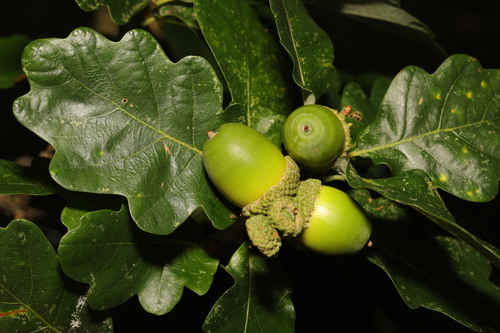
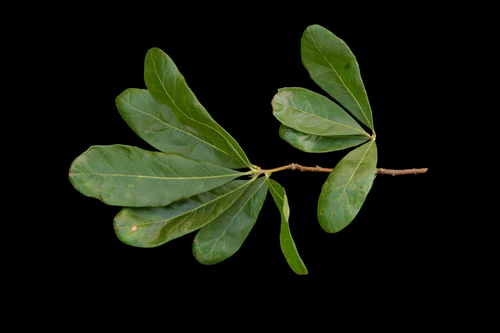
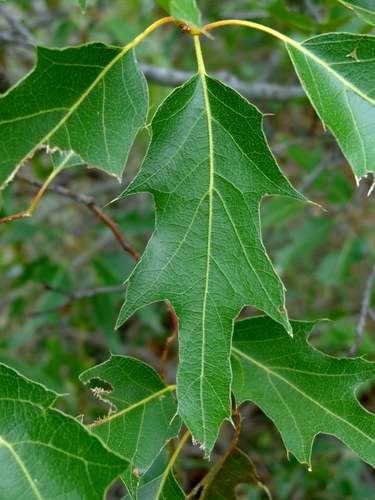
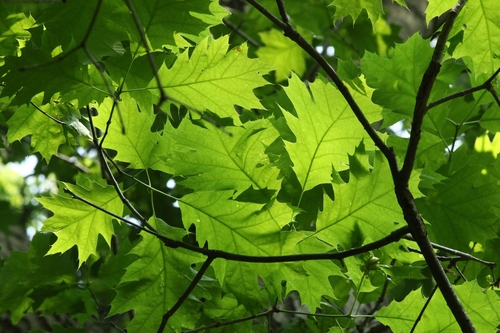
Leaves are alternate, and range from oblong-ovate to oblong, 5 to 10 inches long and 4 to 6 inches broad, with 7 to 11 lobes that taper gradually from broad bases, are acute, usually have repandly dentate edges, and end in long bristle-pointed teeth. The second pair of lobes from the apex is the largest, and the midrib and primary veins are conspicuous. Lobes are often less deeply cut than those of most other oaks in the red oak group. Newly emerged leaves are convolute and pink, covered with soft silky down on the upper surface and thick white tomentum on the lower surface. When fully grown, leaves are dark green and smooth, sometimes shiny on the upper surface, and yellow green on the lower surface, which is smooth or hairy in the vein axils. In autumn, leaves turn a rich red, sometimes brown. The petiole and midvein are often a rich red in midsummer and early autumn, though this is not true for all individuals.
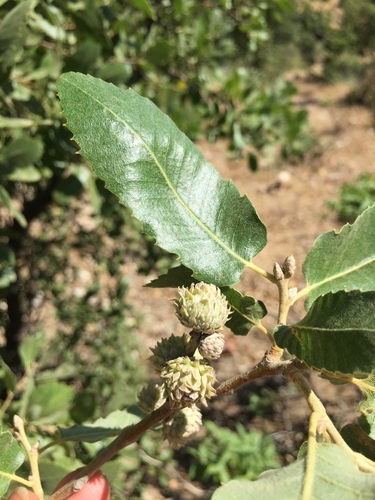
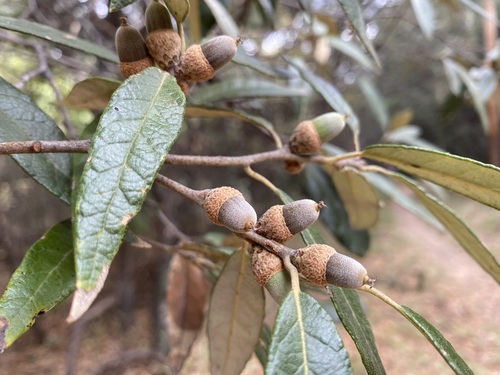
Acorns mature in approximately 18 months after pollination, grow singly or in pairs, and can be either sessile or stalked. The nut is oblong-ovoid with a broad flat base, full with an acute apex, and reaches one half to one and one-fourth of an inch long. Acorns are green when young, maturing to nut-brown. The cup is saucer-shaped and shallow, 2 cm (3⁄4 in) wide, usually only covers the base of the nut (and occasionally covers one fourth of the nut), and is thick, shallow, reddish brown, somewhat downy on the inner surface, and covered with thin imbricated reddish brown scales. The acorn kernel is white and very bitter. Unlike acorns of the white oak group, red oak acorns have epigeal dormancy and will not germinate without a minimum of three months of exposure to temperatures below 4 °C (40 °F), and require two full years of growth on the tree to fully develop.
This species grows from the northern end of the Great Lakes, east to Nova Scotia, south to Georgia, Mississippi, Alabama, and Louisiana, and west to Oklahoma, Kansas, Nebraska, and Minnesota. It grows rapidly and tolerates many soils and varied growing conditions, though it prefers glacial drift and well-drained stream borders. In the southeastern United States, it is frequently a component of the canopy in oak-heath forests, but it is generally not as dominant as some other oak species. It is the second most common oak species in the northeastern US, after the closely related pin oak (Quercus palustris). The red oak group as a whole is more abundant today than it was before European settlement of North America, because forest clearing and logging greatly reduced populations of the formerly dominant white oaks.
Northern red oak is monoecious, dichogamous, wind-pollinated, and self-incompatible. Pollination occurs in the first growing season, but fertilization and acorn maturation take place during the second growing season. Over the last few decades, northern red oak has faced several environmental stressors, mainly disease, insect predation, and limited dispersal opportunities. These stresses have impacted the species' ability to proliferate in both the Northeast and Europe. The varied environmental responses Quercus rubra shows across multiple temperate environmental conditions have made it a model organism for studying symbiotic relationships, dispersal, and habituation between tree species.
Northern red oak is one of the most important oaks for timber production in North America. High-quality red oak is highly valuable as lumber and veneer, while defective logs are used for firewood. Other related oaks in the red oak group, including eastern black oak, scarlet oak, pin oak, Shumard oak, and southern red oak, are also harvested and marketed as red oak, though their wood is not always of equal high quality. Construction uses include flooring, veneer, interior trim, and furniture. It is also used for general lumber, railroad ties, and fence posts. Red oak has such an open wood grain that smoke can be blown through it from end-grain to end-grain on a flat-sawn board. For this reason, it absorbs moisture easily and is unsuitable for outdoor uses such as boatbuilding or exterior trim. Acorns can be collected in autumn, shelled, tied in cloth, and leached to remove bitterness, then eaten whole or ground into meal.
Quercus rubra is grown as a specimen tree in parks and large gardens. It is not planted as often as the closely related pin oak because it develops a taproot and quickly becomes difficult to transplant, though modern growing pots have made starting taprooted seedlings easier than in the past.