About Quercus pubescens Willd.
Quercus pubescens Willd., also called downy oak, is a medium-sized deciduous tree that reaches up to 20 metres (66 feet) in height. Trees growing in closed forests develop tall trunks, while trees growing in open locations form a very broad, irregular crown. This species is long-lived, with individuals surviving for several hundred years. Mature trees become very stout, with trunks up to 2 m (6+1⁄2 ft) in diameter, and open-grown downy oaks often grow multiple trunks.
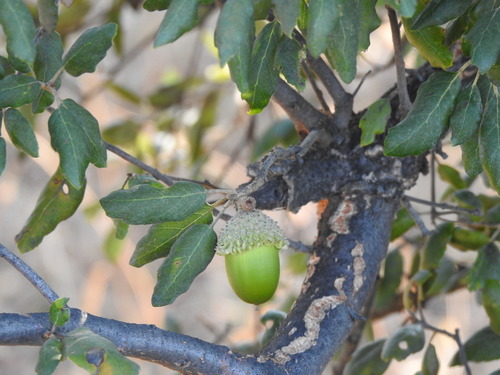
The bark of Quercus pubescens is very rough, light gray, and split into small flakes. Large mature trees develop very thick whitish bark cracked into deep furrows; this bark is similar to that of pedunculate oak, but lighter in color. Twigs are light purple or whitish, and covered in dense fuzzy hair (tomentum). The buds are small, between 3–6 millimetres (1⁄8–1⁄4 inch), blunt, and light brown.
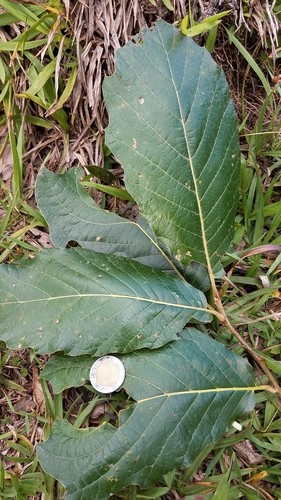
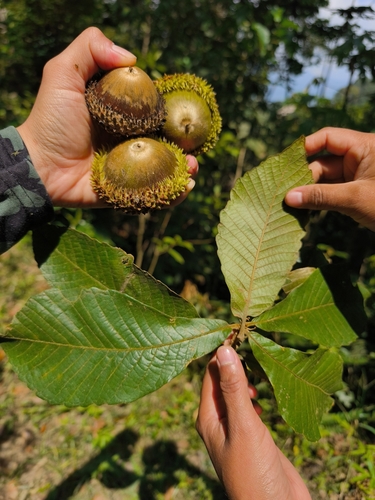
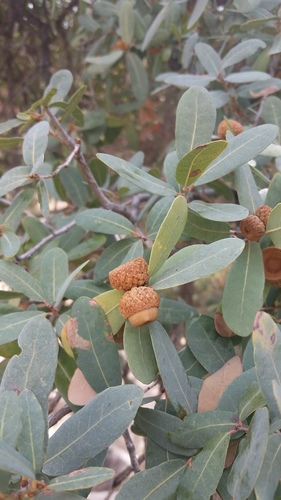
Leaves of Quercus pubescens are leathery, typically 4–10 centimetres (1+1⁄2–4 in) long, rarely up to 13 cm, and 3–6 cm wide, usually widest above the middle of the leaf blade. They grow in clusters at the ends of twigs. The upper leaf surface is dark green and rough, while the lower surface is light green. Both leaf surfaces are covered in fine short hair (pubescence), which may wear away from older leaves by late summer. Young newly expanding leaves are whitish or pinkish, covered in very soft tomentum.
Leaf shape is highly variable, with 3–7 pairs of deep or shallow lobes, which usually divide into a small number of sublobes. The lobes are most often blunt, rarely sharp. The leaf apex is usually wide and round, and the leaf base is heart-shaped, broadly rounded, or sometimes pointed. Petioles are 4–15 mm long, rarely up to 22 mm, stout, and pubescent. Downy oak leaves remain on the tree late into autumn, staying green until early winter, before turning russet or brown and falling.
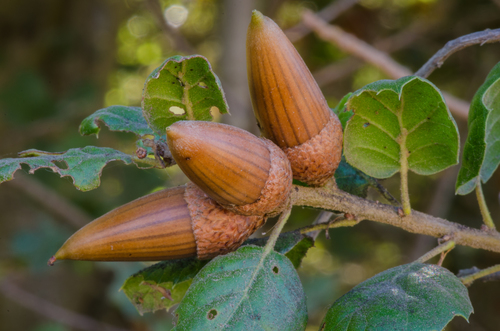
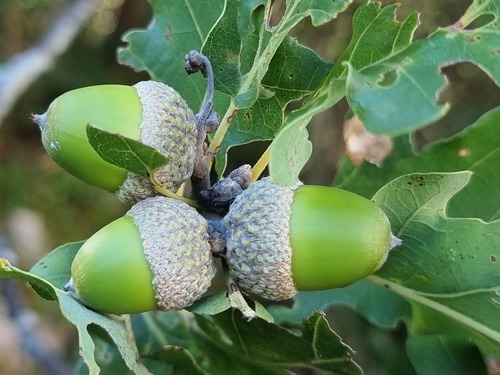
Acorns of Quercus pubescens are light brown to yellow, 8–20 mm long, usually thin and pointed. Acorn cups are light gray to nearly white, with pointed overlapping scales covered in tomentum. Acorn stalks are thick and pubescent, growing up to 2 cm long. Acorns typically grow in groups of 2–5 on the same stalk.
Downy oaks typically grow in dry, lime-rich soils. It is a sub-Mediterranean species, growing from coastlines deep into continental areas. Its optimal growing conditions are in transitional Mediterranean-oceanic climates, which feature warm to hot dry summers and cool (not mild) winters with ample precipitation.