About Quercus parvula Greene
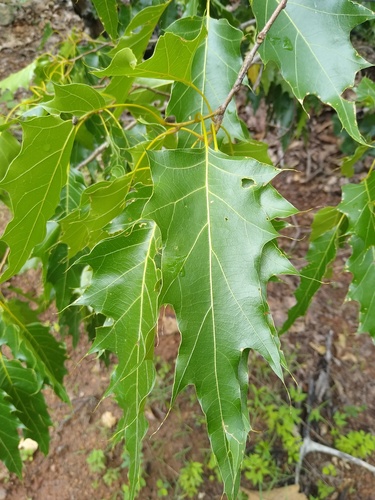
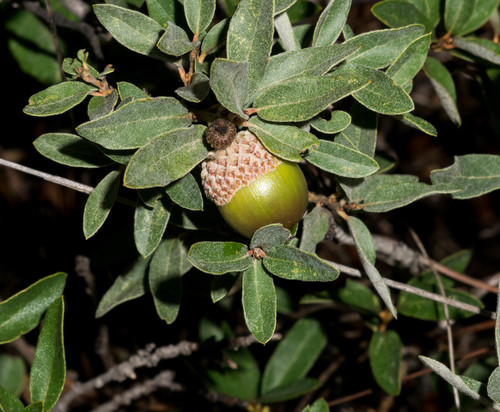
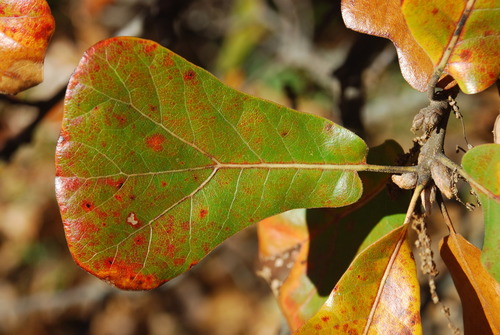
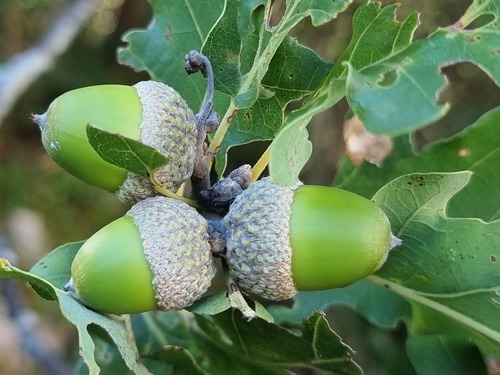
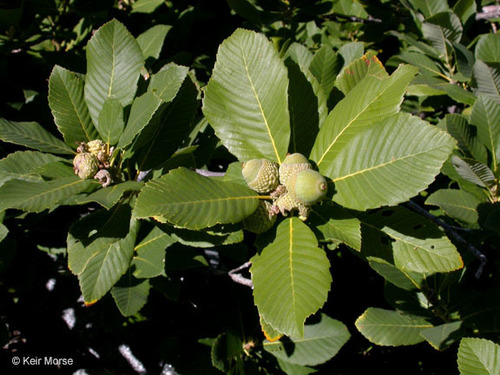
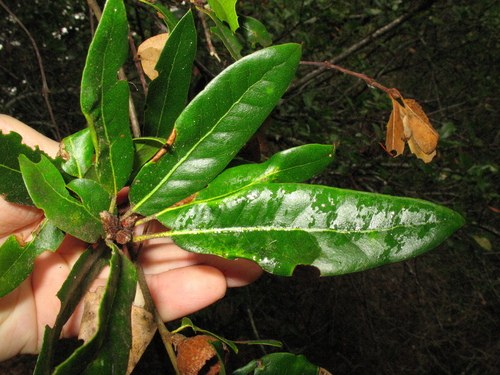
Quercus parvula Greene, commonly known as the Santa Cruz Island oak, is an evergreen red oak in the genus Quercus section Lobatae. It occurs on north-facing slopes of Santa Cruz Island, and along the California Coast Ranges from Santa Barbara County north to Mendocino County. This species was historically taxonomically merged with Quercus wislizeni, until Kevin Nixon resurrected it as a separate species in 1980. Three varieties of Quercus parvula are currently recognized. The type locality of Q. parvula var. shrevei, originally described by C.H. Muller as Q. shrevei, is Palo Colorado Canyon in Monterey County. Quercus parvula differs morphologically from its close relative Quercus wislizeni in several key traits. Its leaf blades are larger, typically over (2) 4 cm long rather than under 4 (6) cm, and thinner, generally less than 0.26 mm near the apex rather than usually over 0.26 mm. Current year twigs of Quercus parvula are 5-sided in cross section, rather than roughly roundish. Its leaf petioles and current year twigs are glabrous to sparsely hairy, rather than moderately to very hairy. Nut tips are blunt, rather than more sharply pointed. Abaxial golden glandular uniseriate leaf blade trichomes are missing or sparse rather than moderate to dense. Abaxial multiradiate leaf blade trichomes on the midvein are missing or sparse, rather than occasional to common. Secondary leaf blade veins are raised abaxially, rather than roughly not raised. Both Quercus parvula and Quercus wislizeni never produce newly emerging leaves with a velvety coating of red bulbous trichomes on the abaxial surface. This trait separates the two species from Quercus kelloggii and both varieties of Quercus agrifolia, which do produce leaves with this coating. Mainland Quercus parvula is most commonly found with or near Sequoia sempervirens (coast redwood), and often near Quercus agrifolia var. agrifolia (coast live oak) and Notholithocarpus densiflorus (tanoak). Ecologically, Quercus parvula also differs from Quercus wislizeni: it occupies island or coastal habitats rather than Sierra foothills, and associates with Sequoia sempervirens rather than Pinus sabiniana.