About Quercus pacifica Nixon & C.H.Müll.
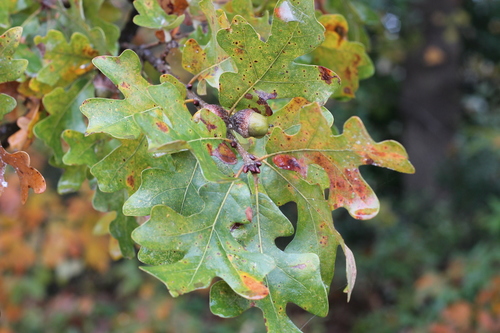
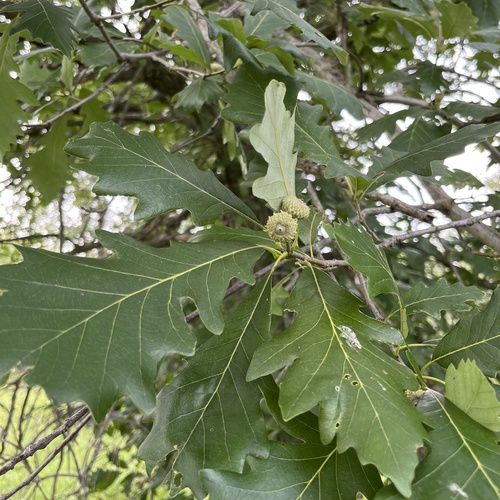
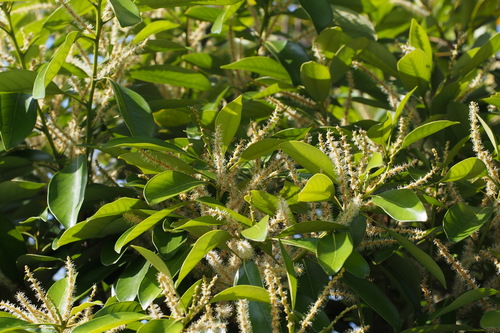
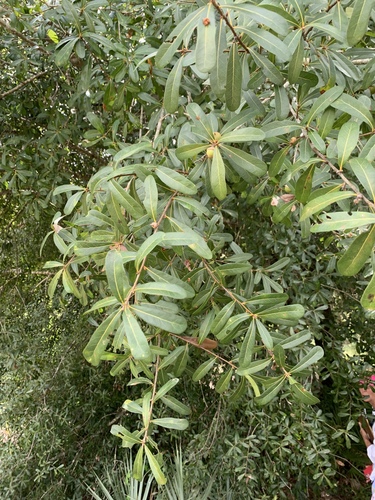
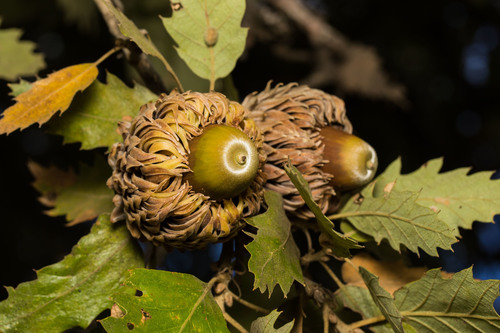
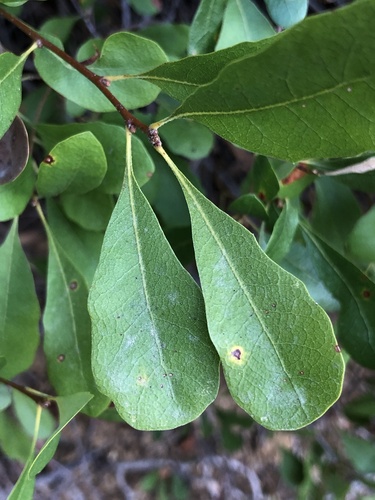
Quercus pacifica Nixon & C.H.Müll. grows as a shrub or small tree, reaching up to 5 meters (16 feet) in height, and occasionally grows taller. Its leaves are roughly oval, with edges that can be entire, wavy, or toothed. The green leaf blades grow up to 4 centimeters (1+1⁄2 inches) long and 4 cm wide, with a shiny upper surface and a waxy, hairy, glandular underside. Its acorn has a cap up to 2 cm (3⁄4 in) wide, and the nut measures 2 or 3 cm (3⁄4 or 1+1⁄4 in) long. This species often forms a stable hybrid with Quercus lobata, which has been named Quercus × macdonaldii. This oak is endemic to the Channel Islands of California, where it occurs on Santa Cruz, Santa Rosa, and Santa Catalina Islands. Santa Cruz and Santa Rosa Islands are part of Channel Islands National Park. While it is restricted to just these three islands, it is not uncommon there, growing in grassland, chaparral, oak woodlands, forest, and other habitat types. It is the dominant oak in many areas of Santa Catalina Island. This species was formally described as a new species in 1994 from a specimen collected on Santa Cruz Island. More than a century before this, the same plant had been described as a variety of Quercus dumosa. The 1994 name remains the correct name for this taxon when it is recognized as a separate species, because naming priority applies only within a given taxonomic rank.