About Quercus oblongifolia Torr.
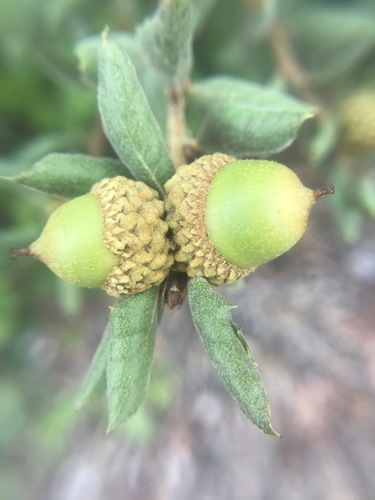
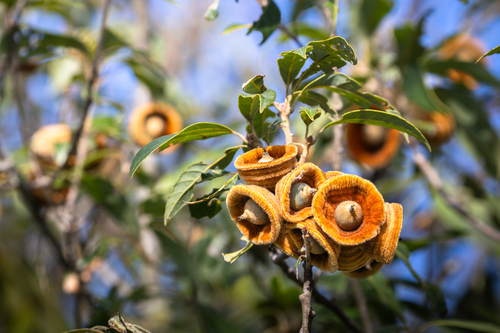
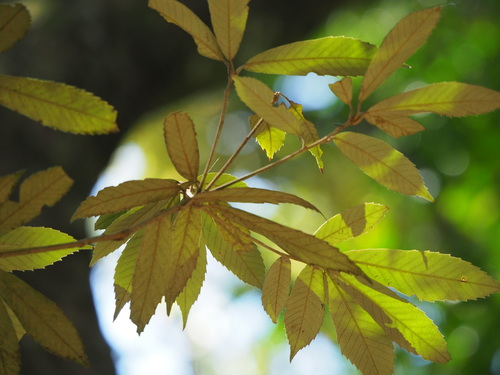
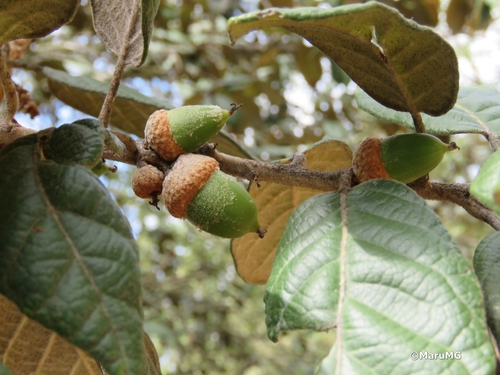
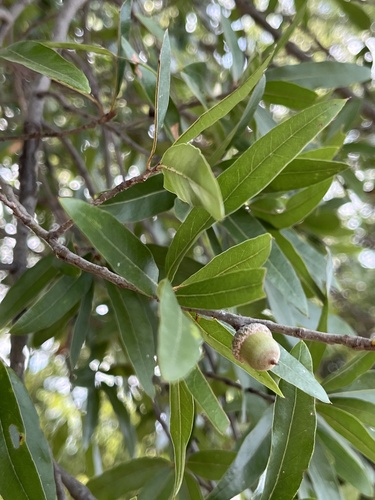
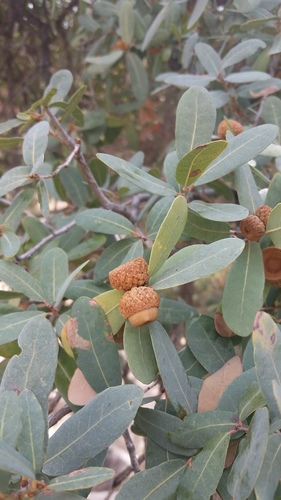
Quercus oblongifolia Torr., commonly called Mexican blue oak, is a small evergreen tree that grows 5–8 metres (16–27 feet) tall with a rounded crown. At higher elevations, it typically grows as a large shrub. Its trunk reaches up to 50 centimetres (20 inches) in diameter, and its bark is light gray and densely furrowed. Twigs are yellowish brown and hairless, with reddish brown buds. Its leaves are small, alternate and oblong, with entire margins; they are leathery, bluish-green on the upper surface, and mid green on the lower surface. Flowers bloom in spring, at the same time old leaves are shed and new leaf growth begins. Male flowers grow as yellowish-green catkins, while female flowers are solitary or paired and grow in leaf axils. The light brown acorns are ovoid or oblong, around 2 cm (3⁄4 in) long, and sit in scaly, bowl-shaped cups that are about one third the length of the nut. Quercus oblongifolia grows in high grasslands, canyons and mesas in southwestern United States (Texas, Arizona and New Mexico) and northwestern Mexico (the states of Baja California Sur, Chihuahua, Coahuila, Sinaloa and Sonora). Mexican blue oak is closely related to Quercus engelmannii (Engelmann oak) of Southern California, and the two species may be conspecific. Mexican blue oak is common at elevations of 1,200 to 1,800 m (4,000–6,000 ft). It is often found on thin sandy soils in semi-arid regions, and is the dominant species in lower open oak woodland, where it grows alongside Quercus arizonica (Arizona white oak) and Quercus emoryi (Emory oak). It is an important constituent of pinyon–juniper communities, where it grows alongside species of pine and juniper, Vauquelinia californica (Arizona rosewood), Eriogonum wrightii (shrubby buckwheat), Mimosa aculeaticarpa (catclaw mimosa), Muhlenbergia emersleyi (bullgrass), Eragrostis intermedia (plains lovegrass), Fendlera rupicola (fendlerbush) and Lycurus phleoides (wolftail). In cultivation, the popularity of Quercus oblongifolia (Mexican blue oak) in landscaping has been increasing in California, with many plantings at Apple Park and other sites in the Bay Area. Its fast growth and attractive blue foliage mean selections sourced from Arizona trees are the best for cultivation.