About Quercus mohriana Buckley ex Rydb.
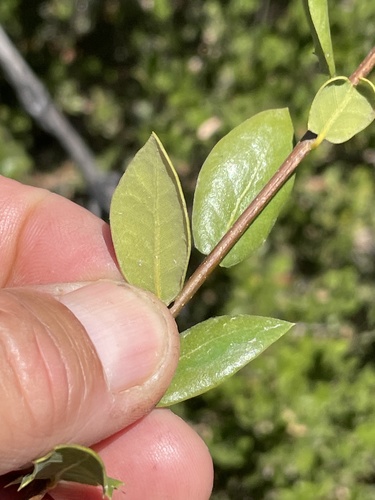
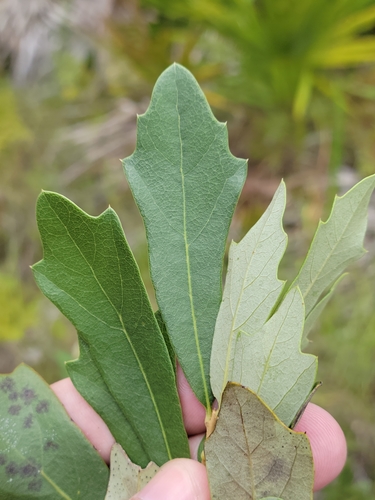
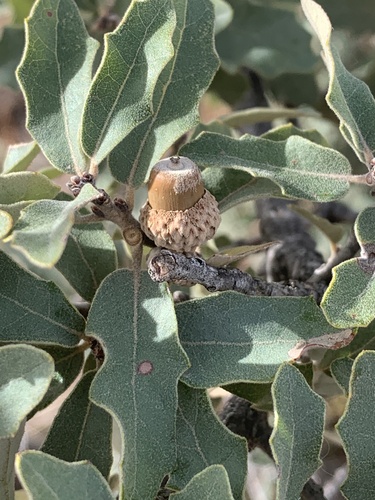
Quercus mohriana Buckley ex Rydb., commonly known as Mohr oak, can grow as a small tree reaching up to 6 meters (20 feet) tall, or as a large, thicket-forming shrub. Its bark is light brown, rough, and deeply furrowed. Young twigs are yellowish or whitish, covered in short velvety hairs, and become smooth as they age. The buds are dark red-brown and sparsely covered with hairs. The leaves are shiny, leathery, and dark blue-gray on their upper surface, with the underside densely covered in light gray hairs. Leaf margins are most often entire, and occasionally toothed. The reddish inflorescence emerges in spring. It produces female catkins holding 1 to 3 flowers, and male catkins holding many flowers. Acorns are light brown, broadly ovoid with a rounded apex, and grow singly or in pairs, enclosed in deep acorn cups. Mohr oak is abundant in western Texas, and also grows in Oklahoma, New Mexico, and Coahuila. It prefers dry limestone or calcareous slopes at elevations between 600 and 2,500 meters (2,000 and 8,200 feet) above sea level, growing in chaparral and desert scrub savanna. It thrives in areas that receive less than 63 cm (25 in) of annual rainfall. It often grows in association with Cercocarpus montanus (true mountain-mahogany), Ceanothus greggii (desert ceanothus), Quercus pungens (sandpaper oak), Juniperus monosperma (oneseeds juniper), Opuntia imbricata (cane cholla), Opuntia phaeacantha (purplefruited pricklypear), Ungnadia speciosa (Mexican buckeye), Diospyros texana (Texas persimmon), Erioneuron pilosum (hairy tridens), and Quercus fusiformis (plateau oak).