About Quercus marilandica (L.) Münchh.
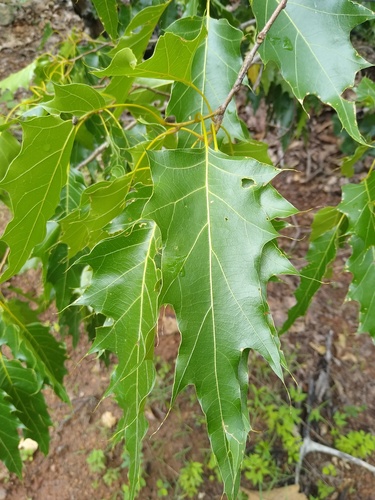
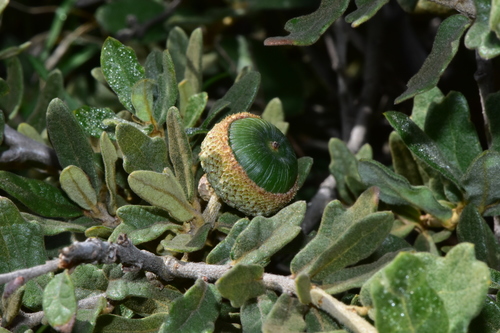
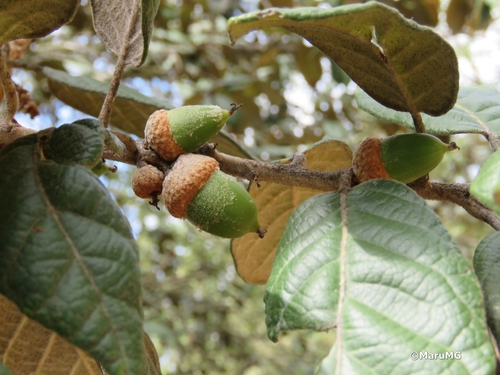
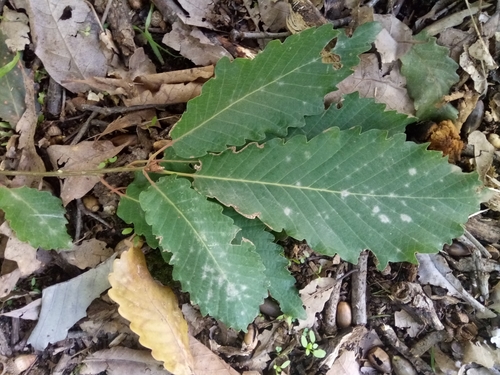
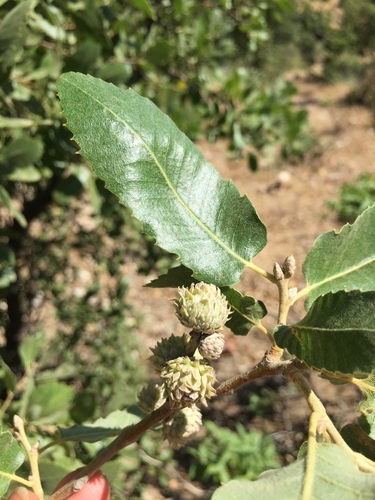
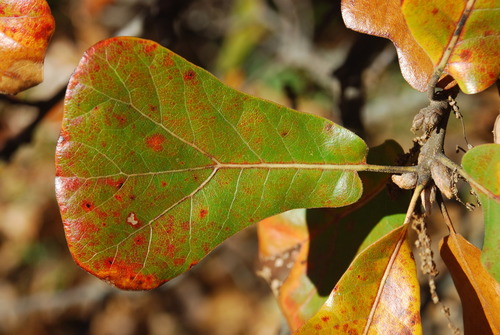
Quercus marilandica, commonly called blackjack oak, is a small deciduous tree. Most individuals grow to 15 meters (49 feet) tall, though specimens in the Cross Timbers region can reach 15 to 18 m (50 to 60 ft) tall; they seldom exceed 12 m (40 ft) there, with a maximum trunk diameter of 41 cm (16 in). Its bark is cracked into rectangular black plates separated by narrow orange fissures. Its leaves are typically 7–20 centimeters (3–8 inches) long and wide, though they may reach 10 to 25 cm (4 to 10 in) in length with matching width in the Cross Timbers. Leaves usually flare from a tapered base to a broad three-lobed bell shape with only shallow indentations. They are dark green and glossy on the upper surface, and pubescent on the underside. In fall, leaves turn from red to brown, and often remain attached to twigs through the winter. The acorns are small, 12–20 millimeters (1⁄2–3⁄4 in) long and 10–18 mm (3⁄8–3⁄4 in) broad; like other red oaks, acorns take 18 months to mature. Blackjack oak is distributed from Long Island, New York, south to Florida, and west as far as Texas, Oklahoma, and Nebraska. A few isolated populations in southern Michigan are thought to be introduced, and the species can also be found as far north as parts of Ohio. One variety, Quercus marilandica Münchhausen var. ashei Sudworth, grows in the western portions of the species' range: northern Texas, Oklahoma, and southern Kansas. Blackjack oak grows in poor, thin, dry, rocky or sandy soils where few other woody plants can thrive, usually on low ground, at altitudes from sea level up to approximately 850 m (2,800 ft). In the southeastern US, it sometimes grows as an understory tree in pine stands on sandy knolls. Along the New Jersey coastal plain, it is more commonly found in relatively sunny, open areas such as those near coastal salt marshes. It often grows near scarlet oaks, post oaks, and pitch pine; common understory companion species include winged sumac, bracken, sweetfern, and bayberry. In the western part of its range, along the eastern edge of the southern Great Plains, blackjack oak and post oak form the semi-savanna ecosystem called the Cross Timbers, which is made up of forested strips mixed with prairie grass glades. On many chert glades in Arkansas's Ozark plateau, scrub forms of Q. marilandica dominate alongside Quercus stellata. This species does not have the attractive form of many other oaks, and is often described as "tough but ugly" and underappreciated. It is still a valuable tree for growing in difficult growing sites, but is sometimes actively eradicated to make space for trees considered more commercially valuable. In ecological terms, blackjack oak sometimes hybridizes with bear oak (Quercus ilicifolia) to produce the hybrid known as Quercus × brittonii. Its acorns are a food source for whitetail deer and wild turkey, but consumption of blackjack oak can cause tannic acid poisoning in cattle. The wood of Quercus marilandica is very dense, and burns with a hot flame, making it an excellent heat source for barbecues and wood-burning stoves. However, it is not recommended for use in residential wood fireplaces, because its combustion causes popping that increases the risk of house fires. In Oklahoma, blackjack wood has traditionally been used as both fuel and smoke wood for barbecue.