About Quercus macrocarpa Michx.
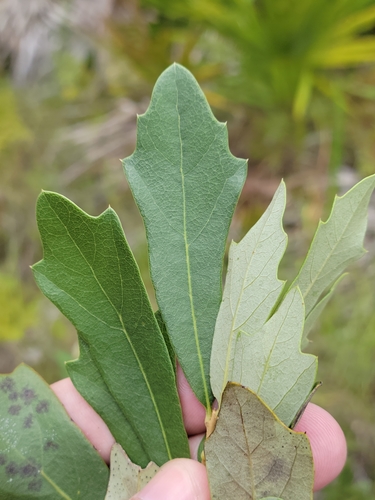
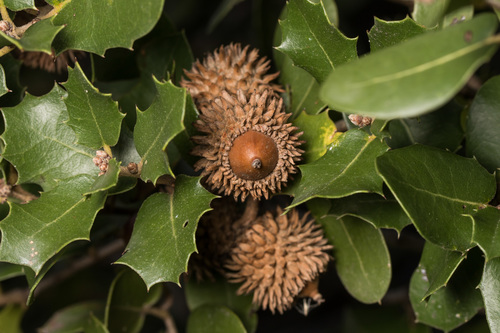
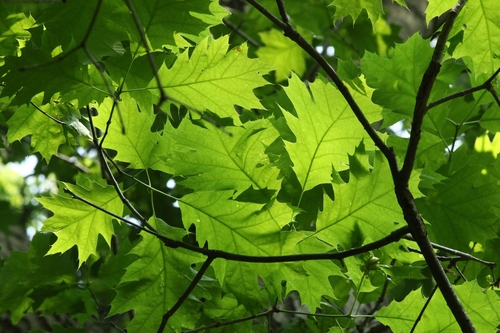
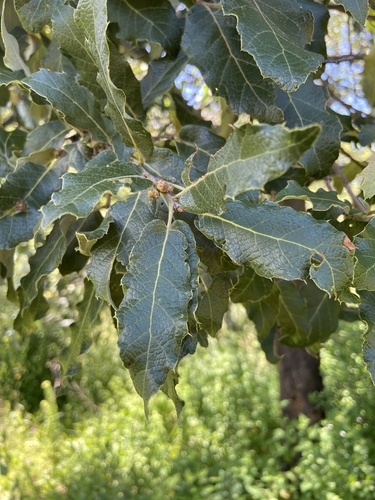
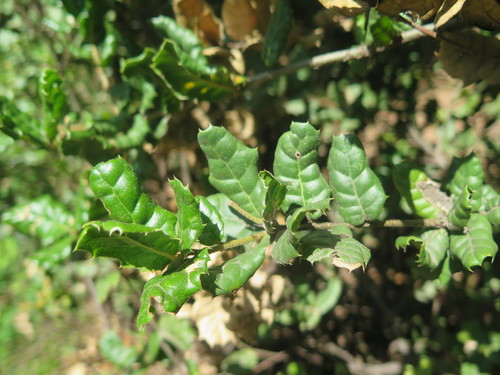
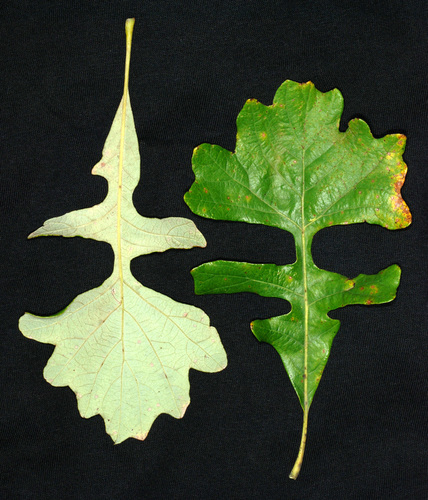
Quercus macrocarpa Michx., commonly called bur oak, is a large deciduous tree. It typically reaches up to 30 metres (98 feet) in height, and rarely grows as tall as 50 m (160 ft). It is one of the most massive oak species, with a trunk diameter that can reach up to 3 m (10 ft). It is also one of the slowest-growing oaks: young trees have an average growth rate of 30 centimetres (12 in) per year, though one source notes that well-established trees can grow up to 51 cm (20 in) per year. A 20-year-old tree grown in full sun will reach approximately 18 m (60 ft) tall, while naturally occurring forest saplings are typically shorter for their age. Bur oaks commonly live 200 to 300 years, and may live as long as 400 years. Its bark is gray with distinct vertical ridges. Its leaves measure 7–15 cm (2+3⁄4–6 in) long and 5–13 cm (2–5 in) broad, with variable shape and a lobed margin. Most often, the basal two-thirds of the leaf is narrower and deeply lobed, while the apical third is wider and has shallow lobes or large teeth. Bur oak foliage usually does not develop strong fall color, though fine golden hues may occur occasionally. Its flowers are greenish-yellow catkins, produced in spring. The acorns of this species are very large, 2.5–5 cm (1–2 in) long and 2–4 cm (3⁄4–1+1⁄2 in) broad. They feature a large cup that covers much of the nut, with large overlapping scales and often a fringe along the cup edge. When sawn transversely, the wood displays characteristic annual rings formed by secondary thickening. Bur oak is sometimes confused with other oaks in the white oak section, including Quercus bicolor (swamp white oak), Quercus lyrata (overcup oak), and Quercus alba (white oak). It can hybridize with several other oak species. Quercus macrocarpa is widespread, ranging from the Atlantic coastal plain from New Brunswick to North Carolina, west to Alberta, eastern Montana, Wyoming, and northeastern New Mexico. The vast majority of its populations occur in the eastern Great Plains, the Mississippi–Missouri–Ohio Valley, and the Great Lakes region. Its range extends farther north than that of any other North American oak, and the species tends to grow as a smaller, shrubby plant at the northern and eastern limits of its range. Bur oaks grow primarily in temperate climates, in the western oak-hickory forested regions of the United States and extending into Canada. It commonly grows in open areas away from dense forest canopies, which makes it an important tree in eastern prairies; it is also often found near waterways in otherwise more forested areas where there is a break in the canopy. It is drought resistant, a trait that may come from its long taproot: at the end of the first growing season, a one-year sapling may have a taproot 1.37 m (4+1⁄2 ft) deep and a lateral root spread of 76 cm (2+1⁄2 ft). This species shows a preference for limestone or other calcareous soils. The West Virginia state champion bur oak has a trunk diameter of almost 3 m (10 ft). Large bur oaks older than 12 years are fire-tolerant thanks to their thick bark. One of the species' most common habitats, especially in the Midwestern United States, is oak savanna, where fires naturally occurred in early spring or late fall. Without fires, bur oak is often outcompeted and replaced by other more shade-tolerant tree and shrub species. Older bur oaks may survive in dense woodlands for 80 years, until they are weakened by wood-rot fungi in lower branches killed by shade, and are often snapped by wind storms between 100 and 110 years of age. The acorns of Quercus macrocarpa are the largest of any North American oak, and are an important food source for wildlife. American black bears sometimes tear off branches to reach these acorns. Heavy acorn crops are only produced every few years, an evolutionary strategy called masting: the large intermittent seed crop overwhelms seed predators' ability to eat all acorns, ensuring some seeds survive to germinate. Other wildlife including deer and porcupine eat the species' leaves, twigs, and bark, and cattle browse it heavily in some areas. Bur oak is the only known host plant for Bucculatrix recognita caterpillars. Many arthropod species form galls on its leaves and twigs, including the mite Aceria querci and numerous cynipid wasps: Acraspis macrocarpae, Acraspis villosa, Andricus chinquapin, Andricus dimorphus, Andricus foliaformis, Andricus flavohirtus, Andricus quercuspetiolicola, Callirhytis flavipes, Disholcaspis quercusmamma, Neuroterus floccosus, Neuroterus saltarius, Neuroterus umbilicatus, Philonix nigra, and Phylloteras poculum. Quercus macrocarpa is cultivated by plant nurseries for use in gardens, parks, and along urban sidewalks. It has been planted in many climates, ranging north to Anchorage, Alaska, and south to Mission, Texas. It can withstand chinook conditions in Calgary, Alberta. It is drought tolerant, and coppicing has been shown to produce superior growth for this species. The wood of Quercus macrocarpa is commercially valuable and durable, used for flooring, fence posts, cabinets, and barrels. Its acorns can be eaten boiled or raw. Native Americans have used the species' astringent bark to treat wounds, sores, rashes, and diarrhea.