About Quercus laurifolia Michx.
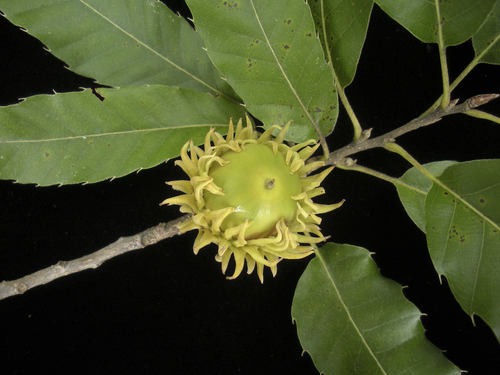
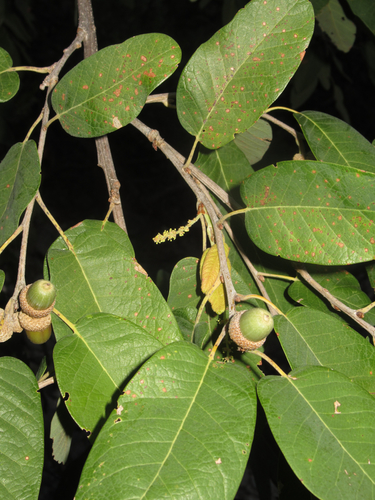
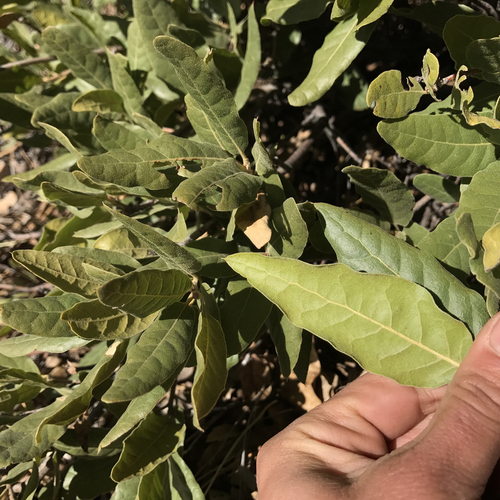
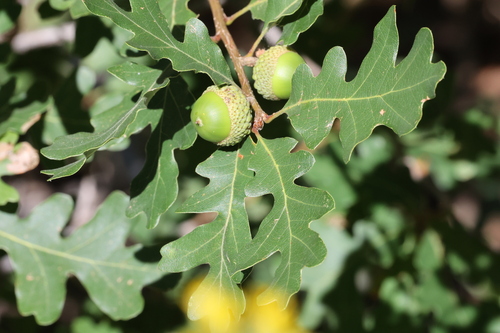
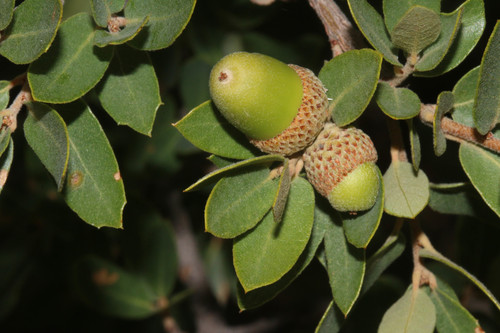
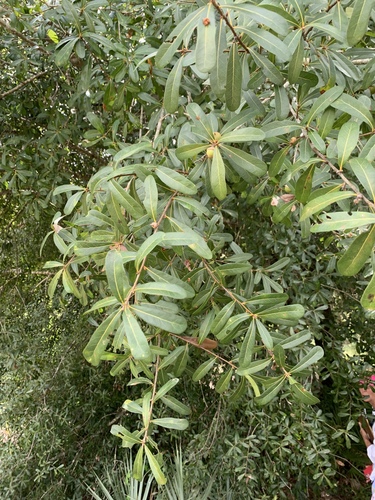
Quercus laurifolia Michx., commonly called swamp laurel oak, is a tree that reaches 20–24 meters (65–80 feet) in height, rarely growing as tall as 40 meters (130 feet). It has a large, rounded crown. Its leaves are broad lanceolate, measuring 2.5–12.7 centimeters (1–5 inches) long and 1.3–4.4 centimeters (1⁄2–1+3⁄4 inches) wide. Most leaves are unlobed with an entire margin and a bristle tip; very rarely, leaves develop three lobes. Its leaves typically drop just as new leaves begin to emerge in spring. The species bears acorns held in a cup that may be shallow or deep. The acorns are hemispherical or oblong, 8.5–16 millimeters (5⁄16–5⁄8 inch) long, and can reach up to 2.5 centimeters (one inch) long. Acorns are green when young and mature to a blackish-brown color roughly 18 months after pollination. Acorn production is often heavy, which increases the species' value to wildlife. Seedlings of Quercus laurifolia have embryo dormancy, and germinate the spring following fall ripening; germination occurs via the hypogeal method. Swamp laurel oak grows quickly and typically reaches maturity in about 50 years. Quercus hemisphaerica, the sand laurel oak, is a similar evergreen oak that also grows in sandy soils. Swamp laurel oak grows naturally from coastal Virginia to central Florida, and west to southeast Texas. There are reports of the species growing in Pennsylvania and New Jersey, but these are almost certainly introduced populations rather than native occurrences. The species is mostly found on alluvial flood plains, at altitudes from sea level up to 150 meters (490 feet). It can tolerate wet growing sites alongside other oak species, but cannot survive continuous or prolonged flooding. It is most often found growing in sandy soil near rivers, and along the edges of swamps that are not flooded too frequently. In central Florida it grows in hammocks, and in west Florida it grows on sand hills adjacent to swamps. It grows best on ultisols and inceptisols. Across its native range, the average annual temperature ranges from 16 to 21 °C (61 to 70 °F). It can withstand extreme low temperatures between −1 and −28 °C (30 to −18 °F), and extreme high temperatures between 38 and 43 °C (100 to 109 °F). It requires 1,250–1,500 millimeters (49–59 inches) of rainfall per year, with 500–1,000 millimeters (20–39 inches) of this rainfall falling during the April to September growing season. The laurel oak is likely one of the most cold-hardy evergreen oaks. Trees growing in Cincinnati show that laurel oak may be hardy further north than previously believed, tolerating temperatures lower than −29 °C (−20 °F) and surviving in USDA hardiness zone 5. Trees in Cincinnati have been observed to remain green well into December. Known hybrids with Quercus laurifolia as one parent include crosses with Q. falcata (Q × beaumontiana Sarg.), Q. incana (Q. × atlantica Ashe), and Q. marilandica (Q. × diversiloba Tharp ex A. Camus). The tree hosts general oak-feeding insects but has no serious insect pest issues. Several species of Curculio weevils infest its acorns. Even though the acorn kernels are bitter, acorns are eaten by deer including white-tailed deer, squirrels, birds including ducks, bobwhite quail and wild turkeys, raccoons, and small rodents. Quercus laurifolia is grown and marketed mainly as pulpwood. It is commonly used as an ornamental tree in landscaping due to its fast growth and pleasing appearance, and is often planted without much consideration for soil type.