About Quercus imbricaria Michx.
Quercus imbricaria Michx. typically grows 15–18 meters (49–59 feet) tall, with a maximum recorded height of 100 feet. When young, it has a broad pyramidal crown, which becomes broad-topped and open as the tree ages. Its trunk can reach up to 1 meter (39 inches) in diameter, and rarely grows to 1.4 meters (56 inches). This species reaches its largest mature size in southern Illinois and Indiana, though the current national champion specimen measures 104 feet tall by 68 feet wide and grows in Cincinnati, Ohio.
The bark is light brown and scaly; on young stems, it is light brown and smooth. New branchlets are slender, dark green, and shiny, then lighten to light brown as they mature, and finally turn dark brown. The heartwood is pale reddish brown, with lighter sapwood. It is heavy, hard, and coarse-grained, and cracks severely when drying. Historically, it has been used for shingles and sometimes for construction. Its specific gravity is 0.7529, and one cubic foot of the wood weighs 46.92 pounds. Winter buds are light brown, ovate, acute, and one-eighth of an inch long.
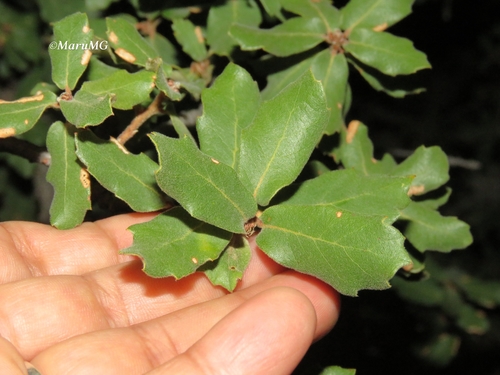
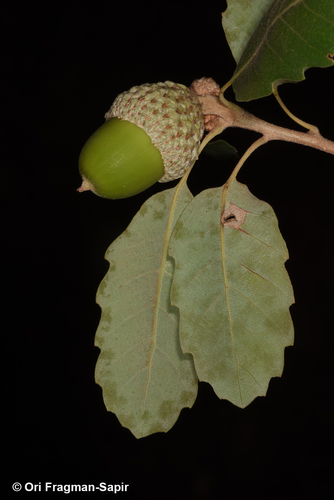
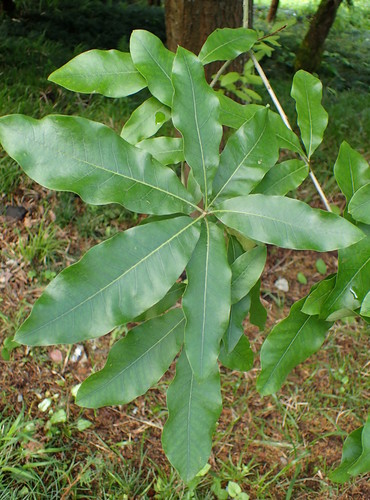
Leaves are alternate, oblong or obovate, 4 to 6 inches long, 1 to 2 inches wide, with a wedge-shaped or rounded base, and an acute or rounded apex. Leaf margins are sometimes entire, sometimes undulated, and sometimes weakly three-lobed. Emerging leaves are involute, bright red, covered in rusty down on the upper surface and white tomentum on the lower surface. When fully grown, leaves are dark green, smooth, and shiny above, and pale green or pale brown and downy below. The midribs are stout, yellow, and grooved on the upper surface, while primary veins are slender. In autumn, the upper leaf surface turns dark red, and the lower surface stays pale; the midrib darkens before the rest of the leaf. Leaf stalks (petioles) are stout, hairy, flattened, and grooved. Stipules are around half an inch long and fall off early (caducous).
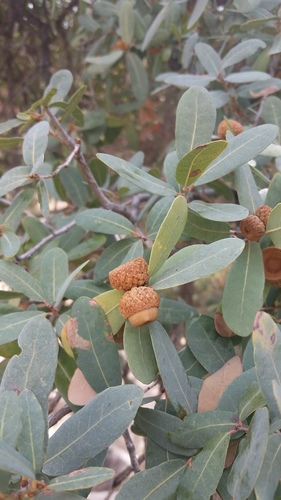
This species is distinguished from most other oaks by its laurel-like leaves, which are 8–20 cm (3–8 in) long and 1.5–7.5 cm (1⁄2–3 in) wide with an untoothed margin, bright green above, and paler and somewhat downy below.
Flowering occurs in May, when leaves are half grown. Staminate flowers grow on 2 to 3 inch long tomentose catkins (aments), with linear-lanceolate bracts. The calyx is pale yellow, downy, and four-lobed; there are 4 to 5 stamens with yellow anthers. Pistillate flowers grow on slender tomentose stalks (peduncles). The involucral scales are downy and roughly as long as the calyx lobes; stigmas are short, reflexed, and greenish-yellow.
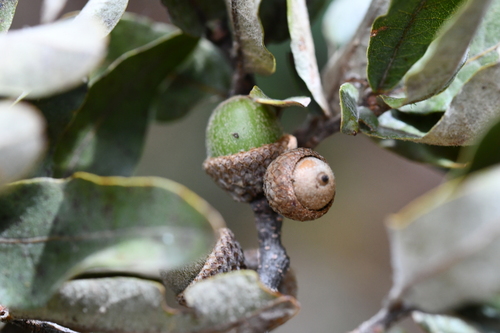
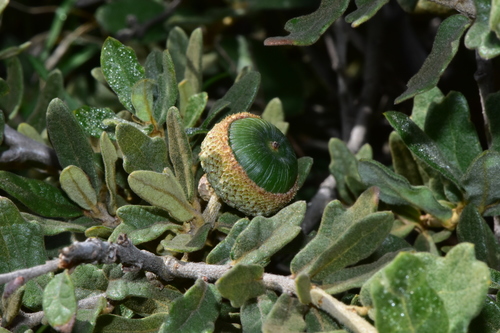
Acorns ripen in the autumn of the second year, around 18 months after pollination. They are borne on stalks, and grow solitary or in pairs. The nut is almost spherical, 9–18 millimeters (1⁄2 to 2⁄3 inch) long. The cup-shaped acorn cup covers one-half to two-thirds of the nut, and is covered with light red-brown, downy scales with rounded or acute apexes. The kernel is very bitter.
Quercus imbricaria is native primarily to the Midwestern and Upper South regions of North America, ranging from southern New York west to northern Illinois and eastern Kansas, and south to central Alabama and Arkansas. It is abundant in the lower Ohio Valley and middle Mississippi Valley, and rare in the eastern part of its range. It most commonly grows on well-drained uplands, and less often along lowland streams, at altitudes between 100 and 700 meters (330–2,300 feet). Its acorns are an important food source for squirrels and some species of birds. In the past, its wood was widely used to make shingles – this use is the origin of its common name.