About Quercus humboldtii Bonpl.
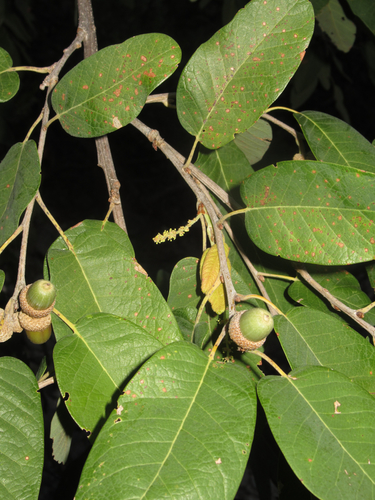
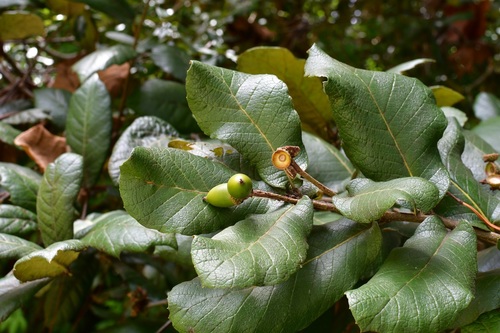
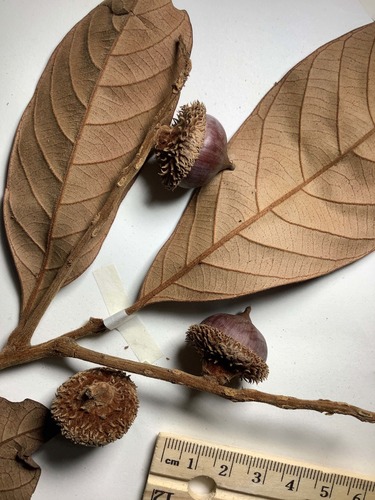
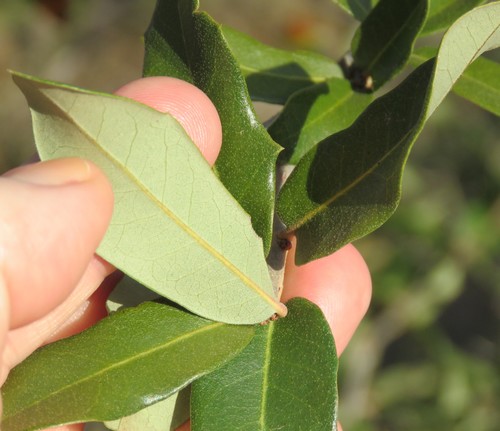
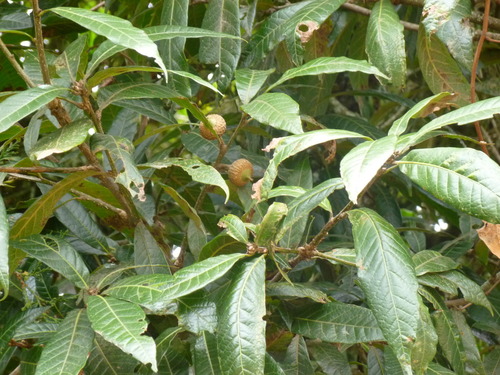
Quercus humboldtii Bonpl. is an evergreen tree that reaches 25 metres (82 feet) in height and 1 metre (3 feet 3 inches) in trunk diameter, with buttresses growing up to 1 metre tall. Its bark is reddish gray or gray, fissured, breaks into square shapes, and flakes off. The leaves are simple, alternately arranged, and lanceolate, measuring 10–20 centimetres (4–8 inches) long, and grow in clusters at the ends of branches. The flowers are small, yellow, and unisexual, arranged in racemic inflorescences. Male flowers are numerous, while female flowers have long styles and are held within a cupula. The fruit is a light brown, ovoid acorn (also described as a capsule) with a leathery pericarp. It measures 20–25 millimetres (3⁄4–1 inch) in diameter and 50–70 millimetres (2–2+3⁄4 inches) in length, and sits on a scaly cupule. Only one fruit develops per cupule, and the inner surface of the acorn shell has a woolly texture. This species grows in mountain habitats at elevations between 1,000 and 3,200 metres (3,300 and 10,500 feet). It occurs across all three Colombian Andean mountain ranges, some low-elevation inter-Andean regions, and the Serranía del Darién along the border between Panama and Colombia. It grows in Andean highlands where the mean annual temperature ranges from 16 to 24 °C, and mean annual rainfall ranges from 1,500 to 2,500 millimetres (59 to 98 inches). It can grow in moderately fertile deep soils as well as degraded soils, and prefers shallow soils with a thick humus layer. Its acorns provide important food for wildlife. Two parrot species, the rusty-faced parrot and Fuertes's parrot, are endemic to the threatened montane ecosystems of the Colombian Andes and are especially dependent on Andean oak forests (dominated by this species) as their habitat.