About Quercus grisea Liebm.
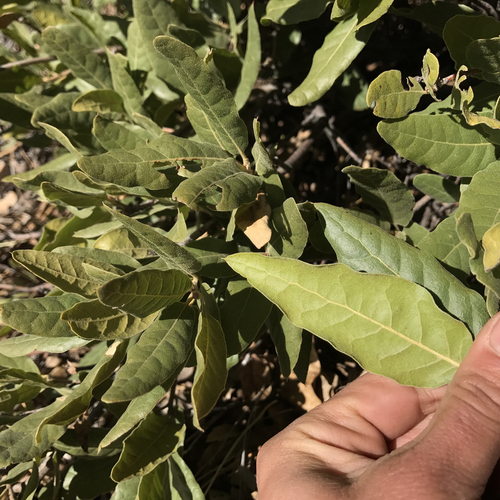
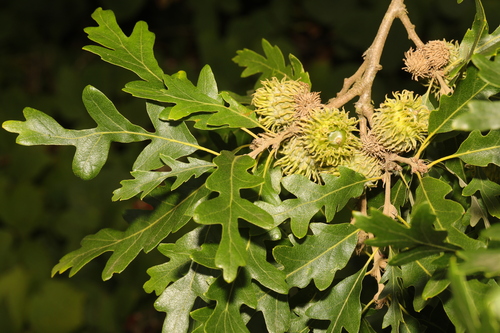
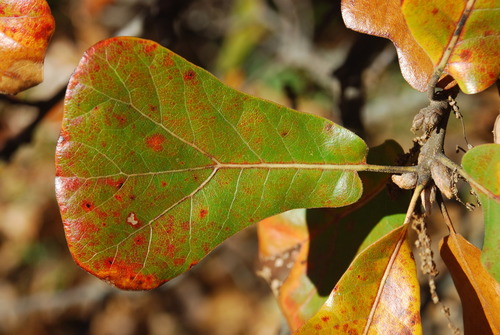
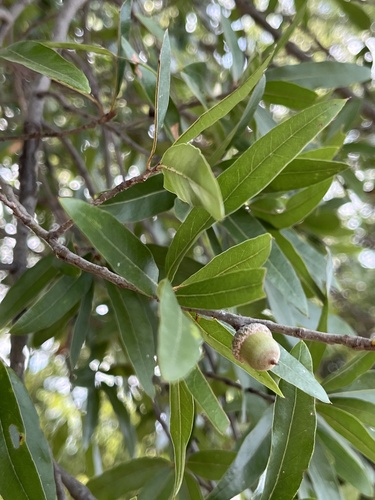
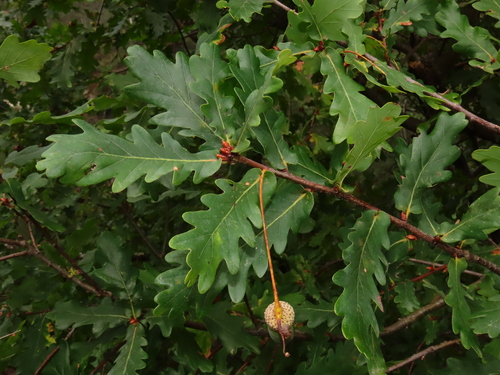
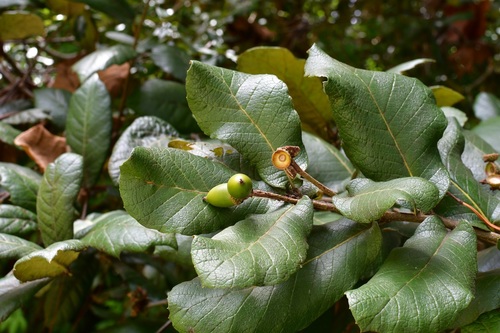
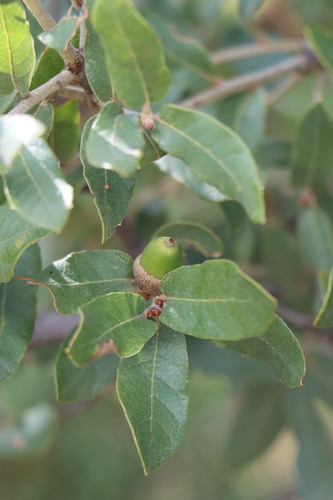
Quercus grisea Liebm., commonly called gray oak, can grow as a multi-stemmed shrub in drier sites. Where rainfall is sufficient, it develops into a medium-sized tree reaching up to around 20 meters (66 feet) tall, with an irregular crown made up of twisted branches. Its trunk can grow up to 60 cm (2 feet) in diameter, covered in light gray bark that is fissured and cracked into small plates. Stout twigs are light reddish-brown and covered in grayish down. Leaves are alternate, leathery, and long ovate, with smooth margins or a few coarse teeth. They are grayish-green on the upper surface and felted on the lower surface, and may drop during winter drought periods. Male flowers form yellowish-green catkins, while female flowers grow in small spikes in leaf axils. Both types of flowers emerge in spring at the same time as new leaves. Acorns grow singly or in pairs, are light brown, and have scaly acorn cups covered in fine hairs that are half the length of the full acorn. Gray oak grows in the mountains of the southwestern United States (western Texas, New Mexico, Arizona, Colorado, and the Oklahoma Panhandle) and northern Mexico (Sonora, Sinaloa, Chihuahua, Durango, Coahuila, San Luis Potosí, Zacatecas, Hidalgo). While generally scarce across its range, it is common in the Trans-Pecos region of Texas. This species occurs at elevations between 1,200 and 2,700 m (4,000 to 9,000 ft) above sea level, growing in valleys, on ridges, on rocky slopes, and along stream banks. It flourishes in semi-arid conditions with mild winters, dry springs, and hot summers. It can reproduce asexually via sprouting root suckers, and may form dense thickets. It grows in association with other oaks, juniper species, Mexican pinyon (Pinus cembroides), pinyon pine (Pinus edulis), fendlerbush (Fendlera rupicola), bushy sage (Salvia lycioides), Texas madrone (Arbutus xalapensis), Fremont barberry (Berberis fremontii), Louisiana sagewort (Artemisia ludoviciana), and soaptree yucca (Yucca elata).