About Quercus falcata Michx.
Quercus falcata Michx., commonly called southern red oak, is a medium to large-sized deciduous tree. It typically grows 25 to 30 meters (82 to 98 feet) tall, while a small number of forest-grown specimens growing on highly productive sites can reach 35 to 44 meters (115 to 144 feet) tall. Its trunk can grow up to 1.5 meters (5 feet) in diameter, and it forms a broad, round-topped crown.
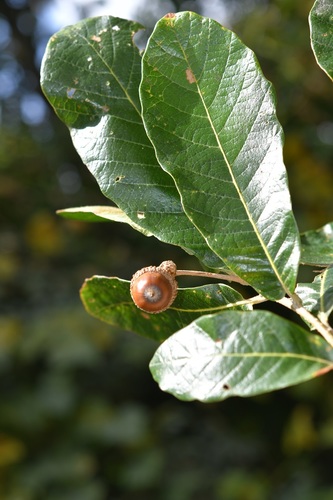
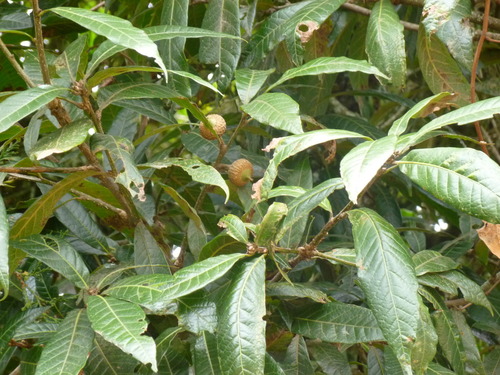
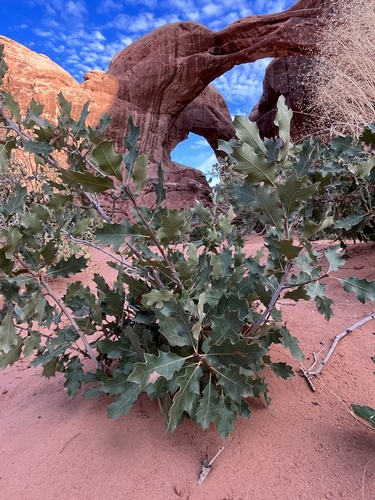
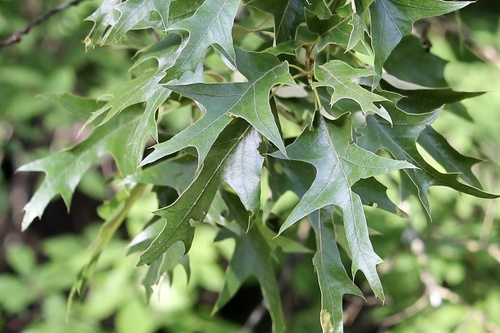
The leaves of Quercus falcata are 10 to 30 centimeters (4 to 12 inches) long, and 6 to 16 centimeters (2 1/4 to 6 1/4 inches) wide. Leaves have 3 to 5 sharply pointed, often curved, bristle-tipped lobes, with the central lobe being long and narrow. The small number of long, narrow lobes is diagnostic, and readily distinguishes southern red oak from other red oaks. The leaf base is distinctly shaped like a rounded inverted bell, and is often lopsided. The upper leaf surface is dark green and shiny, while the lower surface is rusty and hairy, especially along the midrib and veins.
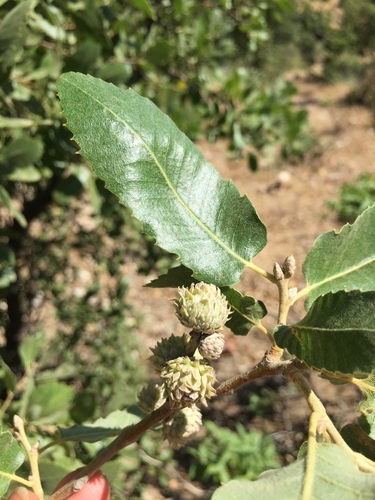
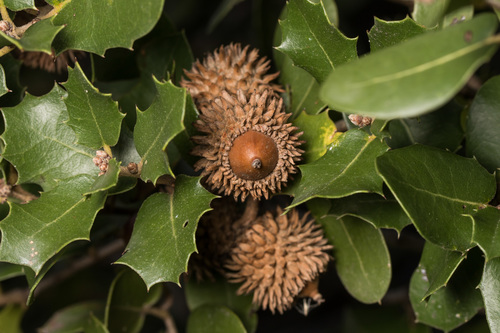
The tree produces a short acorn as its seed, which measures 9 to 16 millimeters (11/32 to 5/8 inches) long and is bright orange-brown. Between one-third to half of the acorn is enclosed in a flat cup, and the acorn matures at the end of its second growing season. The bark is dark brownish gray, with narrow, shallow ridges.
Quercus falcata grows on upland sites with sandy, loamy, or clay soils. These soils are often dry, acidic, and nutrient poor. Its natural range extends from southern New York (Long Island) south to central Florida, and west to Missouri, Oklahoma, and Texas. In the northeastern part of its range, the species is relatively rare, and found almost exclusively along the coast; it is most common throughout the piedmont region of the Southeast.
Southern red oak has been reported to occasionally form hybrids with several other red oak species in its native region. The species is susceptible to damage due to its relatively thin bark, which allows fire to easily damage trees via fire scars and other injuries. Bark roughness is greater on xeric sites than on mesic sites, which may be an adaptation to higher fire frequency. Southern red oak seedlings can survive prescribed fires held in winter. Fire damage often leaves trees vulnerable to heart rot.
When exposed to the fungus Ceratocystis fagacearum, southern red oak (along with many other oak species) develops oak wilt, a condition that causes leaf wilting and reduces photosynthesis to a level low enough to kill the tree. The fungus invades the tree's xylem through infected water, blocks water-conducting vessels, and prevents normal water flow upward through the tree. While oak wilt is not currently known to damage the overall Quercus falcata population, efforts are underway to prevent the disease because southern red oak is a species of major importance to ecosystems. Management of oak wilt uses an integrated approach that combines root disruption, sanitation, and chemical application to address the disease. Root disruption aims to prevent contact between the roots of infected trees and healthy trees connected by root grafts, through installation of trenches, plow lines, or barriers to block contact. Sanitation measures focus on removing infected trees, the source of potential disease spread; this may involve removing only infected individuals, or removing all trees within the infection center. Chemical applications include applying fungicides to healthy trees to prevent infection, or using therapeutic fungicides that cannot cure infected trees but reduce symptom intensity and delay symptom onset. The fungicide propiconazole is most commonly used for this purpose.
Southern red oak is cultivated in the eastern United States, within USDA Hardiness Zones 5a to 9b. It can survive minimum temperatures between −23 and −28.8 °C (−9.4 to −19.8 °F), and maximum temperatures of 38 °C (100 °F).
Southern red oak has a wide range of uses. Its sturdy, durable, coarse-grained wood is used to manufacture flooring, furniture, construction materials, and lumber. The species is abundant in the southeastern United States, where it is ecologically and economically important, contributing approximately 8.1% of annual hardwood timber volume. Its wood is also used as fuel because it has a high heat value. It provides tannin used to preserve and treat leather. Its large root system supports watershed protection, reducing flood damage and improving soil stability. It is also used as a shade tree and for aesthetic purposes in gardens. Its acorns provide food mast for deer, squirrels, turkeys, songbirds, and quail.