About Quercus ellipsoidalis E.J.Hill
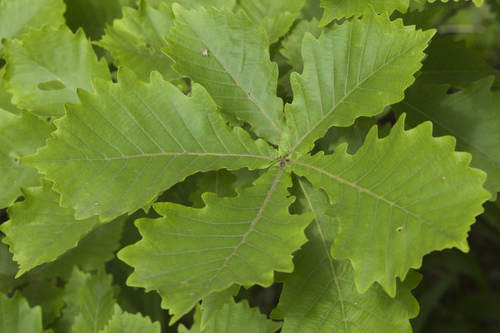
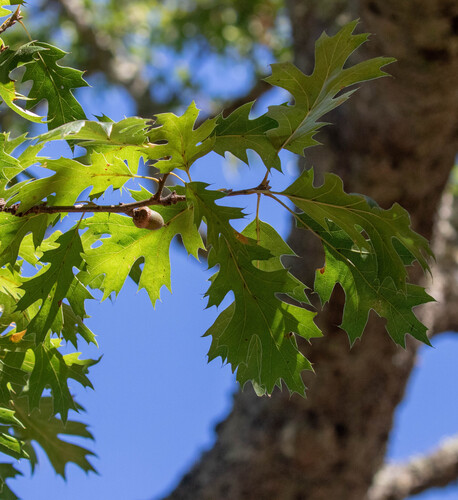
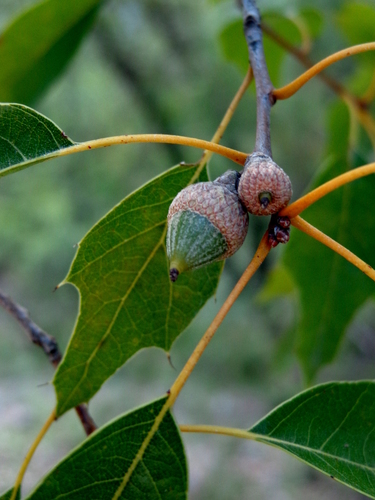
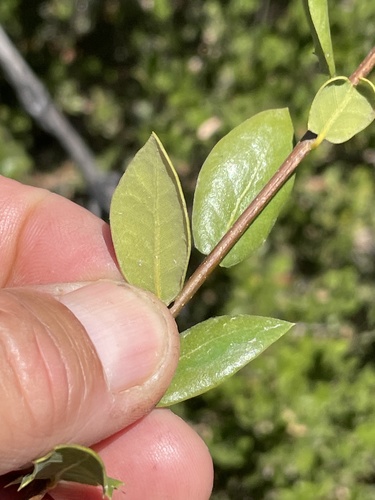
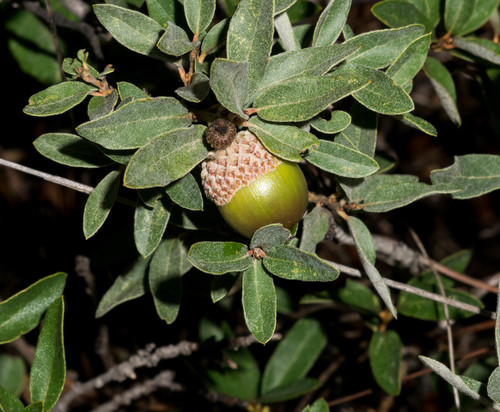
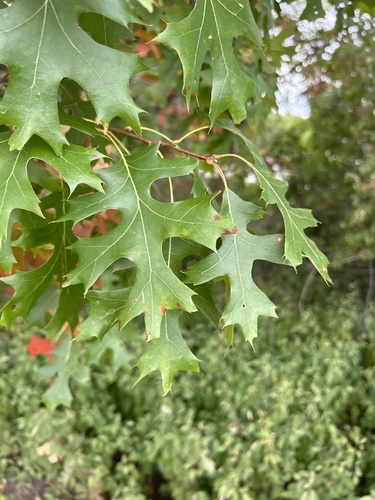
Quercus ellipsoidalis E.J.Hill, also called Northern pin oak, is a medium-sized deciduous tree that reaches 20 meters (66 feet) in height, and develops an open, rounded crown. Its leaves are glossy green, measure 7–13 centimeters (2+3⁄4–5 inches) long and 5–10 centimeters (2–4 inches) broad, and are lobed with between five and seven lobes separated by deep sinuses. Each lobe bears 3–7 bristle-tipped teeth. The leaves are nearly hairless overall, with the only exception being small tufts of pale orange-brown down at the points where lobe veins connect to the central vein. The species gets its scientific name from its typically ellipsoid (ellipse-shaped) acorns, though acorn shape is highly variable and can range to globose. Acorns are 6–11 millimeters (1⁄4–7⁄16 inches) long and 10–19 millimeters (13⁄32–3⁄4 inches) broad, with between one third and one half of their surface covered by a deep cup. Acorns are green when young, and mature to a pale brown roughly 18 months after pollination; their kernel is very bitter. The inner surface of the acorn cap ranges from glabrous (hairless) to sparsely or moderately pubescent. If hairs are present, they tend to be kinky rather than straight. Northern pin oak is planted as an ornamental tree, and is popular for its bright red fall color and tolerance of infertile sandy soils. Its wood is used for fence posts, fuel, and general construction. The cultivar 'Hemelrijk' has received the Royal Horticultural Society's Award of Garden Merit.