About Quercus dumosa Nutt.
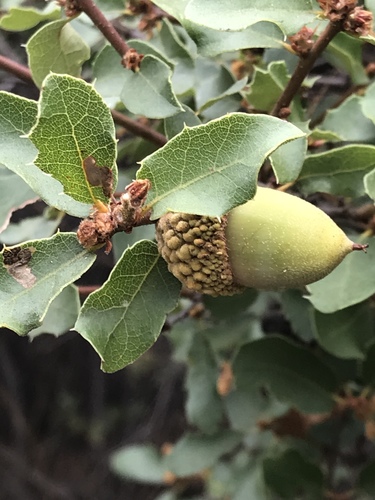
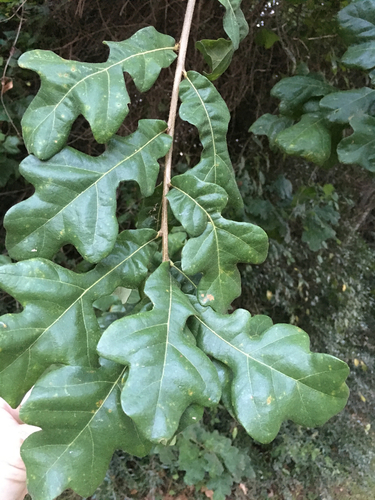
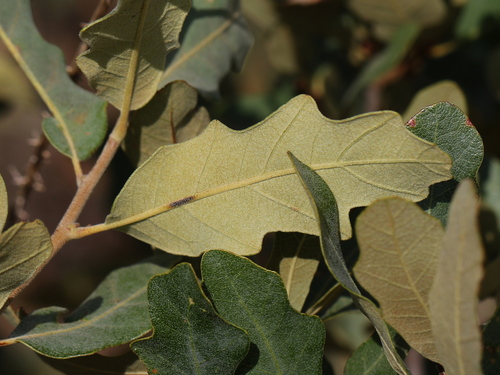
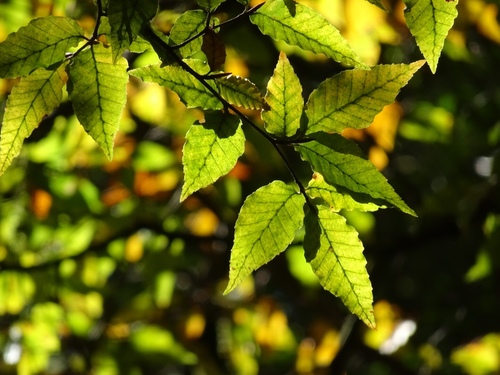
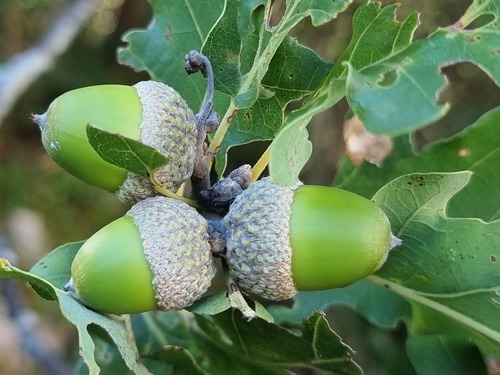
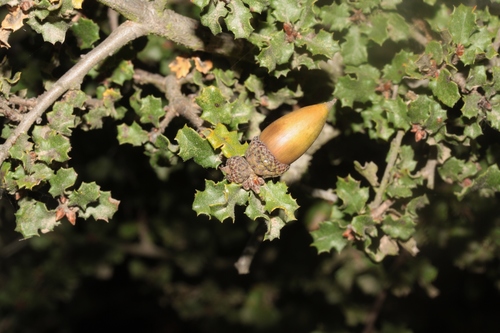
Quercus dumosa Nutt. is an evergreen shrub that typically grows 1 to 3 meters (3.3 to 9.8 feet) tall. Some individuals growing in the canyons of San Diego County have been observed reaching up to 5 meters (16 feet) tall, while others occasionally grow as low, matted clumps. It has a rounded, scraggly overall form, with tangled, slender twigs and branches that are either reddish or grayish, and its branches are often sharply angled. Young bark is smooth, and matures to become scaly. Its dark-green leaves are brittle and leathery, and they fall off when disturbed. Leaves have a short petiole that measures 1 to 2 millimeters (0.039 to 0.079 inches) long. The leaf blade is usually 10 to 20 millimeters (0.39 to 0.79 inches) long, with an undulate or cupped shape and a cordate base. Leaf margins may be abruptly pointed with spines or teeth, shallowly lobed, or rarely entire (smooth). One of the most distinctive characteristics of Quercus dumosa is its trichomes (hairs), which are most prominent on the lower surfaces of its leaves. It has erect, twisted (curly), multi-rayed trichomes that grow up to 0.5 millimeters (0.020 inches) long, a trait that sets this species apart from all other scrub oaks. While a dissecting scope or 10-power hand lens is needed to see these trichomes clearly, they are more visible than the trichomes of other scrub oaks, even to the naked eye. Male flowers are tiny catkins that bloom from February through April. The fruit is a narrow, sharply pointed acorn that grows up to 1.5 centimeters (5⁄8 inch) wide. Some individual plants produce large acorn crops, while others produce very few fruits. Acorns are dispersed by gravity when they fall from the plant, and by animals such as squirrels and jays that carry them away. Animals either eat acorns immediately or store them in caches for later consumption. Acorns tend to germinate easily, but successful reproduction from seed generally only occurs during very moist years. Quercus dumosa is native to the U.S. state of California and the Mexican state of Baja California. It occurs near the coast starting from southern Santa Barbara County, with a disjunct southern population that extends through Orange County and San Diego County into northwestern Baja California. In Santa Barbara County, it grows in Mission Canyon on the south slope of the Santa Ynez Mountains and in the area above Carpinteria. In Orange County, it grows on the coast in the San Joaquin Hills and the Dana Point headlands. In San Diego County, it occurs from the central coast to around 10 kilometers (6.2 miles) inland, extending south to the Mexico–United States border. From the border, it extends into northwestern Baja California, ranging south along coastal hills to Punta Banda, into the area around San Vicente, and reaching its southern limit near the Colonet peninsula. It grows at elevations from sea level to around 300 meters (980 feet). Quercus dumosa is only found in very restricted habitats. It prefers very loose sandstone or granitic soils, and is often associated with soft chaparral and coastal sage scrub plant communities near the coast. Habitats where it occurs include coastal hills, mesic slopes, canyons, coastal bluffs, maritime succulent scrub, and closed-cone pine forests. Though it is a rare species, it usually dominates or co-dominates the sites where it grows. It typically thrives in sandy soils that let it develop extensive root networks. It is threatened by habitat loss, as human development in coastal southern California has left very little of its original habitat intact. Quercus dumosa grows primarily in sandy soils such as sandstone near the coast, and its habitat is often chaparral. This oak sprouts vigorously from its stump and root crown after wildfire, and develops a large canopy within a few years after a fire event. As early as four years after a fire, it sometimes co-dominates habitat alongside Ceanothus species, and it also grows well in the absence of fire.